


On the evening of 31 October 2010, gunmen affiliated with the Islamic State of Iraq, a terrorist organization linked to al-Qaeda, stormed the church during Sunday Mass. What had begun as a religious gathering became a massacre that claimed the lives of dozens of worshippers, priests, security personnel and civilians.
Related: The Massacre of Assyrians At Our Lady of Deliverance Church in Baghdad
The attack was more than an assault on a place of worship. It was a direct attack on the Christian presence in Iraq and the community's right to practice its faith without fear. Sixteen years later, its consequences remain deeply embedded in the collective memory of the Assyrian people, particularly in Baghdad, where religious and ethnic communities were facing escalating threats and violence.
The terrorist assault began on Sunday evening, when gunmen arrived near Baghdad's stock exchange, close to Our Lady of Deliverance Church in the Karrada district. After clashing with guards, they forced their way into the church during evening Mass, held on the eve of All Saints' Day. They were armed with machine guns, hand grenades and explosive belts.
Inside, the attackers took worshippers hostage. As some attempted to escape, several managed to flee, while others sought refuge in the church's rear rooms with the assistance of a priest. The building quickly became a scene of gunfire, threats and panic, with men, women and children trapped inside.
During the hostage crisis, the attackers detonated a car bomb targeting Iraqi security forces, along with several other explosive devices aimed at checkpoints and church guards protecting the surrounding area and those inside. They also opened fire on the congregation, killing worshippers and priests who were carrying out their religious duties.
The gunmen made calls to media outlets during the assault, claiming responsibility for the operation and issuing a series of demands. Among them was the release of individuals accused of terrorism who were being held in Iraqi prisons. They also demanded that the Coptic Orthodox Church release what they described as "Muslim women held in Egyptian monasteries and churches" within 48 hours. The Egyptian government rejected the attempt to implicate the country's Coptic Church in the attack.
The crisis continued for hours before Iraqi security forces stormed the building in an attempt to rescue the hostages and end the siege. During the approximately two-hour operation, the attackers detonated their explosive belts, causing further casualties. The confrontation ended with the gunmen dead, leaving behind one of the darkest chapters in the modern history of Christians in Iraq.
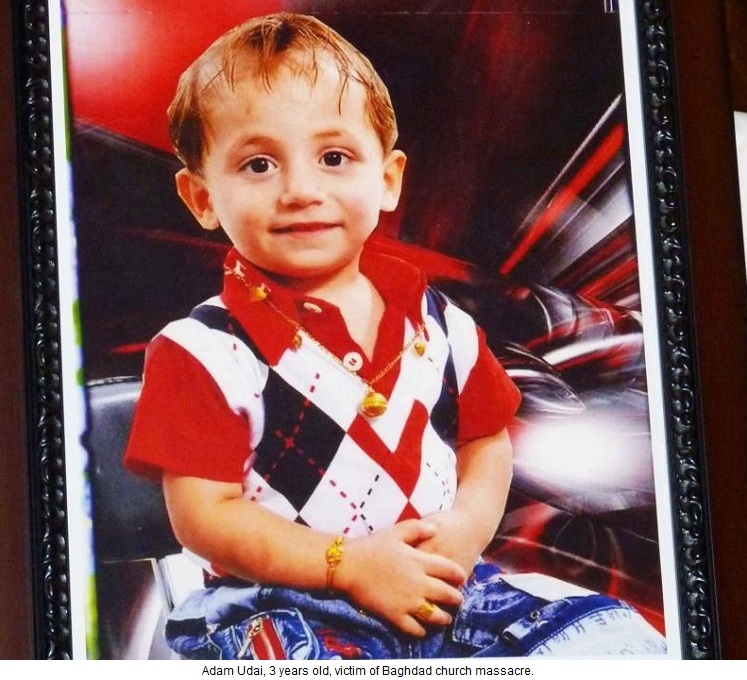
According to widely circulated figures, 58 people were martyred, including worshippers, priests, security personnel and civilians, while another 78 were injured, some seriously. The massacre exposed the vulnerability of religious communities and the devastating consequences of the violence that had engulfed Iraq.
The Iraqi government's handling of the crisis also came under widespread criticism. Critics argued that the response had been too slow and that negotiations with the attackers had prolonged the ordeal, contributing to the high death toll.
The Islamic State of Iraq, an al-Qaeda-linked organization, claimed responsibility for the massacre. Its extremist ideology explicitly targeted Christians and their religious institutions. The threats continued beyond the attack, with subsequent rhetoric portraying Christian institutions, religious leaders and worshippers as legitimate targets, an effort to terrorize the community and accelerate its departure from the country.
The massacre prompted widespread condemnation in Iraq and abroad. Religious leaders and representatives of different Iraqi communities denounced the attack as a flagrant violation of the sanctity of places of worship and the fundamental right of civilians to practice their faith in safety.
Subsequent investigations led to the arrest, in late November 2010, of Hudhayfah al-Batawi, known within al-Qaeda as the "Emir of Baghdad," along with several other suspects linked to the attack. He was accused of orchestrating the operation. Al-Batawi and several other members of the group were killed in May 2011 during an attempted prison escape. Other defendants connected to the massacre received death sentences or prison terms, with court rulings in the case upheld in 2012.
A Massacre that Accelerated an Exodus
For many observers of Christian affairs in Iraq, the Our Lady of Deliverance massacre was part of a wider pattern of persecution and insecurity that contributed to the steady decline of the country's Christian population. Together with the violence that preceded and followed it, the attack exposed the vulnerability of the Assyrian people and the determination of extremist organizations to empty Beth Nahrain and Iraq of their indigenous Christian populations.
The community's population, estimated at approximately 1.262 million during the 1980s and 1990s, representing around 4% of Iraq's total population, has since fallen dramatically. Today, fewer than 500,000 Christians and members of the Assyrian people are estimated to remain across Iraq and the Kurdistan Region of Iraq (KRI), representing less than 1% of a national population of approximately 43 million.
Beyond the figures, the reality is reflected in communities that continue to shrink, families that have left their ancestral towns and villages, and a Christian presence that faces further decline with each passing year.
Assyrian political parties, including the Beth Nahrain Patriotic Union (Huyodo Bethnahrin Athroyo, HBA), have sought to curb emigration and encourage those who remain to maintain their connection to their historic homeland of Beth Nahrain. Their efforts have included national and religious advocacy, sustainable development initiatives, humanitarian assistance and pressure on government officials to improve the living conditions of Christians and the wider Assyrian community.
On the anniversary of the massacre, the HBA issued a statement commemorating the victims and emphasizing that the attack on Our Lady of Deliverance Church was not an isolated incident, but part of a long history of tragedies and violations suffered by the Assyrian people.
The party traced that history through several episodes of mass violence and persecution, including the Sayfo genocide of 1915, the Simele massacre of 1933, the Sorya massacre of 1969, the Anfal crimes of 1988 and the attacks carried out by the terrorist organization of ISIS in 2014, which brought displacement, killings and the destruction of towns and areas with Christian populations.
The HBA described the attack on Our Lady of Deliverance Church as a brutal assault carried out by extremists driven by a dark ideology. It said the loss and grief extended far beyond the families of those killed, becoming part of the collective memory of the Assyrian people and a defining moment in their contemporary history of suffering.
Sixteen Years Later, The Questions Remain
The consequences of the massacre extended well beyond the immediate loss of life. It deepened fear and insecurity among Christians in Iraq at a time when their numbers were already declining because of emigration, security threats and repeated attacks. It also raised fundamental questions about the protection of religious communities, the right to freedom of worship and the state's responsibility to safeguard the lives, property and places of worship of its citizens.
Sixteen years on, Our Lady of Deliverance Church remains a symbol of a tragedy that affected not only the victims and their families, but an entire community. Its story reflects the immense challenges Iraqi Christians have faced in preserving their historic presence, cultural and religious identity, and right to live in safety and dignity in their homeland.
31 October is therefore more than an anniversary. It is a day to remember the worshippers and priests who lost their lives inside the church, to honor their memory and to reaffirm that protecting Iraq's religious and cultural diversity requires more than declarations of solidarity.
It demands justice, accountability for those responsible for crimes against civilians, effective protection of religious communities and guarantees that such atrocities will never be repeated.
or register to post a comment.