


Land Confiscation and Demographic Engineering
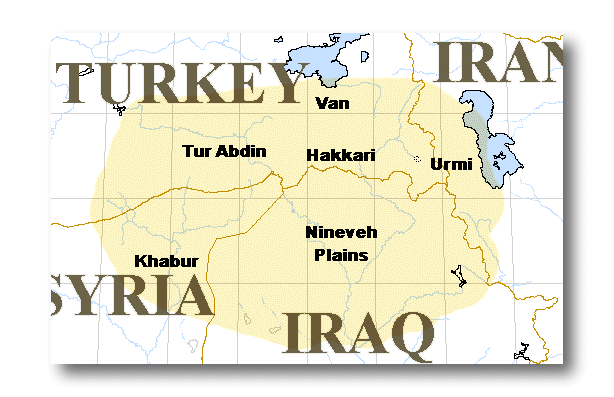
One of the most pressing issues confronting the Assyrian people is the systematic confiscation and control of their ancestral lands. Agricultural fields, villages, and historical properties, often supported by legal deeds and land records, have been seized or reclassified through administrative pressure, coercion, or faits accomplis imposed by force. These actions are frequently justified under security, development, or public interest pretexts, while in practice resulting in irreversible demographic change.
The loss of land is not merely an economic deprivation; it undermines the foundation of Assyrian communal life and accelerates displacement, making return and sustainability increasingly impossible.
Intimidation, Violence, and the Absence of Accountability
Alongside land confiscation, Assyrian communities have endured intimidation, targeted violence, and, in some cases, killings. These acts, whether carried out directly or enabled through impunity, create an atmosphere of fear that discourages political participation, legal resistance, and public advocacy. The lack of effective investigations and accountability mechanisms deepens mistrust and reinforces the perception that Assyrian lives and rights are treated as expendable.
Related: Kurdish Confiscation of Assyrian Lands in North Iraq
Political Control and Exclusion
Assyrians are frequently subjected to political control exercised through imposed representatives, restricted local governance, and limited participation in decisions affecting their own regions. This undermines genuine self-representation and contradicts basic principles of democratic governance and minority rights, as recognized under international law and the Iraqi Constitution.
Cultural and Historical Erasure
Equally alarming is the ongoing attempt to dilute or rename Assyrian history. Historical sites, place names, and cultural narratives are altered or rebranded, severing them from their Assyrian origins. This process is not accidental; it systematically removes Assyrian presence from the historical record and reshapes public memory to legitimize new claims over ancient lands.
Reducing a People to a Religion
Perhaps the most damaging aspect of this marginalization is the deliberate labeling of Assyrians exclusively as "Christians." While the Assyrian people are predominantly Christian, Christianity is a faith, not a nationality. Reducing Assyrians to a religious identity denies their status as an indigenous people with a distinct ethnic, linguistic, and historical identity. This framing strips Assyrians of collective political rights and recasts them as a religious minority dependent on protection rather than a people entitled to self-determination, land rights, and cultural preservation.
A Call for Recognition and Protection
The challenges facing the Assyrian people are not isolated incidents but interconnected policies and practices that collectively threaten their survival as an indigenous people. Addressing these issues requires:
- Recognition of Assyrians as an indigenous people, not merely a religious community
- Protection and restitution of Assyrian lands and properties
- Accountability for intimidation, violence, and killings
- Respect for Assyrian historical narratives, place names, and cultural heritage
- Genuine political representation and participation in local governance
The future of the Assyrian people depends on the acknowledgment that land, identity, and history are inseparable. Denying one inevitably leads to the erosion of the others. Upholding Assyrian rights is not only a matter of justice for one people, it is a test of the commitment to pluralism, rule of law, and human dignity in the region as a whole.
Guest Editorial Policy
or register to post a comment.