


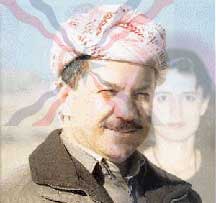
 (AINA) -- On August 16, 2000, Mr. Masud Barzani, the leader of the Kurdistan Democratic Party (KDP), addressed his Behdanani followers in Arbil on the occasion of the 54th anniversary of the establishment of the KDP. Excerpts from Mr. Barzani's presentation emphasizing democracy and pluralism as the cornerstones of KDP policy have been met with cynicism by Assyrians suffering under KDP occupation and Assyrians living abroad. According to Mr. Barzani "freedom of expression, pluralism, and religious and national rights are guaranteed and preserved" and the KDP occupied area "is a centre for religious and ethnic brotherhood and tolerance."
In reality, though, the Behdanani KDP has exercised a systematic campaign of persecution and intimidation against the Assyrian population in northern Iraq. The policies of land expropriation, assassinations, abductions, rapes, and tortures have been widely documented by international organizations such as the United Nations, Amnesty International, the Middle East Council of Churches (MECC) and the International Committee of the Red Cross (ICRC). Despite KDP promises, made under pressure, to carry out investigations, no crime against Assyrians has ever been resolved and no perpetrator ever brought to justice.
Last summer's attacks against the Assyrian villages in the Nahla district (AINA - October 16, 1999, November 30, 1999) by KDP forces have yet to be investigated or public apologies and compensation given by the KDP. The KDP's response to the widespread international outcry was to further intimidate and threaten the besieged villagers into formally writing that no such attacks or persecution ever existed (AINA - January 21, 2000). The KDP also compelled one Assyrian group under KDP occupation to declare "we never had it so good" in their denial of the Nahla attacks. The KDP is also believed to have created a supposed Assyrian News Agency that also denied the attacks ever took place. Involvement in the matter and subsequent independent confirmation of the attacks by the MECC envoy in Iraq as well as the ICRC, the UN as well as Assyrian organizations served to demonstrate the brutality of the KDP occupation as well as expose the primitive disinformation campaign used in the KDP cover up.
The same pattern of Behdanani KDP intimidation of victims following KDP abuses is demonstrated in the murder of Ms. Helen Sawa by Mr. Azet Al Din Al Barwari, a KDP central committee member (AINA - June 19, 1999). Helen was a twenty year old young Assyrian woman who was forced by the KDP to work as a servant in Mr. Al Barwari's home in order to maintain her deceased father's KDP pension. Early in June of 1999, Helen's partially buried and decomposed body was found partly eaten by scavenging animals. Sources in northern Iraq have suspected Mr. Al Barwari of the KDP was responsible for the probable sexual assault and subsequent murder of Helen Sawa. Rather than face an investigation, Mr. Al Barwari has till now continued to enjoy his privileges as an upper echelon Behdanani KDP central committee member.
In keeping with standard KDP policy in such matters, it has been reported that in March and April, Helen's brothers were abducted and severely beaten in order to quiet Assyrian demands for an investigation. Although Helen's family had long ago buried, along with Helen's remains, any hope of ever finding justice under KDP occupation, the continued intimidation and threats against her brothers are presumably aimed at silencing any further international Assyrian community calls for an investigation and possible extradition of Mr. Al Barwari.
In his anniversary speech, Mr. Barzani also stated that "In its programme (sic), the KDP acknowledged the rights of the Turkoman, Assyrian, and Chaldean brothers." This oft repeated reference to Assyrians and Chaldeans as separate people represents a crude, persistent, and deliberate KDP policy of attempting to split Assyrians into different self-identifying communities, for the purpose of weakening Assyrian resolve and demographic significance. Such division has been rejected both by Assyrians under KDP occupation as well as mainstream international organizations and the various Church hierarchies. Most notable has been the recent statement by the Patriarch of the Chaldean Church describing his nationality as Assyrian and his sectarian affiliation as Chaldean. Similar statements by the Patriarch of the Assyrian Church of the East have repeatedly declared that "we are one people."
Such KDP rhetoric attempting to divide Assyrians has become increasingly infuriating in light of the various Assyrian communities including those who identify themselves as Syriac, Chaldean, and Maronite in the U.S. requesting their members to be tabulated together as one people in the 2000 U.S. Census under one category (AINA - June 13, 1999). It is widely believed that recognition by the U.S. government of the desire by the different Assyrian communities to be tabulated together and that irrespective of their self-identifying nomenclature, Assyrians, Chaldeans, and Syriacs are all one people has sent a stern warning to the Behdananis, Soranis as well as Arab governments throughout the Middle East otherwise bent on dividing the Assyrian people.
Such pervasive political rhetoric by leaders such as Mr. Barzani regarding the Assyrian people is deliberately designed to be and indeed does amount to a serious and flagrant affront to the Assyrian sense of nationhood and identity. With Behdanani, Sorani, and Kurmanji "Kurds" adhering to different languages, cultures, appearances, geographies, and histories, it is especially ironic that the leaders of these distinct peoples still do not recognize the inherent danger to their very own movements in deliberately promoting a policy of divisiveness amongst the Assyrians. Furthermore, with well researched articles on the violent Kurdification policies of the ultra-nationalist Kurds against non-Kurds such as the Zaza and Alevies of Turkey, readily available, Kurdish leaders should refrain from using such crude dividing tactics, lest they draw attention to their own "Kurdish identity". The savage and bloody national wars among the "Kurds", based on conflicting national identifications, ideologies, ethnicities, and goals as well as the brutal Kurdification policies against the Zaza and Alevies of Turkey, serve as a not so subtle reminder of the serious divisions amongst the Sorani, Behdanani, Kurmanji, and other "Kurds".
or register to post a comment.