


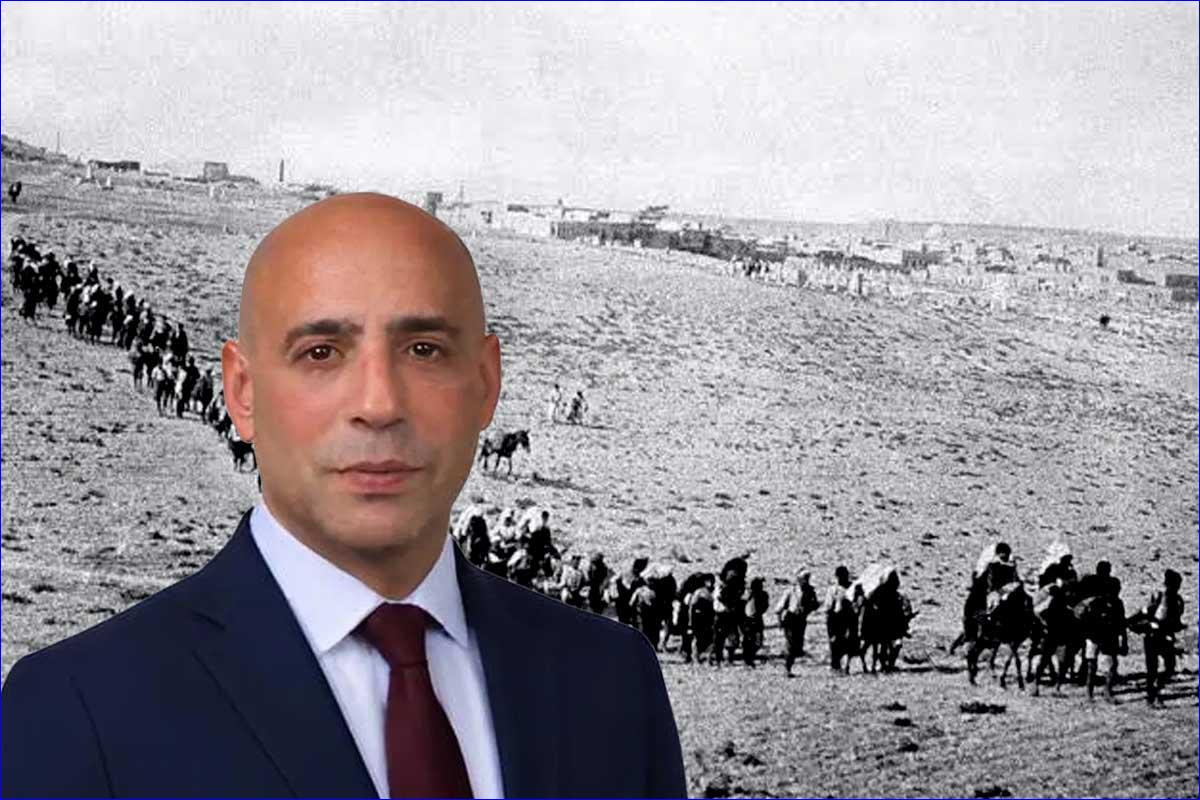
The interview, which is of particular importance to the Pontic Greek community, focused primarily on geopolitical developments in the Eastern Mediterranean, relations between Greece, Cyprus and Israel, and Turkish foreign policy.
Related: The Assyrian Genocide
However, the discussion also addressed the issue of historical justice and the recognition of the genocides of Greeks, Armenians and Assyrians.
'A Jewish state does not bargain with the truth'
Christos Konstantinidis, drawing on his own Pontic Greek heritage, raised the need to recognise the atrocities committed against Christian populations by the Ottoman authorities and, subsequently, Turkish nationalist forces.
He also asked the Israeli analyst why official recognition by Israel had proved so difficult, despite the central place of Holocaust remembrance in Israel's history and national consciousness.
Gal's response was deeply personal. As the grandson of a Holocaust survivor, he directly linked the memory of the extermination of European Jews with the obligation to acknowledge atrocities committed against other peoples.
'Christos, as the grandson of a Holocaust survivor, I understand the duty of remembrance. A Jewish state does not bargain with the truth,' he said.
Netanyahu's recognition and the unresolved issue of the Pontic Greeks
The Israeli analyst referred to Benjamin Netanyahu's public acknowledgement of the three genocides in 2025, distinguishing between statements made by political leaders and formal decisions taken by the state.
According to Gal, the Israeli government's recognition of the Armenian Genocide in June 2026 represented a significant development, but one that must be followed by further action.
He argued that equally unequivocal recognition should be extended to the Greeks, including the Pontic Greeks, and to the Assyrians.
The role of Turkey and Azerbaijan
Gal also offered an explanation for Israel's longstanding reluctance to address the issue.
In his assessment, Israel's strategic relationships with Turkey and Azerbaijan had been major factors limiting its willingness to grant official recognition.
While acknowledging the importance of these bilateral relationships, he maintained that they should not determine Israel's position on historical atrocities.
He also pointed out that maintaining relations with Baku did not prevent Israel from developing closer cooperation with Yerevan.
Gal rejected the notion that acknowledging historical truth should depend on geopolitical considerations or shifting diplomatic alliances.
Parliamentary resolutions, education and remembrance
Gal went beyond calling for a formal declaration, outlining specific measures through which Israel could establish lasting recognition of the genocides.
He argued that recognition should be reflected in parliamentary resolutions, incorporated into education, commemorated through national remembrance events and integrated into the country's diplomatic policy.
Such measures, he explained, would ensure that recognition did not depend on the political preferences of an individual prime minister or the state of relations between Jerusalem and Ankara.
He also proposed cooperation between Israel, Greece, Armenia and representatives of the Assyrian community to preserve historical testimonies and challenge genocide denial.
'Reconciliation cannot require abandoning history'
Gal also drew an important distinction between the historical responsibility of the Turkish state and the individual responsibility of Turkish citizens today.
He argued that present generations do not inherit personal guilt for crimes committed in the past.
Nevertheless, he insisted that the Turkish state has a responsibility to acknowledge historical events.
In this context, he rejected the idea that reconciliation could be achieved by remaining silent about past atrocities or demanding that descendants of the victims abandon their collective memory.
For the Israeli analyst, recognition is a moral obligation that should not change according to the state of diplomatic relations.
Historical remembrance as an area of Greek--Israeli cooperation
Gal's intervention carries particular significance because it comes from an Israeli analyst who links geopolitical cooperation between Greece and Israel with the need to acknowledge historical responsibility.
He does not regard recognition of the genocides merely as a diplomatic means of exerting pressure on Turkey.
Instead, he presents it as an independent moral and historical obligation that must remain unaffected by changes in international relations.
For the Pontic Greek community, the most important aspect of the interview is Gal's explicit support for formal recognition of the Genocide and his proposal to make the issue part of sustained international cooperation on historical remembrance, education and public awareness.
His position reinforces the argument that historical justice and diplomatic cooperation need not be competing priorities, and that genuine reconciliation must begin with an acknowledgement of the past.
or register to post a comment.