


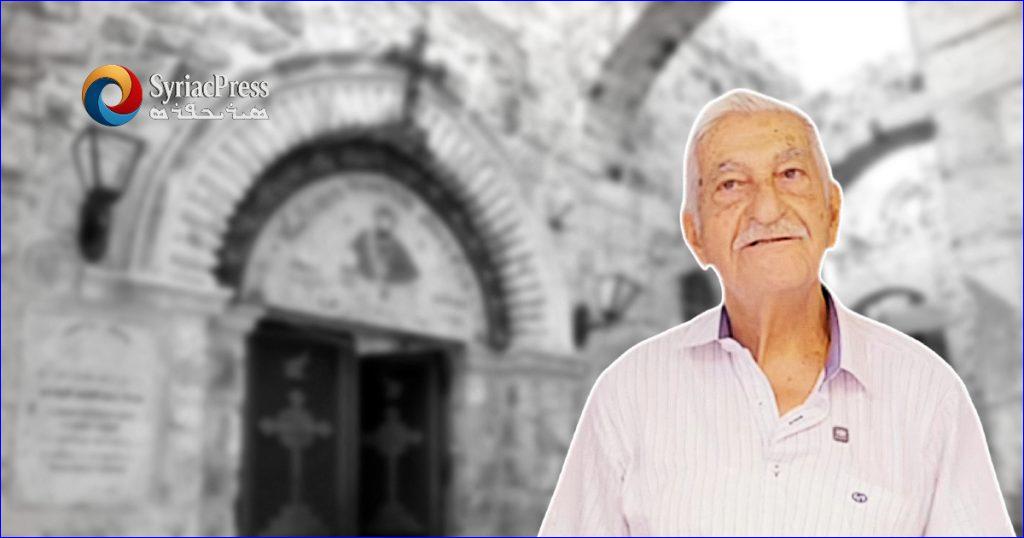
Born on 5 August 1935, near the Assyrian Orthodox monastery in Jerusalem's Old City, Barsoum has witnessed nearly a century of transformation in a city where generations of Christians have struggled to preserve their religious and cultural inheritance.
"I am originally Assyrian, and I was born here in Urishlem," he says. "I am the Assyrian mukhtar."
He recalls becoming a mukhtar at the age of 22, making him one of the youngest people to hold the position. His neighbors chose him, he says, because of his willingness to help others and his commitment to charitable work.
"They saw me serving people and helping them, even before I became mukhtar," he recalls. "That is why they elected me."
His position reflects a longstanding tradition of community representation in Urishlem, where mukhtars have served as intermediaries, helping residents navigate everyday concerns and maintain relationships within their communities.
For Barsoum, however, the role is also a connection to a past that he believes younger generations should not forget.
A Community with Centuries of History
The Assyrian presence in Urishlem stretches back at least to the fifth century, according to academic research on the Assyrian Orthodox community. Its religious and cultural history is closely associated with St. Mark's Monastery in the Old City, one of the community's most important institutions.
The monastery is traditionally associated with the house of Mary, the mother of John Mark, and with the Last Supper, although these connections belong to the church's religious tradition rather than established archaeological consensus.
Historical records document Assyrian Orthodox bishops in Urishlem between 793 and 1099. The community experienced periods of displacement and institutional decline, but maintained its presence through monasteries, churches, and religious institutions.
St. Mark's became the seat of the Assyrian Orthodox bishop of Jerusalem in the late fifteenth century and continues to serve as a center of worship and community life.
The Assyrian community also experienced significant demographic changes during the twentieth century. According to a study published by Palestinian Vision in 2020, its population in Urishlem stood at approximately 100 people at the beginning of the century, increased to around 2,000 by 1945, and subsequently declined.
The same study estimated that approximately 400 Assyrian Orthodox remained in Urishlem in 2019, representing about 4% of Urishlem's Christian population.
These figures are estimates, not the results of a comprehensive census. They illustrate, however, the considerable demographic changes affecting the community.
Preserving a Language and an Identity
Assyrian identity is inseparable from its language. Sami Mousa Barsoum describes Assyrian as the language of Jesus Christ, referring to its historical relationship with Aramaic, the language spoken in parts of the eastern Mediterranean during the first century.
Assyrian is a literary and liturgical tradition within the broader Aramaic language family. It has been preserved for centuries through religious texts, prayers, manuscripts, and church services.
During the conversation, Barsoum is invited to teach a few Assyrian expressions. The exchange becomes an informal language lesson, a small demonstration of the cultural inheritance he has carried throughout his life.
His recollections also reflect the linguistic diversity of Urishlem. He says he speaks Armenian and Turkish, languages he learned during his years growing up and working in the city.
For a community whose history is closely tied to the preservation of its religious traditions, the transmission of language remains an important part of maintaining its identity.
Seven Decades Behind the Sewing Machine
Barsoum's life has not been defined by community responsibilities alone.
During his school years, when the 1948 war transformed Urishlem, he attended a school in the Russian Compound, known locally as the Muscovia. Alongside his education, he began learning tailoring, a profession that would become the defining occupation of his adult life.
He estimates that he has spent approximately 70 years working in the same tailoring shop, making suits and clothing for generations of customers.
But the profession that once occupied much of his life has gradually disappeared.
"Today, there is no tailoring anymore. There is nobody," he says, describing a changing commercial landscape and the disappearance of traditional workshops.
He no longer works with needles or takes on tailoring assignments. Instead, he spends his time recalling the past and telling the stories of a Jerusalem that has changed around him.
His memories offer a glimpse of a city in which neighborhoods, professions and languages once existed in closer daily contact, and where family businesses passed their skills from one generation to the next.
The passage of time has brought, for Barsoum, both personal change and a wider transformation of the community he represents.
As Urishlem's Assyrian Orthodox population becomes smaller, the responsibility of preserving its history increasingly falls on institutions, families and the older generation who still remember its earlier decades.
At 91, Barsoum remains one of those witnesses. His story is not simply about a title held for decades or a tailoring profession that has faded.
It is about a man whose life has remained closely tied to a community and a city, and whose memories preserve a chapter of Jerusalem's Christian history that might otherwise be overlooked.
or register to post a comment.