


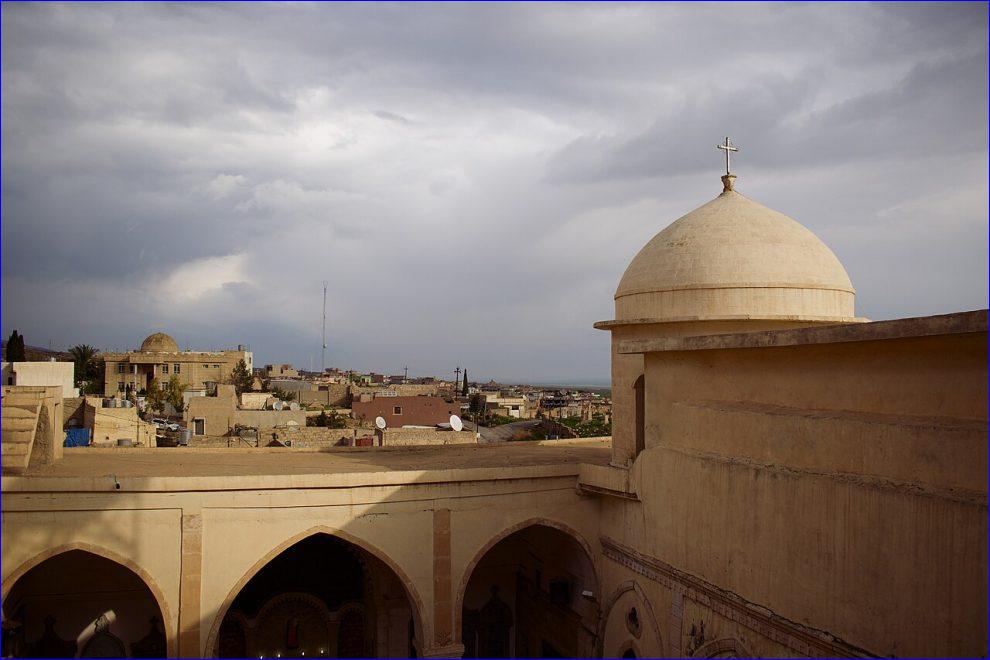
Over the past two decades, Iraq's population has fallen dramatically. The European Centre for Law and Justice reports that the Iraqi Christian population in particular has declined from "1.5 million in 2003 to 150,000 today due to ongoing violence and lack of resources." Amid this uncertainty, the Chaldean Catholic faithful are seeking reassurance, stability, and renewed confidence in their future.
The Chaldean Catholic Church is among the world's oldest Christian traditions, tracing its origins back to the earliest Christian centuries in the region of Mesopotamia. The faith was brought to the region through the missionary work of St. Thomas the Apostle and his disciples, St. Addai and St. Mari. Initially, the Chaldean Catholic Church was part of the Church of the East--that is, one of the branches of Christianity that developed during the church controversies of the fifth and sixth centuries. The other Christian churches that trace their lineage back to the Church of the East are the Assyrian Church of the East, the Ancient Assyrian Church of the East, and the Syro-Malabar Church.
The modern Chaldean Catholic Church emerged in the 1500s, out of further dissent within the Church of the East. A group of bishops who opposed the practice of hereditary succession among the patriarchs deposed their existing patriarch and elected the monk Yohannan Sulaqa to replace him. Later, in the 19th century, Pope Pius VIII recognized Yohannan VIII Hormizd as Patriarch of Babylon for Chaldeans, bringing the principal patriarchal lines under Roman leadership.
Today, the Chaldean Catholic Church is one of more than 20 Eastern Rite churches. It retains a distinct East Syriac liturgical and spiritual heritage, but it is also in communion with Rome. The church in the region is facing many challenges, including displacement, economic hardship, and conflict--pressures that have drastically reduced the Iraqi Christian presence.
In April 2026, His Beatitude Mar Paul III Nona was elected the new Patriarch of the Chaldean Catholic Church of Baghdad. The election of a prominent spiritual leader carries significance far beyond the walls of the church. In the Republic of Iraq and the Kurdistan Region, faith, history, and politics remain strongly intertwined. Mar Paul III Nona's election has been welcomed as a moment of hope for Chaldean Christians and the wider region. Many see the new patriarch's election as an opportunity to strengthen the church's role in community dialogue, support persecuted communities, and pursue reconciliation and healing across Iraq and the Kurdistan region.
As President Masoud Barzani of the Kurdistan Region said, on the occasion of the patriarch's election, "we reaffirm that the Kurdistan Region will remain, as it has always been, a safe haven for all religious and ethnic communities. We will continue our full support for our Christian citizens in protecting their rights, identity, and their deep-rooted history in the Kurdistan Region and Iraq."
That message underscores the relationship that has developed between the Kurdistan Region and Iraqi Christian communities, especially those displaced during the rise of ISIS in 2014. The new patriarch himself was one of tens of thousands of Christians who were forced to leave the city during that era.
Yet this is a difficult moment for Iraq and the Kurdistan Region. Iraq's geography has placed it amid the widening U.S.-Iran-Israel conflict. The presence of U.S. military bases and installations in Iraq and the Kurdistan Region has left the country vulnerable to attacks from Tehran-backed groups and the Iranian Revolutionary Guard Corp (IGRC), followed by U.S. retaliation. For Iraq's Christian communities, who have already endured persecution, displacement, and emigration, the current period of regional instability brings renewed uncertainty.
In March 2026, Vatican News reported escalating conflict and explosions affecting Ankawa, Erbil's historic Christian district. Ankawa is home to a large Assyrian Christian population, including people who fled persecution from ISIS in 2014 and sought to rebuild their lives there. The convent of the Chaldean Daughters of Mary Immaculate and some flats owned by the Chaldean Archdiocese of Erbil were damaged because they were located in the conflict zone.
Archbishop Bashar Warda of Erbil captured the anxiety felt by many Iraqi Christians in a statement he made to the group Aid to the Church in Need (ACN) in March: "When war erupts in the Middle East, we face another erosion, fast or slow. Do we stay? Do our children have a future?"
Continued instability can only accelerate Christian emigration from Iraq.
Cardinal Louis Raphaël Sako, the former Chaldean Patriarch of Baghdad, has warned of the risks Iraq could face if the regional conflict widens. He highlighted Iraq's demographic and geographic realities, including its large Shiite Muslim population and its proximity to Iran. Widening the conflict could lead to deepening divisions in the country. He emphasized that diplomacy is the proper path to resolving the conflict. Sako had also encouraged prayers for peace at Sunday Mass and called on Muslim leaders to use their voice to promote fraternity and solidarity with their Christian brothers and sisters.
Today, the Chaldean Catholic Church continues to play an important role in the life of Christians in Iraq and the Kurdistan Region. Recently, the ecumenical Feast of the Exaltation of the Holy Cross in September reflected Christian communities' determination to preserve the church's faith and traditions. This October will be very significant, as it has been announced that His Holiness Pope Leo XIV will celebrate a Mass to proclaim ecclesial communion with His Beatitude Patriarch Mar Paul III Nona and the Chaldean bishops at Saint Peter's Basilica. This shows the Catholic Church's unity and communion with the Holy See.
For Catholics in the United States, learning about the Chaldean Catholic Church is an opportunity to discover a living part of the Catholic faithful and recognize the richness of the church's unity in diversity. From the churches of Ankawa to the Chaldean Catholic parishes in the United States, the faith of Chaldean Catholics reminds us that the Catholic faith is truly universal: Many peoples, languages, traditions, and histories are united in the same faith and communion. Supporting and standing with Chaldean Catholics who continue to preserve their presence in the Middle East is not simply a concern for a distant community. It is an expression of the shared Catholic identity and solidarity with members of the Catholic Church.
or register to post a comment.