


The delegation was headed by Assyrian Writers and Authors Union President Akad Murad, his deputy Nimrod Qasha, and several members of the union's administrative board. They visited Evan Jani Koreil, Soran's Director General of Education, in the town of Diana to congratulate him on assuming his position and to discuss the state of education and prospects for its development, with particular emphasis on Assyrian education.
During the meeting, Akad Murad reviewed the state of Assyrian language education in Iraq and the KRI, drawing on more than four decades of experience overseeing Assyrian language education at the Ministry of Education in the KRI. He discussed the challenges facing Assyrian language instruction, the need to revive the language and strengthen its standing in educational institutions, and the issues concerning the Assyrian curricula adopted in Iraq and the KRI.
Assyrian education is not merely about teaching an additional language in the classroom. It is closely tied to the survival of a rich linguistic and cultural heritage and to the ability of younger generations to connect with their history, literature, and identity. From this perspective, teaching the language in schools is one of the main ways to ensure its transmission from one generation to the next, rather than leaving knowledge of it confined to families or cultural institutions.
This issue is particularly important amid the challenges facing mother-tongue education, including the need to improve curricula, provide a suitable learning environment, monitor teaching standards in schools and ensure that students have genuine opportunities to learn and use their language.
Evan Jani Koreil said he would work within the scope of his authority to address the challenges facing Assyrian language education during his tenure. He stressed the importance of monitoring Assyrian schools, identifying shortcomings, and working to improve their performance to bring mother-tongue education up to the desired standard.
These commitments underscore the importance of moving beyond recognizing the Assyrian language as part of the cultural heritage and taking practical steps to strengthen its presence in educational institutions. Sustaining mother-tongue education requires regular school monitoring, assessments of schools' needs, attention to curricula and teaching staff, and the provision of conditions that enable students to acquire the language and develop their skills.
In this context, Assyrian schools are essential institutions for preserving the language and passing it on to future generations. Their role extends beyond teaching reading and writing to introducing students to their literature, history and cultural heritage, strengthening the connection between education and identity.
However, developing this sector requires sustained follow-up beyond official visits and general pledges. This includes identifying schools' actual needs, addressing the difficulties faced by teachers and students, and improving the quality of curricula and educational materials. Coordination between the relevant educational authorities and cultural institutions working to preserve the Assyrian language could also help strengthen its presence both inside and outside the schools.
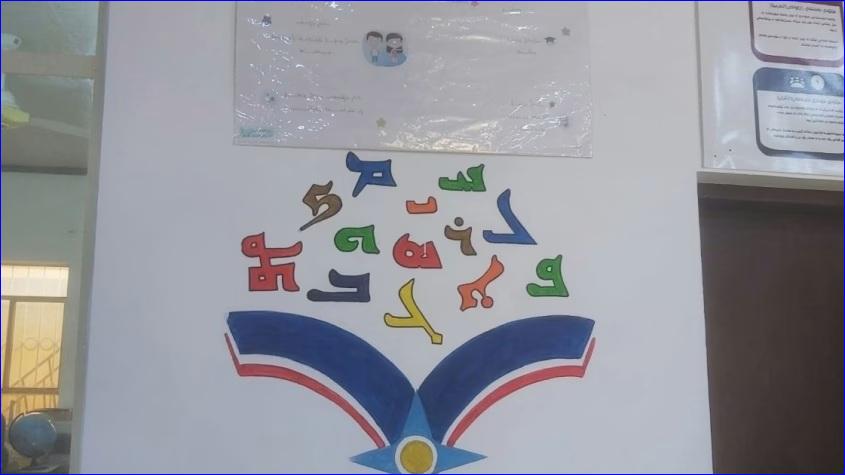
Following the meeting, the delegation and several employees of the General Directorate of Education visited the Assyrian primary school in Diana. They were received by the school's principal, Rita Romeo Khoshaba, who gave a brief overview of the school and the state of Assyrian education there before accompanying them on a tour of one of the school's classrooms.
The visit provided an opportunity to examine the school's learning environment, highlighting the importance of connecting discussions about educational development with the everyday realities of students and teachers. It also provided an opportunity to understand the needs of institutions responsible for teaching the Assyrian language.
Before the visit concluded, poet Yusuf Qabou, a member of the union's administrative board, presented the director general of education with a shield bearing the union's insignia. Poet Gabriel Mamuka also gifted him a collection of the union's latest publications, underscoring the ties between educational institutions and the Assyrian literary and cultural movement.
Diana and the Soran Independent Administration
Diana is a subdistrict of the Soran district in the governorate of Arba'ilo (Erbil) and forms an integral part of the Soran Independent Administration. Established in 1962, it is known for its ethnic and religious diversity and its tradition of peaceful coexistence and tolerance among its different communities.
Evan Jani Koreil officially assumed his duties in May 2026. He is a researcher and academic who has participated in cultural and historical conferences and seminars addressing the history and heritage of the Suraya (Assyrian-Aramean-Assyrian-Chaldean) people.
While official visits provide an opportunity to raise educational concerns and reaffirm commitments to addressing them, the future of Assyrian education will depend largely on translating those commitments into tangible measures in schools. These measures must ensure curriculum development, address existing shortcomings, and expand opportunities for learning in the mother tongue.
Protecting the Assyrian language cannot be achieved simply by celebrating its history or emphasizing its importance. It requires keeping the language alive in classrooms, equipping children with the tools they need to learn and use it and ensuring that the schools teaching it receive the attention and support they require. Developing Assyrian education is therefore an investment in the language's future and continuity, and in younger generations' right to learn about and preserve their linguistic and cultural heritage.
or register to post a comment.