


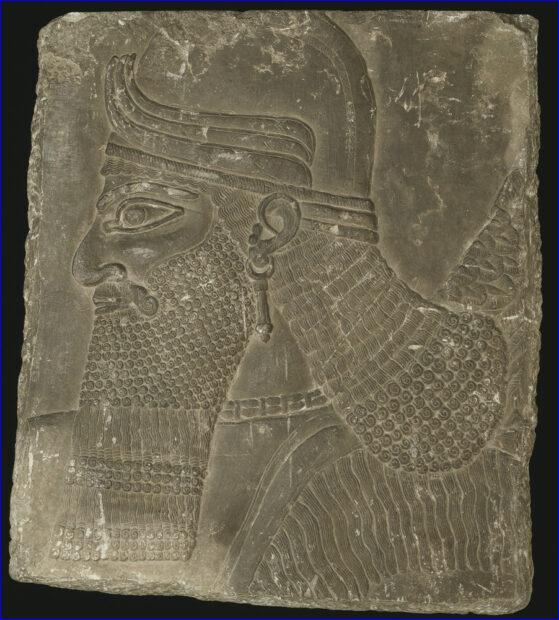
 Art Institute of Chicago, George F. Harding Collection)
The fragmentary carving depicts the head of a luxuriously bearded, winged figure, which once adorned the elaborately decorated walls of the palace of Assyrian king Ashurnasirpal II at Nimrud. Known as an apkallu, this was a recurrent figure in the decorative program of the palace, and is often interpreted as either a semi-divine sage or a guardian spirit. Depicted in lucid profile, the meticulously articulated lines that delineate the intricate spiraling ringlet patterns within its beard are striking in their detail; they lend the work a tactile quality that makes you wish you could satisfyingly run your thumb across its surface. While the head is on display here, the rest of its body was once on the wall at the king's Northwest Palace at Nimrud.
Nimrud (called Kalhu in the Bible, and 20 miles south of Mosul in modern Iraq) was once the capital of the Neo-Assyrian Empire under King Ashurnasirpal II. Built in the ninth century BCE, the palace was a sprawling complex originally intended to make an emphatic statement of political power and authority. It was adorned with monumental carvings of Ashurnasirpal's military conquests, images of the king's ritual sport hunting of lions, and figures like this winged figure, who kept a watchful and protective eye over the king, who ruled an empire that spread as far north as modern Turkey, as far west as Egypt, and as far east as modern Iran. This fragment belonged to "Room S," one of several comparatively small, private chambers adjacent to the much grander throne room.
Until recently, the nearly 3,000-year-old palace of Nimrud remained somewhat intact, though many sections of its relief carvings had, since the 19th century, been carted off by archaeologists, and those that remained were reassembled during 20th century restorations. But in 2015, what remained of Nimrud was filled with many 55-gallon drums of explosives and performatively destroyed by ISIS, and in a few seconds, 3,000 years of civilization's history was tragically reduced to debris. Fragments like this at SAMA, excavated before the destruction, are the lucky survivors.
Given the layered history of this apkallu, it's natural to make some connections between this artifact and the sculptures of contemporary artist Michael Rakowitz. A Chicago-based artist of Iraqi descent, Rakowitz has spent much of his artistic career recreating works of art from Iraq that were looted or destroyed. While much of his work addresses artifacts looted from Baghdad during the American war in Iraq, this ongoing project now includes recreating the sculptures destroyed at Nimrud.
Rakowtiz doesn't recreate these artifacts in their original alabaster, though. Rather, he renders them in the skin of the colorful packaging from foodstuffs sourced from Arab American markets, bringing color back into these relief carvings, which were once all brightly painted. In his considered recreation of the destroyed rooms from Nimrud, Rakowitz fabricates, to scale, what these rooms would have looked like immediately prior to their destruction. But in doing so, these works also reveal the conspicuous gaps in the walls of Nimrud, representing the relief carvings (such as this one) that had been carted off in the 19th century and sent to other parts of the world. To look upon the relief carvings of Nimrud the day before its destruction in 2015 would reveal a sculptural program already displaced and fractured.
As for the Palace of Nimrud today, there's no way to smooth over its cruel destruction. But at the very least, the story doesn't end in 2015 with ISIS. In 2017, an international team led by the Smithsonian Institution in collaboration with the Iraqi Ministry of Culture launched the Nimrud Rescue Project, which sought to salvage the remains from the palace. As part of this exhibition's programming, SAMA hosted Brian Michael Lione of the project, who spoke of the tireless efforts of the team to document, preserve, and restore what they could from the rubble. (Against all odds, a mostly intact apkallu still stands erect at the palace, as if in proud defiance.)
This little exhibition is very modest in scale, but it's rooted in layers of history that make it equal parts compelling and haunting. It speaks to the many dynamics of the art of power and the power of art. The creation of the palace of Nimrud was a way to flaunt the superhuman power of the king, a recurring theme in Assyrian art. And the destruction of Nimrud in 2015 was an assertion of a wholly different sort of political power. Artifacts like this that were spared from the destruction stand as triumphant signifiers of defiance against cultural erasure.
Kingship and Power in Ancient Assyria is on view at the San Antonio Museum of Art through May 17, 2028.
or register to post a comment.