


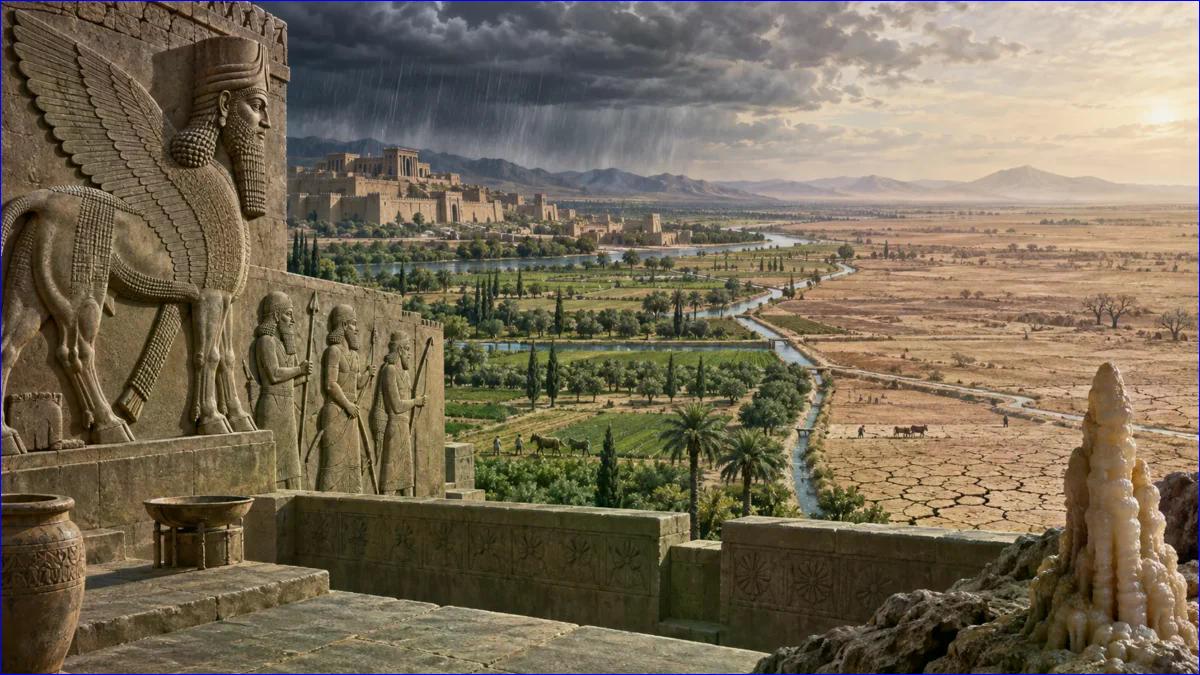
It is one piece of a larger story. The empire faced war, revolt and a succession crisis. A run of poor harvests could have made those pressures harder to absorb, but the cave record does not prove that drought caused Nineveh to fall.
Rainfall preserved in a cave
In 2019, Ashish Sinha and colleagues analysed a stalagmite from Kuna Ba Cave in northern Iraq. Stalagmites grow as mineral-rich water drips onto a cave floor. Changes in the layers and their chemistry can preserve clues to rainfall and vegetation outside.
The researchers measured oxygen isotopes and trace elements, then built a high-resolution timeline. Their record suggests that the centuries of Assyrian expansion were relatively wet. During the early to mid-seventh century BC, conditions shifted toward repeated droughts lasting decades.
This is not a rain gauge for every field in the empire. The cave records conditions in its own region; the team compared that signal with other climate evidence and with what is known about farming in northern Mesopotamia. It can show a broad change in the heartland's water supply, not the exact harvest in any given year.
A state that depended on harvests
Assyria's royal cities and armies relied on grain, livestock, taxes and the movement of supplies across long distances. Northern Mesopotamian farmers depended partly on seasonal rain. If rainfall failed repeatedly, the effects could reach beyond the fields: less food to store, fewer taxes to collect and a harder task keeping soldiers and officials supplied.
The empire also resettled millions of people across conquered territory. That policy gave the state labour and helped secure control, but it tied more households to an administrative system that had to move food and resources. The Science Advances authors argue that prolonged drought could have put extra pressure on this system.
That is a plausible chain of effects, not a ledger recovered from an Assyrian granary. The cave cannot show how each province responded or whether a particular army went hungry. It offers an environmental backdrop against which the political record can be read.
Nineveh's fall had several causes
Assyria's final decades were already marked by political instability. A succession struggle followed the death of Ashurbanipal. Babylonian resistance grew, and the Medes joined Babylon in the campaign against Nineveh. Assyrian forces continued fighting after the capital fell.
Drought may have reduced the resources available to the court at a moment when it needed to defend distant territory and maintain alliances. But the climate study does not connect one drought episode to one revolt or battle. The written sources describe political choices and military events; the stalagmite measures changes in water reaching a cave. Each tells a different part of the history.
That distinction matters. Climate stress can tighten a state's options without dictating what its people do. Assyria did not collapse because a stalagmite says so. The record suggests the empire may have entered its crisis with less agricultural room to manoeuvre.
What the cave changes
Royal inscriptions celebrated victories and building projects. The cave preserves a quieter record: rain patterns that continued whether or not the king's scribes noticed them. Matching those records helps historians ask how environmental change affected the people who grew the empire's food.
The layers do not mark the precise moment Nineveh fell. They show a worsening climate pattern across a period when the empire was also fighting for survival. That makes drought a useful part of the explanation, as long as it stays one part among several.
For the primary study and its data, see the links below. Curiosmos has also explored the earlier history of ancient Sumer, another society shaped by the rivers and agricultural systems of Mesopotamia.
or register to post a comment.