


 Andrew McNamara May)
The program is aimed at preserving the language while also ensuring that the dense Chaldean-speaking population in Southeast Michigan is accessible, in and out of the hospital room.
The scholar of an ancient empire
Stephen Hannawi, President of the Chaldean Language Workshop at Oakland University, is the brain behind the program.
For Oakland, the event drew an impressive array of participants.
OU President Ora Pescovitz, Executive Vice President for Academic Affairs and Provost Amy Thompson and faculty members from the Department of Modern Languages and Literatures were in attendance to show their support.
Last year, Hannawi piloted the highly successful Chaldean Language Workshop, focused on learning and preserving the language, culture and hospitality of the Chaldean people.
And he hasn't taken any breaks since its success.
Hannawi spent the summer putting out a whirlwind of content on social media.
He borrowed the old YouTube motto of "broadcast yourself" across the airwaves of TikTok and Instagram. Want to know how to say "go away" in Chaldean? Find out in 15 seconds or less.
He announced over 1 million social media views during the launch.
That is more than there are remaining Chaldean speakers on the planet.
The language itself is considered Neo-Aramaic. And as an interesting fact, Aramaic was spoken by Jesus of Nazareth. Now, in a crowded conference hall at Oakland University, scholars gather to hear the faint embers of the Chaldean language.
"I promise you I will not disappoint you," Stephen said to the crowd.
The war to keep words alive
It is a herculean task to keep a language in use. It is estimated that of all languages in human history, approximately 81% have gone extinct.
They are even flagged and tracked by scientists for endangered status, just like rare animals. Just as there is great effort to save nature, there is a great battle to preserve languages.
Languages often become at risk in a single generation due to displacement, conquest, assimilation and natural disaster. They can disappear in a lifetime.
The last great bastion of Chaldean speakers was in Iraq. And generations of instability in the Middle East have not been easy on the Chaldean people. The language is classified as endangered.
Slaughter, genocide, persecution. The bloodline, wearing the names of the former kings of Mesopotamia's greatest empire, found themselves run out of their own ancestral home.
Not all was lost, however.
Many went on to form diaspora communities, one of the largest being right here in Metro Detroit.
They quickly became an indispensable part of the greater Michigan community.
The large influx of Chaldean immigrants has had a dramatic effect locally, with Oakland and Macomb counties having two of the highest concentrations of Chaldean people left in the world.
Oakland University finds itself in a whirlwind. Not only in providing education to Chaldean students, but also in sharing the richness of Chaldean culture with the greater student body and the world.
"I am so proud of the fact that Stephen has really taken up this program to try to ensure the survival of a program and a language that is at risk because the population that speaks this language fluently is really aging out," President Pescovitz said following the event.
"When a language is passed from one generation to another, all things are carried forward with it," Provost Thompson said.
The sense that those at Oakland will be the generation to push the language forward filled the room.
The human element of language
And even in the cases of languages that are dying, the remaining speakers face unique challenges; one of the most pronounced exists in health care.
Imagine not understanding your doctor.
This bleak reality is increasingly common across America.
About 8% of Americans over the age of five are considered to have limited English proficiency, known as LEP.
That 8% faces tremendous challenges in receiving proper medical care.
This is especially true of those who speak rarer languages, such as Chaldean.
It is not only possible that speakers of these rare languages encounter these problems, but it is an inevitability.
Room for hope on the hospital bed
In recent years, there have been great strides made for language interpretation in medicine. While not a constant, there are a handful of languages that increasingly can expect reasonable accommodations in medicine.
Spanish is one such language.
Adolfo Campoy-Cubillo shared some lessons from teaching medical Spanish at Oakland.
"If you don't get to the professional level, do not try to work with a patient in Spanish," Campoy-Cubillo said. "It is important to have a standard."
For preserving and caring for human life, the standard is high.
After the event, President Pescovitz explained that "one of the reasons we try to put medical language in eighth-grade English is because even people who are native speakers don't understand -- what I am going to call -- 'medicalese.' So, we have to translate it into a way that patients understand what we are saying. Whatever the language is."
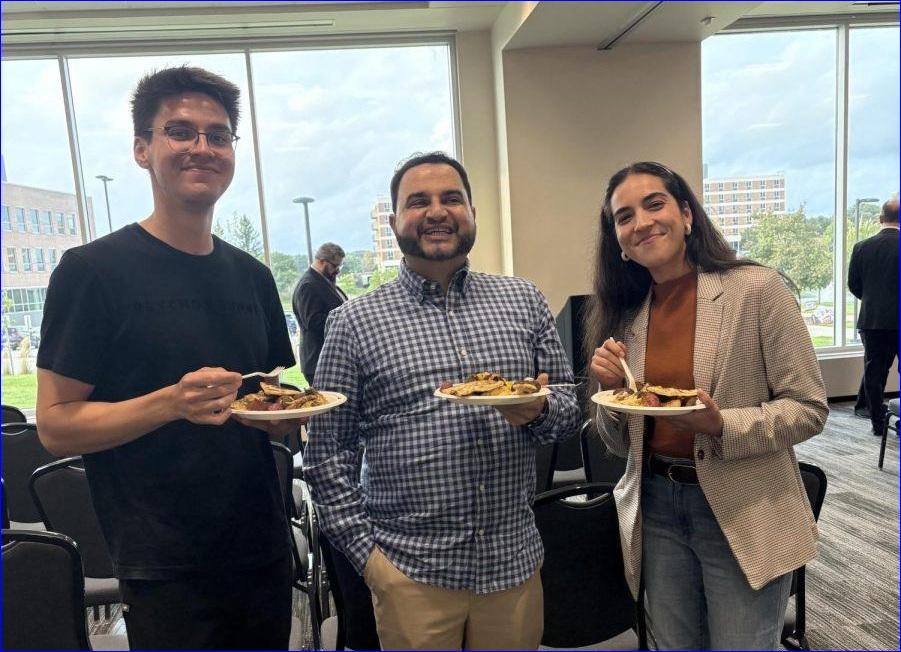
After the lecture, the tremendous suspense of the delicious aroma was released.
Rice, pita bread, hummus, salad and grilled chicken were enjoyed by all -- a truly proud trademark of Chaldean culture.
Thus, the final lesson of that night's workshop closed. Preserving a language requires summoning its spirit too.
or register to post a comment.