


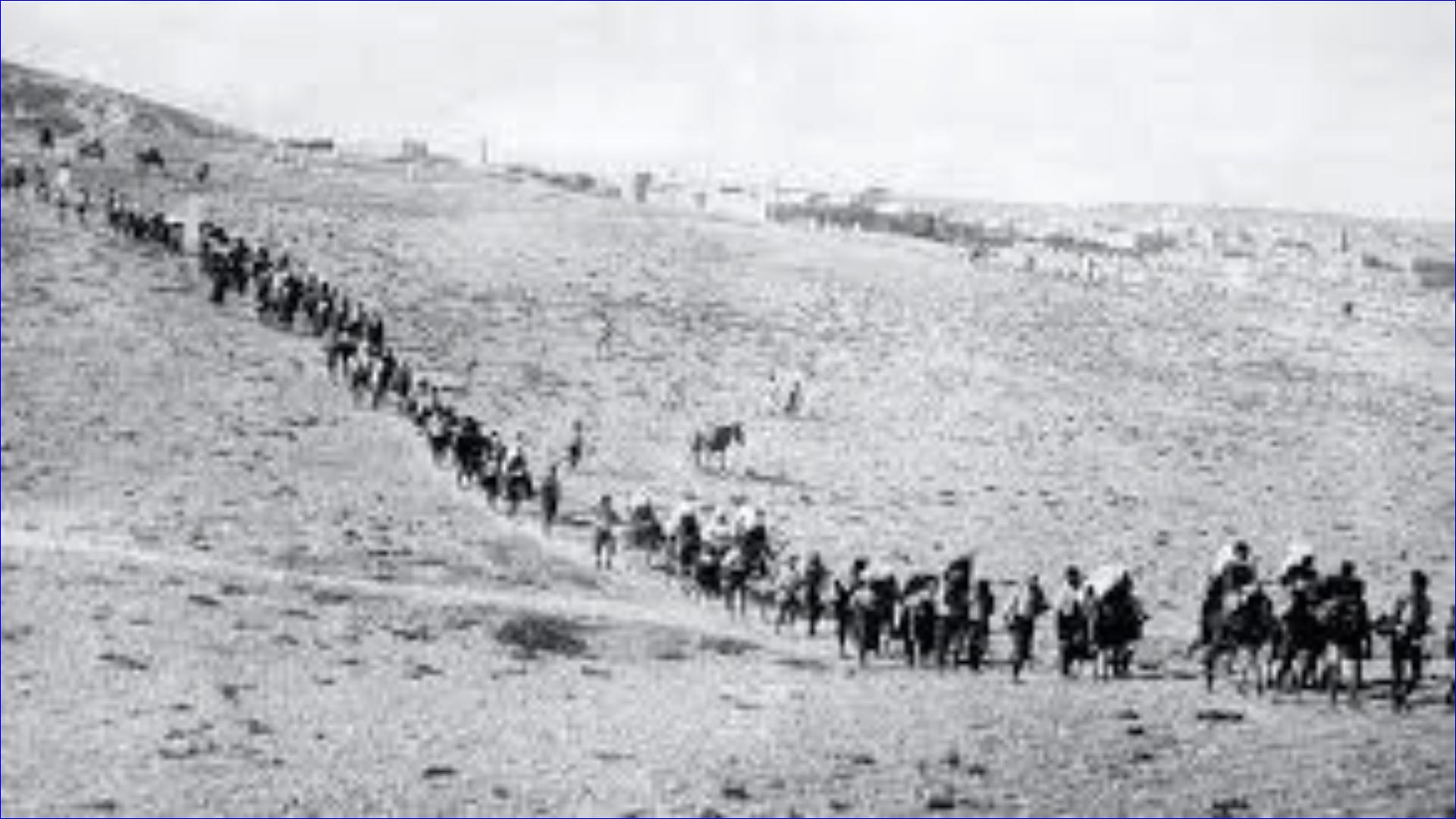
This understanding of martyrdom has become one of the most powerful symbols connecting Greek, Armenian and Assyrian communities to their traumatic past. Although each experienced its own distinct history and developed different ecclesiastical and commemorative traditions, those who suffered are frequently remembered in connection with their Christian faith, identity and homeland.
Related: The Assyrian Genocide
The language of martyrdom has also entered cultural memory, with victims of genocide often remembered and represented as martyrs in commemorations, community narratives and memories inherited from survivors by their descendants.
The Greek word from which the English word martyr derives, martys, originally meant "witness", and it is this dual sense of suffering and testimony that shapes how these communities remember their dead. Martyrdom represents the victims as witnesses: their deaths become testimony to a faith that endured beyond destruction, while in cultural memory they also embody the survival of communal identity. Above all, it is a symbol of resilience, holding within it the conviction that death does not have the final word, but is confronted by the Christian hope of resurrection and spiritual renewal.
The martyrs of Asia Minor
Among Greek Orthodox communities, this understanding centres on the Holy Hieromartyrs and Ethnomartyrs of the Asia Minor Catastrophe: the bishops, clergy and faithful martyred during the destruction of the Greek Orthodox populations of Anatolia in 1922. The titles reflect their commemoration both as Christian martyrs and as figures whose deaths became bound to the destruction of their people.
In 1992, the Holy Synod of the Church of Greece canonised five leading hierarchs: Chrysostomos of Smyrna, Gregory of Kydonia, Ambrosios of Moschonisia, Prokopios of Iconium and Euthymios of Zela. The synodal decision also encompassed clergy and faithful killed with them in Asia Minor, placing the named hierarchs within a broader commemoration of the martyrs of the catastrophe.
Saint Chrysostomos of Smyrna, the metropolitan bishop, is often revered in commemorations. On 9 September 1922, when Turkish nationalist forces entered Smyrna, he was handed over to a mob and murdered in the streets he had refused to leave, among the people he had refused to abandon. French soldiers stationed nearby witnessed the killing but were ordered by their commanding officer not to intervene.
Chrysostomos died of his wounds after being dragged through the streets. His death quickly became one of the defining symbols of the destruction of Smyrna and the wider Greek Genocide, reflecting how the destruction of a community's leadership was itself part of the genocidal process. Far from fading into history, his martyrdom remains an important part of Greek genocide commemorations and a symbol of enduring faith and resilience.
A wider symbolism of renewal can also be found in Greek cultural memory. The traditional Pontian lament Η Ρωμανία Πάρθεν ("Byzantium Has Fallen"), rooted in the memory of the fall of Constantinople in 1453, ends with the assurance that although Byzantium has fallen, it will blossom and flourish again. Sung today, this is not a claim about the political restoration of an empire long gone. Sung across generations, its imagery of catastrophe followed by renewal echoes the broader conviction that revival follows even the deepest destruction.
The canonisation of Armenian martyrs The Armenian experience reflects a similar tradition in which martyrdom is recognised as a path to sainthood. Armenia was the first nation to adopt Christianity as its state religion, in 301 AD. During the centenary of the Armenian Genocide, on 23 April 2015, the Armenian Apostolic Church canonised the approximately 1.5 million victims of the genocide at the Mother See of Holy Etchmiadzin in Vagharshapat, in a service jointly led by Catholicos Karekin II and Catholicos Aram I in Armenia.
Held on the eve of the centenary itself, the canonisation meant that when Armenians entered 24 April 2015, the hundredth anniversary of the genocide's beginning, the dead were commemorated not only as victims, but as saints formally recognised by the Church.
It is widely regarded as the largest single canonisation in Christian history. The two-hour open-air ceremony was timed to end at 7.15pm (19.15), Yerevan time, mirroring the year 1915 and the genocide's beginning. At that moment, bells rang out one hundred times, synchronised across many churches worldwide. The Church affirmed the dead as holy martyrs, refusing to let them be remembered solely through tragedy, their memory instead affirmed as eternal.
As Karekin II put it, their memory would no longer be "a requiem prayer of victimhood," but "a victorious song of praise by incorporeal soldiers, triumphant and sanctified by the blood of martyrdom." Within Armenian remembrance, this movement from victimhood to spiritual triumph intersects with the deeper theological hope of resurrection. The survival and renewal of Armenian life after genocide can therefore be understood as another expression of that same enduring hope.
Assyrian Martyrs Day Across the Assyrian community, martyrdom likewise occupies an important place in cultural memory. Within Assyrian collective memory, those who perished in the Sayfo, the "sword," in the late Ottoman Empire and other genocides have frequently been remembered as both national and Christian martyrs. Their deaths are understood not simply as a loss, but as bearing witness to Christian faith and to the endurance of a stateless indigenous people. That memory also intersects with continuing concerns over autonomy, cultural rights and political representation in countries such as Iraq.
It is most visible on Assyrian Martyrs Day, observed each year on 7 August, when Assyrians commemorate the victims of the 1933 Simele Massacre in Iraq and honour the broader history of Assyrian martyrdom. Religious leaders, national figures and ordinary victims are remembered together. This remembrance carries its own hope for renewal, expressed through the enduring aspiration that Assyria might rise again.
Across these distinct traditions, a related conviction emerges: that death is not the final word. For Assyrians this can be expressed through Scripture, particularly Isaiah's vision in which Assyria is blessed as "the work of my hands", a passage that holds a unique resonance for a people seeking redemption and perseverance. For a stateless people, this scriptural imagery gives the hope of national renewal a weight beyond mere sentiment.
The final word Greek, Armenian and Assyrian traditions give this conviction different forms: through canonisation and liturgical commemoration, through Scripture and cultural memory, and through songs that transform catastrophe into a language of resilience. But each leads to a similar place. The dead are not only mourned; they are witnesses, and their witness does not end with death.
Formal canonisation, where it has occurred, gives martyrdom particular theological expression. It honours the dead in ways particular to each church's own tradition, affirming their memory as eternal. Across the three communities, this act of remembrance gives suffering the weight of testimony: suffering, remembered as testimony to faith or, in cultural memory, to the violence perpetrated against a people, becomes testimony that outlasts death itself. The victims are not remembered as lives simply ended by death, but within a hope in which the dead await resurrection. The symbolism common to all three communities shows us that to remember those lost is, then, itself an act of defiance: a refusal to let the perpetrator and death have the final word.
Dr Themistocles Kritikakos is a Greek-Australian historian and writer. He holds a PhD in History from the University of Melbourne. He is the author of Armenian, Greek, and Assyrian Genocide Recognition in Twenty-First Century Australia: Memory, Identity, and Cooperation (Palgrave Macmillan, 2026).
or register to post a comment.