


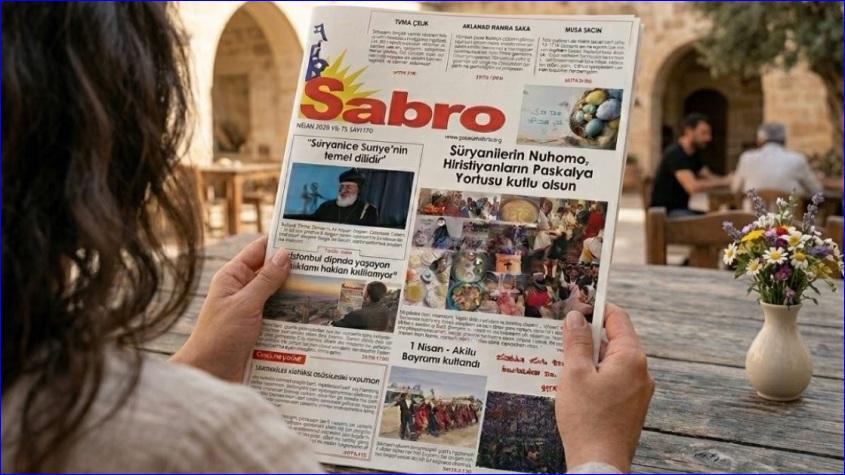
The issue stems from a parliamentary question submitted in June by Istanbul lawmaker Mustafa Yeneroglu to Vice President Cevdet Yilmaz, concerning the mechanism for providing support to minority newspapers and the exclusion of Sabro from the aid programme.
Sabro is a Assyrian newspaper published in Merde, but it does not benefit from the financial support allocated to the minority press because the programme requires the newspaper's administrative headquarters to be located in Istanbul.
In his response to the parliamentary question, Yilmaz explained that the BIK is a public legal entity established under Law No. 195 of 2 January 1961, and is responsible for publishing official advertisements in periodicals that meet the requirements set out in the relevant legislation.
He noted that, in addition to publishing official advertisements, the agency provides various forms of support to the press, including loans to press institutions, associations and unions, as well as assistance to media workers who are unable to continue working and death benefits for needy heirs.
Yilmaz also confirmed that the agency provides financial assistance to minority newspapers and press associations, explaining that such assistance is provided in accordance with criteria set by the agency's Board of Directors.
According to the response, the agency does not receive financial resources from the state budget. Instead, it covers its expenses and support programmes through commissions it earns for brokering official and commercial advertisements.
However, the response did not clarify the legal or administrative reasons behind the exclusion of Sabro, which was the central issue raised by Yeneroglu.
In his question, Yeneroglu had pointed out that since 2011, the BIK had provided financial assistance to newspapers published by communities classified as minorities under the Treaty of Lausanne. However, the amount of assistance was not fixed, with payments suspended in some years and significantly reduced in others.
He added that the agency's General Assembly decided at its meeting on 13 February 2026, to allocate TL 471,000 in financial assistance for 2026.
However, according to Yeneroglu, a decision issued by the agency's Board of Directors on 28 February 2026, stipulated that eligibility for the assistance was limited to "periodicals published by Armenian, Greek and Jewish communities whose headquarters are located in Istanbul."
Yeneroglu argues that this requirement directly excludes minority publications based outside Istanbul, noting that the Assyrian newspaper Sabro, headquartered in Merde, is among the publications most affected by the decision.
The Turkish lawmaker said the newspaper had submitted a request for information regarding its exclusion, but the response issued on 8 June merely reaffirmed the requirement that its administrative headquarters be located in Istanbul, without providing a clear legal basis for the condition.
Yeneroglu also pointed out that, according to his assessment, Turkey's Press Law No. 5187 contains no specific provisions governing the minority press that make having its headquarters in Istanbul a condition for receiving the support.
He argued that applying different treatment to newspapers operating within the country, serving the same purpose and falling under minority status, solely because their headquarters are located in different cities raises an issue concerning the principle of equality.
The parliamentary question included a series of inquiries about the minority press support programme, including the total value of financial assistance and official advertisements provided by the BIK to minority newspapers and magazines since 2012, as well as the annual breakdown of these amounts.
Yeneroglu also called for the names of the newspapers and magazines that received support, along with those that were excluded and the reasons for their exclusion, to be disclosed.
He further sought clarification of the legal and administrative grounds for excluding Sabro, the basis for the agency's Board of Directors' decision of 27 February 2026, particularly the requirement that the publication's administrative headquarters be located in Istanbul, and whether the circumstances of minority publications operating outside Istanbul had been taken into account when the condition was introduced.
The questions also covered the number of official advertisements placed with minority newspapers over the past five years, as well as whether the agency collects commissions on official and commercial advertisements placed with these newspapers and the value of those commissions.
While the Turkish vice president provided a general explanation of the BIK's functions and mechanisms for supporting the press, the questions concerning the legal basis for Sabro's exclusion and the Istanbul requirement went unanswered directly, leaving the issue open to debate over equality standards in supporting the minority press in Turkey.
or register to post a comment.