


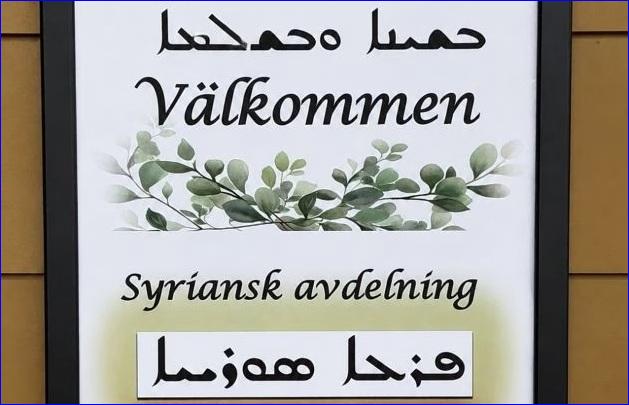
The unit at Tornet Care and Nursing Home in Norsborg, in Botkyrka Municipality south of Stockholm, was inaugurated on Thursday, 27 August. The opening followed years of political advocacy and comes as the generation of Assyrian immigrants who arrived in Sweden in large numbers during the 1960s and 1970s reaches old age.
Botkyrka Municipality began gradually developing the unit in May. According to the municipality's announcement, the aim is to maintain a core staff able to communicate with residents in both Swedish and Assyrian, while Swedish remains the principal language of the facility.
The care provided is otherwise subject to the same standards and responsibilities as at the municipality's other elderly-care homes. The language profile is intended to address residents' communication and linguistic needs rather than create a separate form of care.
The initiative is modeled partly on Finnish-language sections already operating at two other Botkyrka care homes, Silverkronan and Alby äng. Municipal officials have said language can be an important source of security and participation for elderly residents, particularly when communicating with caregivers and expressing their needs.
For older people who learned Swedish later in life, maintaining access to their first language can become particularly important as they age. Communication difficulties can make it harder for residents to explain symptoms, understand instructions or express their needs, while cognitive decline can sometimes affect second-language abilities.
The opening therefore represents more than a cultural initiative for Sweden's Suroyo community. It reflects a broader demographic shift within a community that has been established in the country for more than half a century.
From Immigration to Old Age
The first substantial groups of Suroyo immigrants arrived in Sweden during the 1960s and 1970s. Over subsequent decades, they established churches, congregations, associations, businesses, sports organizations, and cultural institutions, creating one of Europe's largest Suroyo diaspora communities.
Many of those who arrived as young adults are now in their 70s, 80s, and 90s. As the first generation ages, questions surrounding elderly care, language, and social isolation have become increasingly important.
The development at Tornet is consequently part of a broader transition in the community. Earlier generations focused heavily on establishing themselves in Sweden, finding employment and housing, learning Swedish and creating institutions for their families. Their children and grandchildren subsequently became established across Swedish society, including in higher education, business, politics, culture, and public service.
The emergence of language-specific elderly care is another indication that the community has become a permanent and multigenerational part of Swedish society.
Proposal Dating Back to 2017
The initiative has a considerably longer political history than the 2026 opening might suggest.
In 2017, Botkyrka's Christian Democrats submitted a motion calling for a new elderly-care home in northern Botkyrka with language profiles, specifically proposing Assyrian- and Turkish-language services. The motion was submitted by Aram El Khoury, Stefan Dayne, and Yusuf Aydin.
According to municipal documents concerning the proposal, the proposal was intended to address the needs of elderly residents whose mother tongue was not Swedish and to provide greater linguistic and cultural competence among care staff.
Municipal officials initially opposed the proposal. The administration argued that it would be difficult to guarantee sufficient demand for a dedicated language-profile facility, raising the possibility that places could remain vacant while the municipality simultaneously had to purchase care places elsewhere.
The original proposal therefore did not immediately lead to a dedicated facility.
Almost nine years later, however, a modified version of the idea has become reality -- not as a separate nursing home, but as a Assyrian-language-profile department within an existing facility.
Yusuf Aydin has remained one of the initiative's principal political advocates. When Botkyrka announced the project in April, Aydin said the Christian Democrats (Kristdemokraterna) had wanted to establish Assyrian-language elderly care in the municipality for many years.
The project was ultimately implemented through the local political cooperation known as Botkyrkas bästa. Aydin attended the inauguration alongside Kia Hjelte of the Moderate Party (Moderata samlingspartiet), chair of Botkyrka's Health and Social Care Committee, and fellow Moderate Party politician Brayam Danho.
Language and Care
Botkyrka officials have stressed that the linguistic profile does not alter the professional requirements or basic services provided to residents. Instead, the aim is to make language an additional tool for delivering person-centered care.
"Language is an important part of people's identity and security," Petra Oxonius, Botkyrka's director of care and services, said when the initiative was announced.
Kia Hjelte similarly said that language can contribute to security and participation in elderly care.
Local newspaper Mitt i reported in May that the new unit would have personnel able to speak both Swedish and Assyrian. The report also described the initiative as a new department at Tornet and noted that it followed the model of the municipality's existing Finnish-language care units.
The importance of language can extend beyond basic communication. Older residents may have spent decades using Swedish in their professional and public lives but still retain strong emotional and cultural ties to the language they learned as children.
For residents experiencing dementia or other forms of cognitive decline, communication in their first language can become especially important. A language-profile unit can therefore help staff better understand residents' needs while potentially reducing misunderstandings between caregivers and those receiving care.
At the same time, a Assyrian-language profile does not mean every resident will have identical cultural or social preferences. The success of the initiative will depend on combining language skills with individualized care.
or register to post a comment.