


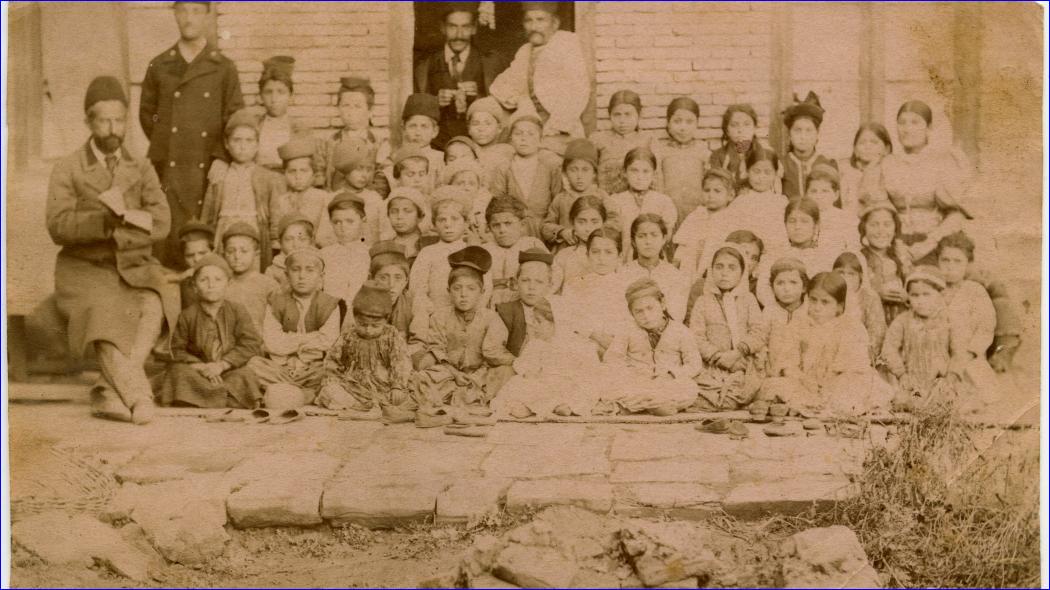
Assyrians are the last Aramaic-speaking ethnic community indigenous to a homeland between Iraq, Turkey, Syria and Iran. Their communities were transformed by missionary education beginning in the 19th century, but documenting this history through Assyrian voices has proven elusive in the wake of their displacement.
This traveling exhibit's unique collection of papers and objects from the Lake Urmia region of Iran documents the life, travels and education of one Assyrian-Iranian family in the late 19th and early 20th centuries.
Dr. Eden Naby Frye, who was instrumental in the organization and development of this collection and exhibit, was happy to relay the news to PHS's Executive Director Nancy J. Taylor ahead of the exhibit's final installation at the Bancroft Library this fall. Naby is an Assyrian-Iranian cultural historian of Central Asia and the Middle East. She was born in the Assyrian village of Golpashan, located outside Urmia in Iran. Both of Naby's parents were students at the Presbyterian mission schools in Urmia. Her mother graduated from Fiske Seminary in 1924; her father graduated from a men's seminary in 1918. She has conducted research, taught and published on minority issues in countries from Turkey to Xinjiang; her work on Afghanistan and on the Assyrians stands out in the field of cultural survival.
As they digitized the original exhibit materials, the Bancroft Library team simultaneously digitized a collection of correspondence, consisting of about 200 letters. "This is, in all likelihood, the first ever Assyrian collection of letters and journals (as in diaries) to be digitized and made universally available," Naby wrote when corresponding with Taylor.
PHS hosted the exhibit in the spring of 2024. In conjunction with the exhibit, PHS welcomed Dr. Hooman Estelami of Fordham University for an event and talk on March 21, when he discussed the work of the first community of Presbyterian missionaries in Urmia, a city in northwestern Persia, during the Qajar Era. Focusing on the domains of education, medicine and evangelism, Estelami used mission reports, missionary correspondence, diaries, biographies and archival photographs to delve into missionary service to the Assyrian population of the region. A full recording of the presentation is available for viewing on the PHS YouTube channel.
One of the missionaries Estelami mentions in his historic overview is John Haskell Shedd, who, along with his son William Ambrose, served as a missionary in Urmia from 1859 to 1918. In 2023, Shedd descendants and Estelami worked together to publish a newly discovered manuscript, "The Life of John Haskell Shedd." Uncovered in family papers in 2020, the book shows how Shedd methodically recorded his observations and experiences as he conducted missionary work among Christian populations in the Turco-Persian border region.
Around the same time that PHS was hosting the Assyrian exhibit, descendants of the Shedd family dropped off boxes of donations meant to be ingested into the already existing collection of Shedd Family Papers. Prior to that, the collection consisted of five cubic feet of records.
John Shedd's notes and manuscripts provide insights into the lives of the people who lived in the geographically isolated mountains in the Northwest corner of Persia. But it was his son's second wife, Louise Wilbur Shedd, whose photographs offer invaluable documentation of the Assyrians, Armenians, and Jewish people of Persia --groups who would be persecuted and displaced during World War I. An album of Louise Wilbur Shedd's photographs was found amongst the newer donated material, and some of those images were shared in the Spring 2024 edition of Presbyterian Heritage, in the main article "The Shedd Family Papers: Documenting dedication in Urmia."
Louise Wilbur Shedd's access to photography equipment, something most missionaries would not have carried through the mountains of West Persia, along with being a woman in the field gave her access and the opportunity to photograph families, women and children in their homes. Her intimate portraits, along with the notes and observations of John Haskell and William Ambrose Shedd, portray a place and time where religious and ethnic groups lived side by side, before global upheaval and war set the wheels of displacement in motion.
In a similar way, the letters, journal, historic images, passport, and currency that form the Assyrian traveling exhibit offer a glimpse at what life was like on the other side of the missionary equation. The exhibit materials also highlight the importance of archiving and preserving family-held documents that enhance deeper understanding of the modern evolution of social and cultural change, especially among indigenous minority populations.
Although most of the 200 digitized letters are in Assyrian vernacular Aramaic -- "the writing system promoted so ably by American missionaries in Iranian Azerbaijan," mentions Naby -- there are about 30 letters from American missionaries themselves, including Shedd. The letters date from just before and during World War I. "I think ... researchers ... would want to know how the Americans influenced the use of the term 'Nestorian' and 'Syriac' while objecting to the use of the term 'Assyrian,'" Naby shared.
The materials will be installed at Bancroft Library at the University of California-Berkeley in late 2026. Don't fret if you can't make it to California -- the materials being digitized means they're accessible right at home. Browse the digitized Assyrian traveling exhibit material online.
or register to post a comment.