


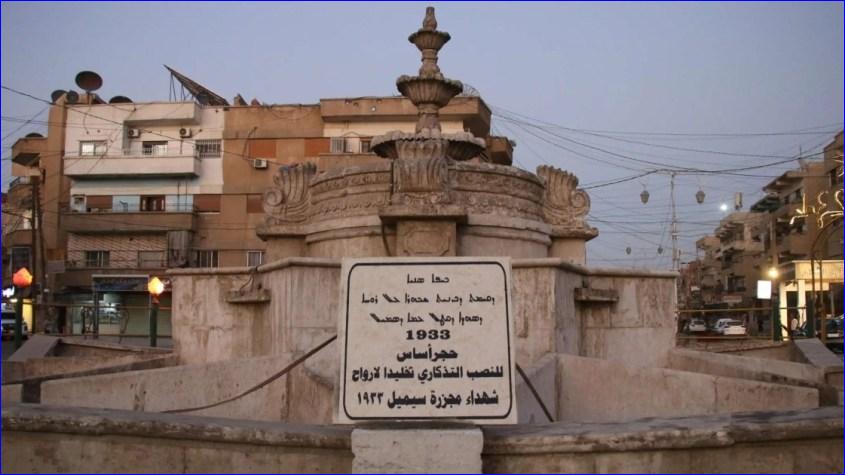
In 1933, Assyrians were massacred and uprooted in the Upper Beth Nahrinian town of Simmele and surrounding villages. Many of the victims were forced to flee to Simmele -- now part of Nohadra (Dohuk) -- during the 1928 Hakkari-Nestorian Exile. Now that they were on the run again, they crossed the border into French-administered Syria. There, they settled along the Khabur River and founded villages named after their old villages in Hakkari.
Related: The 1933 Massacre of Assyrians in Simmele, Iraq
On the 93rd anniversary of the Simmele Massacre, we spoke with Dr. Aziz Emmanuel Eliya Zebari, a lecturer at the Catholic University in Arba'ilo (Erbil) and member of the Executive Board of the Beth Nahrain Patriotic Union (Huyodo Bethnahrin Athroyo, HBA).
Tibeyla Nahrin: What happened on 4--5 August 1933?
Dr. Aziz Emmanuel Eliya Zebari: The events of 4--5 August 1933 marked the beginning of the crisis that led to the Simmele Massacre. After negotiations with the Iraqi government failed, a group of armed Assyrians led by Malik Yaqo crossed into the French Mandate of Syria. They were later disarmed and returned to the Iraqi border. On 4 August, as they attempted to re-enter Iraq near the village of Derabun, fighting broke out with Iraqi Army units. Although historians disagree on how the clash began, it resulted in casualties on both sides, including many Iraqi soldiers, and further increased tensions between the Assyrian community and the Iraqi government.
The Iraqi authorities and the press presented the Battle of Derabun as an Assyrian rebellion, strengthening nationalist sentiment and providing the justification for military action against Assyrian communities. On 11 August 1933, Iraqi Army forces under General Bakr Sidqi, supported by allied irregulars, attacked the town of Simmele and more than sixty surrounding Assyrian villages. Hundreds of civilians were killed, villages were looted and destroyed, and thousands of survivors were displaced.
Estimates of the number of victims range from about 600 to 3,000. The Simmele Massacre remains one of the most significant tragedies in modern Assyrian history and continues to shape Assyrian collective memory and debates on minority rights in Iraq.
TN: What became of the Assyrian people living in the region in the aftermath of the massacre? What kind of policy was pursued against them?
AZ: The massacre had lasting consequences for the Christian population that speaks a variety of Neo-Aramaic dialects, particularly for the members of the Assyrian Church of the East, the Chaldean Catholic Church, the Syriac Orthodox Church, and the Catholic Church. Fear, insecurity, and increased government surveillance forced many families to leave their villages and settle in cities such as Mosul, Kirkuk, and Baghdad, while others eventually emigrated abroad. Although the Iraqi government did not adopt a policy of physical extermination, it pursued policies that limited Assyrian political aspirations, encouraged integration into the dominant population, and weakened the distinct identity of minority communities. Continued discrimination, displacement, and political instability throughout the twentieth century contributed to the steady decline of the Assyrian-speaking Christian population in its historic homeland.
TN: The date of the massacre is also observed as a day of mourning for Assyrians. Could you explain its meaning and significance?
AZ: The Assyrian community commemorates the Simmele Massacre each year on 7 August, observed as Assyrian Martyrs Day. The day honors the victims of the 1933 massacre and all Assyrians who have suffered persecution and displacement. Although the fighting at Derabun occurred on 4--5 August and the massacre began on 11 August, 7 August was adopted as the official day of remembrance to symbolize the collective suffering of the Chaldean--Syriac--Assyrian people. It has become an important occasion for preserving historical memory, strengthening Assyrian identity, and calling for recognition of the massacre and the protection of the rights of Iraq's indigenous Christian communities.
TN: On the anniversary of the Simmele Massacre, what are the demands and calls of the Assyrian community?
AZ: Each year, the Chaldean--Syriac--Assyrian Martyrs Day also provides an opportunity to renew demands for justice and equal rights. Organizations, churches, and civil society groups call for official recognition of the Simmele Massacre, the preservation of Chaldean--Syriac--Assyrian history and cultural heritage, and constitutional protection of their political, cultural, linguistic, and religious rights as an indigenous people of Iraq. They also seek improved security for remaining Christian communities, the restoration or compensation of confiscated property where appropriate, and conditions that would allow displaced families to return safely to their ancestral villages. More broadly, the commemoration reaffirms the community's commitment to equality, effective political representation, the preservation of the Assyrian language and heritage, and the prevention of future atrocities.
Achieving these goals requires both governmental support and sustained efforts within the Chaldean--Syriac--Assyrian community. Greater cooperation among churches, political organizations, and civil society is essential to strengthen representative institutions and preserve the Assyrian language, culture, and historical heritage. Continued engagement with the Iraqi government, the Kurdistan Regional Government, and international organizations through peaceful and legal means remains important for advancing minority rights, security, property claims, and political representation.
The Chaldean--Syriac--Assyrian diaspora also plays a vital role by supporting educational, cultural, and development projects, promoting academic research, and raising international awareness of Chaldean--Syriac--Assyrian history and contemporary challenges. Together, these efforts can help preserve the community's identity and contribute to securing its rightful place in a democratic and pluralistic Iraq.
or register to post a comment.