


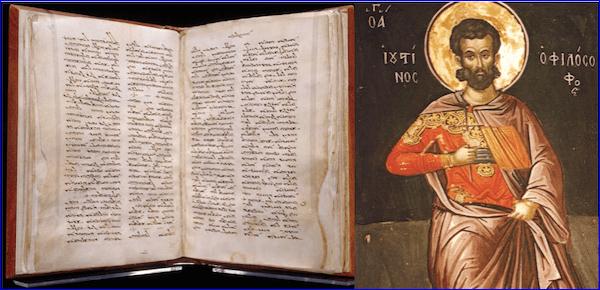
Nearly eighteen centuries after his death, Tatian--the second-century Assyrian Christian thinker and disciple of St. Justin Martyr--is being rediscovered as an important figure in the heritage of Eastern Christianity.
In a recent study, "Tatian and His Legacy", Salesian scholar Father George Thadathil argues that the forgotten Christian apologist deserves renewed attention, particularly among India's Syriac Christian communities, whose spiritual roots are closely linked to the East Syriac tradition.
"His name may not be immediately familiar to many Christians today, especially in India, yet his influence on the Eastern churches was enormous," Thadathil says.
Born around 120 AD in Assyria, Tatian lived at the crossroads of Syriac, Greek, Persian, and Roman cultures.
After travelling to Rome, he became a disciple of Justin Martyr, one of Christianity's earliest defenders before the Roman world.
Yet Tatian soon developed a distinctive voice of his own, insisting that Christianity represented God's true wisdom rather than simply another philosophical system.
His most enduring contribution was the "Diatessaron", a remarkable harmony that wove the four canonical Gospels into one continuous narrative.
Compiled around the middle of the second century, it became the principal Gospel text used in many Syriac-speaking churches for worship, preaching, and catechesis.
"The importance of the "Diatessaron" cannot be overstated," Father Thadathil observes. "In many Eastern Christian communities... it appears to have served as the chief Gospel text for public reading and liturgical use."
The work made the story of Jesus easier to proclaim, memorize, and teach in an era when biblical literacy was still developing.
Although Church leaders in the fifth century restored the use of the four separate Gospels, the widespread popularity of Tatian's harmony demonstrated its profound influence on Christian worship across the Syriac East.
Beyond biblical scholarship, Tatian championed a life of radical Christian commitment. He promoted discipline, simplicity, fasting, and freedom from worldly attachments--qualities that later became hallmarks of Eastern monastic spirituality.
Thadathil notes that Tatian's rigour also generated debate. While his emphasis on asceticism inspired generations of monks, it sometimes appeared too severe for ordinary Christian life.
"He reminds us that the Christian life must be serious, but also that zeal can become unbalanced if it forgets the goodness of creation," the author writes.
One of the study's most significant contributions is its relevance for Indian Christianity.
Thadathil argues that the Syriac churches of South India are heirs to the same rich Eastern Christian tradition that produced Tatian.
Rather than viewing the history of Christianity primarily through a Western lens, he invites readers to recognize the theological creativity that flourished in Mesopotamia and Syria during the Church's earliest centuries.
"The Syriac churches were not passive recipients of Christianity from the West," he writes. "They were creative centers of theological, biblical, and liturgical life."
The article also points to an intriguing area of ongoing scholarship: possible connections between Tatian's "Diatessaron" and "Puthen Pana", the celebrated Malayalam devotional work composed by Arnos Pathiri (Johann Ernst Hanxleden).
Such studies could shed fresh light on how Syriac biblical traditions travelled across cultures and eventually enriched Indian Christian spirituality.
According to the author, Tatian's influence extended well beyond the Middle East. The "Diatessaron" was translated into several languages, including Arabic and Latin, and evidence suggests that versions of the Gospel harmony circulated across Europe, reaching as far as Italy and the Germanic world during the early medieval period.
For contemporary Christians, Thadathil believes Tatian's legacy speaks to issues that remain strikingly relevant.
"First, he reminds us that the early Church in the East was intellectually active and creatively original.
"Second, he shows how Scripture can be received not only as text but as liturgical life.
"Third, he challenges Christians to think about the relationship between faith and culture, and about the moral seriousness that should mark Christian witness."
As interest grows worldwide in recovering the diverse traditions of early Christianity, Father Thadathil believes Tatian deserves to be remembered not as a marginal figure but as one of the architects of Eastern Christian thought.
His life, he concludes, stands "at the intersection of East and West, of Scripture and liturgy, of discipline and proclamation," offering a heritage that still has much to teach the Church today.
or register to post a comment.