


 Iraq's General Authority for Antiquities and Heritage)
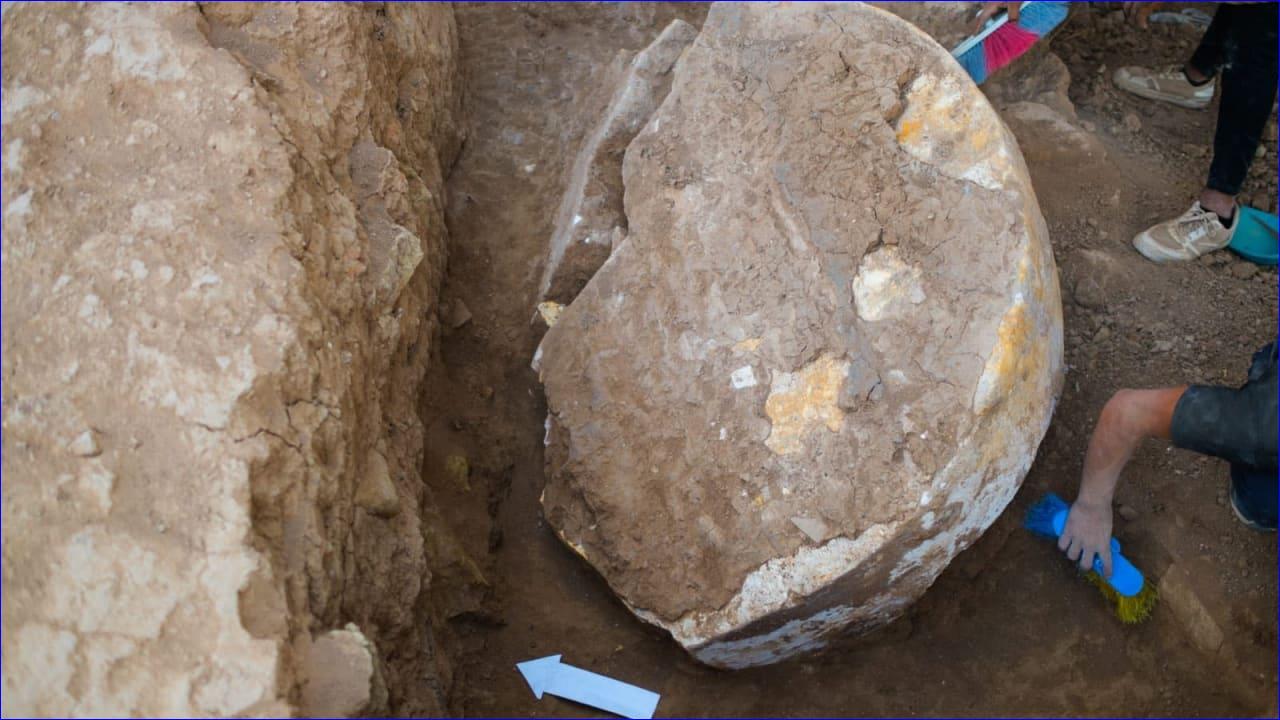
The stele's discovery, announced on social media in late June by both the Nineveh Antiquities Inspectorate and Iraq's Antiquities and Heritage State Board, was unearthed by a joint Iraqi-American archaeological mission.
The front of the stele, standing at two meters high and 1.55 meters wide, bears a large, high-relief sculpture of Ashurbanipal, while its back side features two smaller reliefs of unnamed Assyrian kings.
The back of the stele also features cuneiform inscriptions believed to document the king's architectural works and achievements in the ancient city Nineveh and throughout the Assyrian Empire.
Nineveh had served in antiquity as the capital and largest city of the Neo-Assyrian Empire.
Among his other achievements, Ashurbanipal is remembered for constructing the Library of Ashurbanipal, believed to have held over 100,000 texts - the largest collection of its kind until the construction of the Library of Alexandria in Egypt several centuries later.
Over 30,000 cuneiform texts from ancient library have survived, remaining highly important textual sources on the life and culture of ancient Mesopotamia.
The stele has since been moved to the Inspectorate's headquarters to undergo initial restoration work so that it can be studied in depth.
The discovery "reflect the antiquity and civilizational depth of the city of Nineveh, as one of the most prominent historical centers in Iraq and the region," said Ali Obaid Shalgham, the board's president.
Shalgham added that finding the fragment reflects the "continuation of archaeological work in uncovering more evidence documenting the history of Mesopotamian civilization, highlighting its civilizational depth and human contributions, thereby strengthening its presence on the global cultural and civilizational stage."
Nineveh Antiquities and Heritage Inspector Ruwaid Muwaffaq emphasized that the stele's discovery highlights "the grandeur of Assyrian civilization and its urban development," during a press conference in late June.
The stele, Muwaffaq explained, is one of the most prominent pieces of archaeological evidence commemorating Ashurbanipal's achievements as king.
Further, Muwaffaq noted that the discovery sheds light on the cultural and architectural prosperity that Nineveh witnessed during the Assyrian era.
According to him, the stele "reinforces the archaeological evidence indicating that many of the city's gates and historical sites contain royal tombstones and significant architectural achievements."
Iraq races to restore ancient Ziggurat of Ur amid threat of climate erosion
Seperately, in early May, Iraqi outlet Shafaq News reported that Iraq had begun restoring the ancient Ziggurat of Ur using locally made bricks and traditional building methods.
According to Shafaq, the current initiative is expected to include restoring the first level of the 4,000-year-old temple and its three main staircases, repairing cracks on the second level, and reconstruction work on the third level based on available archaeological evidence.
This marks the "seventh major restoration campaign at the ziggurat since its construction under the Third Dynasty of Ur around 2112 BCE," Shafaq noted.
The ziggurat was originally constructed in honor of the Mesopotamian moon god Nanna, the patron deity of Ur.
It later crumbled during the Neo-Babylonian period, until it was eventually restored by the last Neo-Babylonian king, Nabonidus, who ruled from 556 BCE until the fall of the empire.
In 1862, Henry Rawlinson identified Ur Kaśdim - the birthplace of Abraham in Jewish tradition - with Tell el-Muqayyar, a site located near the ziggurat.
Today, it remains one of the best preserved examples of ancient Mesopotamian architecture.
or register to post a comment.