


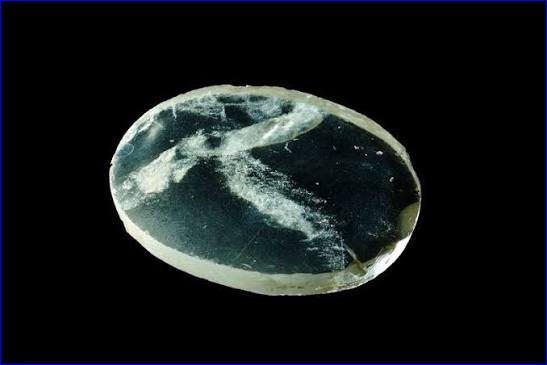
The Nimrud Lens is considered one of the most curious artifacts in the archaeology of the Assyrian Empire. Discovered in 1850, during excavations at the ancient palace of Nimrud, in the current region of Iraq, the piece was found among the ruins of one of the main cities of ancient Mesopotamia. Since then, the object has been studied by specialists, as it presents optical characteristics that continue to spark interest.
Dated to the 8th century BC, approximately 3,000 years ago, the lens was produced in carefully polished rock crystal. Additionally, it measures about 4 centimeters and has the capacity to magnify objects and concentrate light, characteristics that fuel different interpretations of its use.
What is the Nimrud Lens?
According to historical records, the piece was discovered by British archaeologist Austen Henry Layard, during excavations carried out in Nimrud, the ancient Assyrian capital.
Since then, the artifact has been analyzed by archaeologists and historians due to the precision of its cutting. Additionally, its manufacture demonstrates a high level of mastery of the techniques available at that time.
Consequently, the lens has come to occupy a prominent place among the most studied objects in Middle Eastern archaeology.
Could the lens have been used as a primitive telescope?
One of the most well-known hypotheses suggests that the Nimrud Lens could have been part of some rudimentary optical instrument.
If this interpretation were confirmed, it would indicate that knowledge related to optics was mastered many centuries before the telescopes attributed to the astronomer Galileo Galilei, in the early 17th century.
However, this hypothesis is not a consensus.
On the contrary, most researchers consider it unlikely that the Assyrians developed a complete telescope. Nevertheless, specialists recognize that the piece demonstrates quite sophisticated technical knowledge for the time.
Why is the object still being studied?
To this day, no documents have been found that accurately explain the purpose of the lens.
For this reason, new analyses continue to be conducted. Additionally, modern technologies are employed to examine its curvature, its imperfections, and its magnification capacity.
Thus, while no definitive conclusion is reached, the object remains surrounded by scientific inquiries.
What are the main hypotheses about its use?
As there are no written records describing its original function, different possibilities continue to be evaluated by archaeologists.
Among the most accepted hypotheses are:
- Magnifying glass for reading or observing small details;
- Tool used in high-precision artisanal work;
- Instrument for concentrating sunlight to produce fire;
- Part of some unknown optical equipment;
- Object used in ceremonies or rituals.
What does the Nimrud Lens reveal about Assyrian technology?
Regardless of its original use, the Nimrud Lens demonstrates the high technical level achieved by Assyrian craftsmen.
Its manufacture required precision, skill, and extensive mastery of rock crystal cutting.
Moreover, the artifact reinforces that various technologies developed by ancient civilizations are still subjects of investigation.
Finally, while new research continues to be conducted, the Nimrud Lens remains one of the greatest enigmas of archaeology, increasing interest in the scientific knowledge and engineering developed in ancient Assyria.
or register to post a comment.