


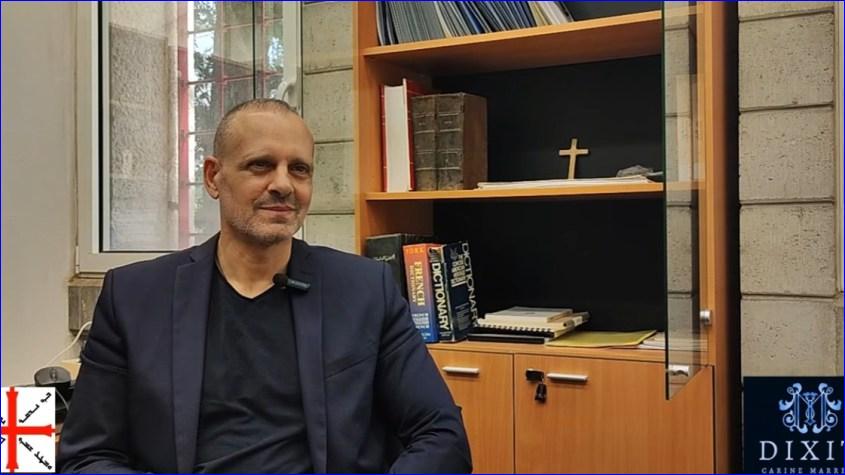
Speaking in an interview with Dixit, a program featuring conversations with contemporary intellectuals, writers, and artists, Iskandar presents the Syriac language not as a relic of the past but as a living foundation of Lebanon's civilization, one that continues to shape the country's language, liturgy, and collective memory despite decades of political and social marginalization.
Syriac as the language of Lebanon's Christian heritage
Iskandar traced his own interest in the Syriac language to his early work as an architect studying Lebanon's historic buildings. While researching traditional Lebanese architecture, he says he struggled to explain recurring symbols and artistic forms through the lens of modern Arab culture alone. His search eventually led him to Syriac manuscripts, particularly the sixth-century Rabbula Gospels (Codex Rabulensis), where he found architectural motifs that remain visible in Lebanese homes today.
According to Iskandar, his findings reveal to him that many of Lebanon's architectural symbols, religious traditions, and historical narratives are deeply rooted in the Syriac heritage preserved by the Syriac Maronite Church of Antioch.
He describes Syriac as a literary language that emerged during the first centuries of Christianity when Aramaic-speaking Christians of Beth Nahrain (Mesopotamia), Phoenicia, and Urhoy (Edessa, modern-day Urfa) enriched their language with Greek philosophical vocabulary to express Christian theology. Once written and standardized, it developed into a distinct language that became the intellectual and spiritual vehicle of Eastern Christianity.
"Lebanese is simply not Arabic"
One of Iskandar's central arguments is that the language commonly spoken in Lebanon should not be regarded merely as a dialect of Arabic. He maintains that while Modern Standard Arabic became Lebanon's official language after independence, everyday Lebanese speech preserves Syriac grammar, syntax, pronunciation and vocabulary.
Among the examples he cites are common Lebanese words such as 'shmel' (left), 'jouwa' (inside), and 'barra' (outside), which he argues derive from Syriac rather than Arabic. He also points to distinctive phonetic features in Lebanese speech that are absent from classical Arabic.
In his view, describing Lebanese simply as an Arabic dialect reflects political ideology more than linguistic reality.
A language lost through Politics
Dr. Amine Jules Iskandar argues that Syriac remained part of education in Maronite schools until the mid-twentieth century. Although Lebanon formally recognized Arabic as its official language after independence in 1943, he notes that Syriac-language instruction continued in some mountain schools until the retirement of older teachers during the 1960s.
He describes the removal of Syriac from education as a political decision that gradually weakened Lebanon's connection to its own history. "The loss of language," he suggests, "meant the loss of historical consciousness." He urges Maronite educational institutions to restore Syriac teaching in schools and universities while encouraging churches to expand its liturgical use.
Throughout the interview, Iskandar emphasizes the historical importance of Syriac scholarship, arguing that Syriac scholars played a decisive role in transmitting Greek philosophy, medicine, mathematics, astronomy, and other sciences. According to his account, many Greek scientific works were first translated into Syriac before later becoming available in Arabic, serving as a bridge through which classical knowledge ultimately reached Europe.
For Iskandar, this intellectual legacy demonstrates that Syriac is not merely a liturgical language but one of the major scholarly languages of late antiquity.
Lebanon's Christian history
The interview also explores the historical development of Lebanon's Christian communities. Iskandar traces Christianity in Lebanon to the first century, citing early apostolic missions before describing the gradual conversion of Tur Levnon by the disciples of Mor Maron during the fifth and sixth centuries.
He identifies the election of Mor John Maron as the first Syriac Maronite Patriarch in the late seventh century as a defining moment in the formation of the Syriac Maronite community. According to Iskandar, four elements shaped this emerging nation: a defined homeland in Tur Levnon, an independent church, the Syriac language, and a military force capable of defending the community.
He also discusses successive periods of prosperity, the Crusader era, the Mamluk campaigns, Ottoman rule, the nineteenth-century massacres and the famine ('Kafno' in Syriac) of World War I, portraying each as pivotal moment in the survival of Lebanon's Christians.
In 1860, sectarian conflict erupted between the Syriac Maronite Christians and the Druze, fueled by changing social hierarchies and Ottoman administrative policies. The violence quickly spread from the mountains to Damascus, resulting in the deaths of an estimated 10-25 thousand Christians and the destruction of hundreds of villages and churches.
If not Federalism, then Partition
Turning to contemporary politics, Iskandar argues that Lebanon's recurring crises cannot be resolved solely through the disarmament of individual militias and armed groups. Instead, he advocates a fundamental restructuring of the Lebanese political system that would allow each community greater autonomy through a federal model.
If such reforms prove impossible, he says, partition should no longer be considered a taboo subject, arguing that constitutional arrangements exist to serve people rather than the reverse.
France, Francophonie, and Lebanon
Despite criticizing recent French policies toward Lebanon, Iskandar stressed that France remains deeply intertwined with Syriac Maronite identity. He argues that Lebanon's historic relationship with France should not be abandoned, warning that replacing French entirely with English would represent another cultural rupture comparable to the decline of the Syriac language.
For Iskandar, preserving both Syriac and Lebanon's Francophone tradition is essential to maintaining the country's historical character and cultural plurality.
Prayer
Asked what sustains him personally, Iskandar answer is simply: prayer.
When invited to define his ideal of earthly happiness, he replies that it lies in striving for transparency, justice, and integrity--an aspiration he acknowledged can never be fully attained but remains worth pursuing.
Throughout the conversation, Iskandar returns to a consistent theme: that languages are far more than tools of communication. They preserve memory, shape identity, and carry spiritual traditions across generations. In his view, the future of Lebanon's Christian heritage depends not only on political stability but also on whether its ancient linguistic inheritance continues to be taught, spoken and valued.
or register to post a comment.