


Assyrian Inscriptions Finds
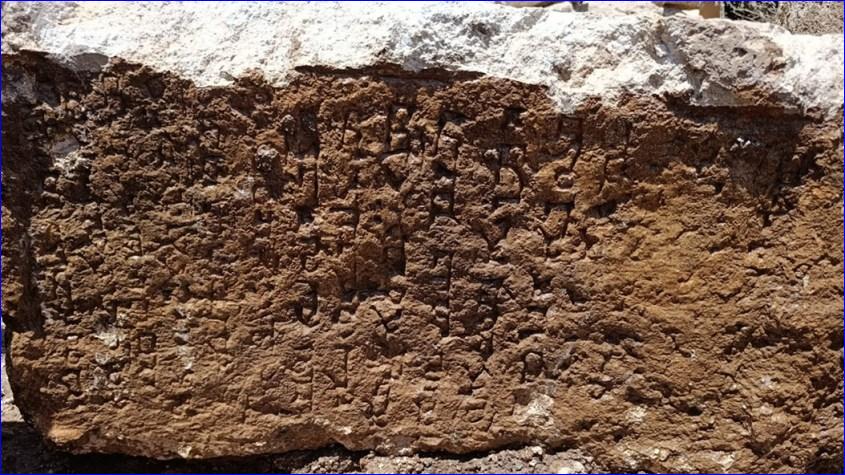
For example, in October 2025, a Assyrian inscription was discovered in Oymakli, a village in the Gerger district of Adiyaman. Immediately upon its discovery, news outlets falsely reported that the inscription was written in Armenian. The Director of the Adiyaman Museum also stated to the press that the text was Armenian. However, when I watched the news coverage and closely examined the artifact, I realized that the inscription was not in the Armenian language, but in the Assyrian language.
Shortly thereafter, I contacted the journalist who had reported the story, and he provided me with photographs of the inscription. Since I am not proficient in Assyrian myself, I sent the images to several friends in Turkey who are, asking for a Turkish translation. However, they all found the text difficult to read and decipher. I then forwarded the photographs to a close friend living in Belgium, whom I knew to be highly proficient in Assyrian.
Acknowledging that the text was indeed difficult, my friend in Belgium forwarded the photo to a Assyrian language expert in Beirut. Two weeks later, a response arrived containing the accurate translation. The inscription, carved into a rectangular stone, read: "This house, this structure, was built in the year 1186." This valuable artifact from Oymakli village was later transferred to the Adiyaman Museum for preservation.
More recently, in June 2026, inscriptions with significant value were uncovered in Medyad (Midyat). During municipal roadwork and paving operations in the village of Ortaca, an excavator unearthed several stones bearing ancient writings. A total of 13 stone blocks were unearthed, and the inscriptions immediately drew widespread attention. Prompt examinations clearly confirmed that the texts were written in the Assyrian language.
The preliminary investigations dated the inscriptions back to 722 AD. One of the writings recorded that "the Church of Mor Aday was destroyed that year and was subsequently rebuilt through the collective efforts of the priests."
Assyrian-language expert Adem Coskun, who serves as Director of the Medyad Municipality Telkari Museum and Head of Tur Abdin Institute, stated that the stone blocks highly likely belonged to the Assyrian Church of Mor Aday, originally constructed in the fourth or fifth century AD. Statements from other linguists aligned with this assessment, conclusively demonstrating that the inscriptions are indisputably Assyrian.
While the discovery of these inscriptions is extremely valuable, another deeply concerning issue has emerged. Following the media coverage of the discovery, some commentators argued that the inscriptions belonged to Central Asian Turks, while others claimed they were Kurdish. Though some may dismiss these assertions as minor or insignificant, they actually expose an underlying desire to distort history, deny cultural identity, and appropriate the heritage of others. These inscriptions must therefore be comprehensively examined, and without delay, meticulously translated into Turkish and preserved in museums to secure their rightful place in history.
The Goddess of the Mountain and Jacob the Assyrian
Ömer Faruk Alpdogan is a young writer from Gaziantep. He has dedicated many years to researching Assyrian heritage.
His second book, Jesus, Moses, and Mary, was a highly acclaimed novel that beautifully depicted the hardships and struggles faced by minorities in Turkey.
His third and latest book, The Goddess of the Mountain and Jacob the Assyrian, focuses on the suffering, challenges, and genocide experienced by the Asyrian people. Through the eyes of a female genocide survivor, Alpdogan vividly depicts life in the towns of Adiyaman, Kâhta, and Gerger, while also addressing the historical issue of antiquity smuggling around Mount Nemrut in Adiyaman.
Published by Yason Publishing, this poignant work possesses all the qualities of a narrative that deserves to be adapted into a feature film.
or register to post a comment.