


Another Elizabeth who ruled for a brief period, perhaps. Or a Charles III who preceded the current king, effectively making him Charles IV.
Such a finding would shake up the popular understanding of how the crown has been passed down over the ages and leave scholars with a whole new set of questions about the British monarchy.
Related: Assyrians: Frequently Asked Questions
New research into the ancient Assyrian kingdom promises to be similarly disruptive for the world of Assyriologists. A study by Yale's Eckart Frahm and Alexander Johannes Edmonds, of the University of Münster, in Germany, provides evidence for three previously unknown Assyrian kings who ruled for brief periods in the 10th and 8th centuries BC
The study, "Three New Kings of Assyria," appears in the Journal of Cuneiform Studies.
The discovery of what look to be three additional kings during the last stage of Assyrian history, known as the Neo-Assyrian period, "came as a surprise -- no one expected there would be room for any new and unknown rulers during this time," said Frahm, the John M. Musser Professor of Near Eastern Languages and Civilizations in Yale's Faculty of Arts and Sciences. The new study builds on previous research by Frahm, one of the world's foremost experts on the Assyrian empire, which described evidence of one of the three kings.
"But as Edmonds and I demonstrate in our research, three such rulers have been hiding in the shadows, in some poorly preserved cuneiform documents published some time ago but not properly understood," Frahm said.
In his 2023 book, "Assyria: The Rise and Fall of the World's First Empire," Frahm detailed a history of Assyrian civilization, which lasted from circa 2025 BC to 609 BC It began as the city-state of Ashur, located in what is now Iraq, but eventually expanded into a vast empire that dominated much of Western Asia.
Assyriologists thought they had "a pretty good idea" of all the kings who ruled during the Neo-Assyrian period, based on the so-called Assyrian King List (AKL), an ancient document known from three well-preserved cuneiform clay tablets, Frahm said.
Based on that list, it appeared that during the last centuries of Assyrian history, succession passed without incident, usually from father to son.
However, said Frahm, "the Assyrian King List seems to provide an idealized version of Assyrian kingship in which all unrest, everything unstable, is essentially erased from the record."
He and his colleague argue that Assyria's political history was much messier -- more Game of Thrones than Camelot.
Take, for example, the king discovered by Frahm.
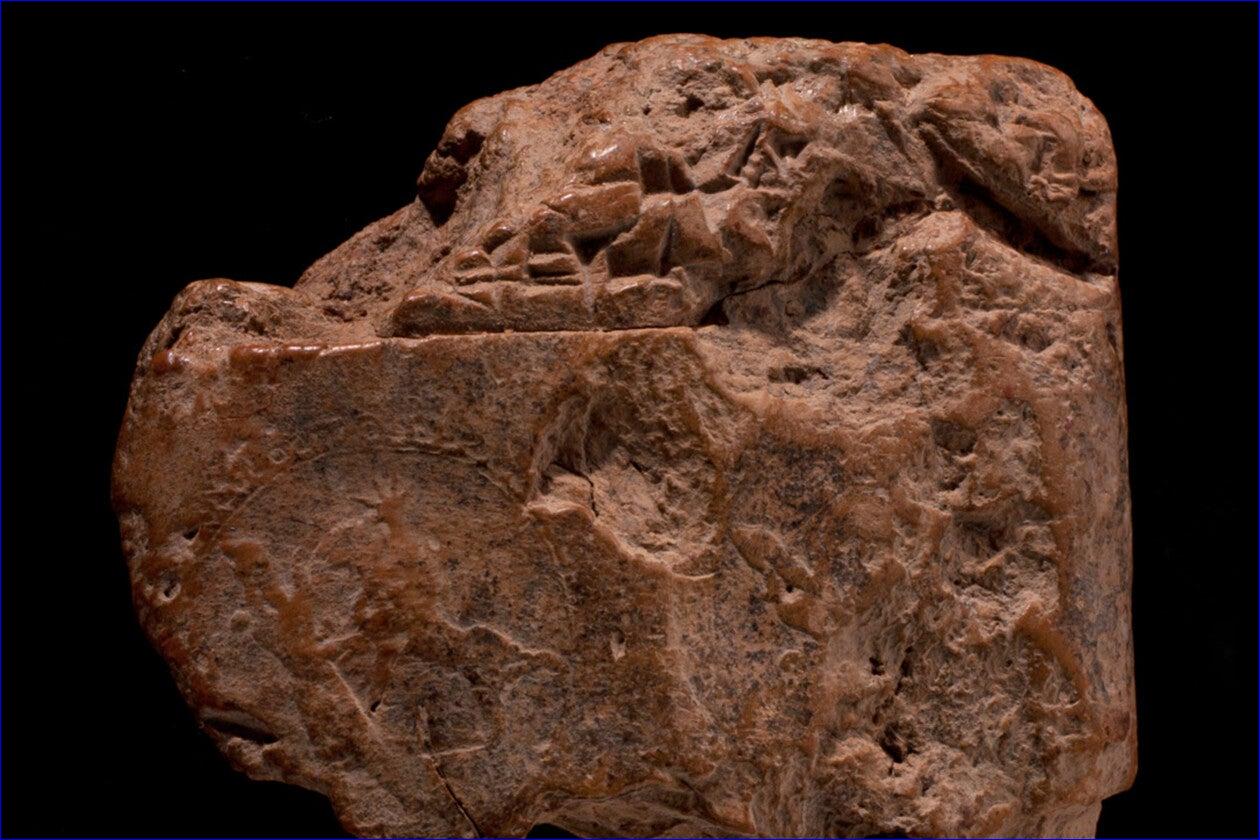
A few years ago, Frahm examined a poorly preserved royal grant -- a cuneiform recording of an Assyrian king's gift of land to an individual -- housed at the British Museum. Such texts were dated by eponym; in this instance, the year was 762 BC
Scholarly translations had previously assumed the king issuing the grant was Adad-nerari III, who ruled from 810 until his death in 783 BC Another royal name also mentioned on the tablet is that of Tiglath-pileser. Previously, he had been identified as Tiglath-pileser III, who ruled from 745 to 727.
But neither of those kings ruled during the year recorded on the tablet, a conundrum scholars have been at a loss to explain.
Frahm's explanation, based on a new reading of the cuneiform in the first line of the text, is that the grant was likely not made in the name of Adad-nerari III, as the name of that king is written differently in other texts. More likely, he says, is that the grant was made under Tiglath-pileser, only not the one in the AKL, but a previously unknown Assyrian prince who had assumed the same royal name.
Such a scenario is bolstered by the Assyrian Eponym Chronicle, a text in cuneiform which chronicles major events that happened throughout the empire's history. The chronicle describes a rebellion and insurgency in the city of Ashur in 763 and 762. Frahm surmises that the unknown prince started a rebellion during this time.
A celestial phenomenon provided the perfect opening. A solar eclipse had occurred early in 763, according to the chronicle, which would have been interpreted at the time as a sign that the moment had come for the demise of the ruling king, Frahm said.
In addition, "the Eponym Chronicle also indicates that a couple of years earlier, in 765, there was a bout of plague, an epidemic in this area, which may well have been the root cause for the overall crisis that occurred," he said.
He and Edmonds used similar reinterpretation techniques and sleuthing to uncover two additional rulers: a new Shalmaneser (ca. 747-745 BC), "whose reign coincided with wide-spread chaos within Assyria, such as disloyal vassals and nomadic incursions," and a new As?s?ur-uballit? (ca. 913--912 BC), who is mentioned in a text listing rulers who restored a silver ritual vessel for beer, dedicated to the god Ashur.
Each king ruled for less than two years. Frahm believes their names were deliberately removed from the record, likely by their successors. In the case of As?s?ur-uballit?, for example, it appears that he was the legitimate heir to his father, but was replaced by another prince.
"And that other prince had no interest in indicating that he had ascended to the throne under somewhat shady circumstances," Frahm said.
The findings fundamentally alter the overall picture of how Assyria grew into an empire -- the world's first, in Frahm's view. The empire's emergence under Tiglath-pileser III is often considered the result of a protracted and unstoppable rise, beginning in the late 10th century BC, with a few minor setbacks and a long series of mostly uncontested father-son successions, he said. But the new research shows that, in the years prior to Tiglath-pileser III's accession, Assyria went through a period in which various members of the royal family competed with one another for power, and the country endured both plague and the beginnings of a phase of increasing aridity.
And yet, he added, "the result of all this -- pandemic, climate change, succession crises, and even, for good measure, a solar eclipse and the rise of a new class of oligarchs -- was not political collapse but Assyria's transformation into a predatory empire of proportions unseen before, a scenario that resonates in some respects with global events of our own times."
or register to post a comment.