


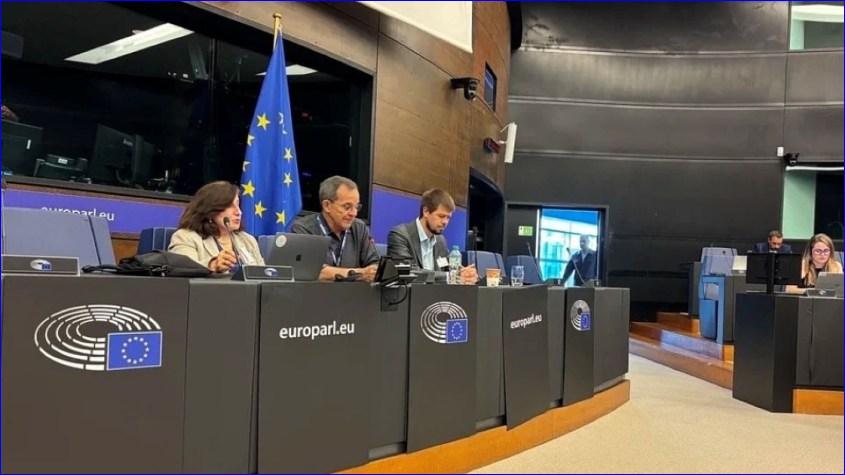
The appeal came during the 18 June meeting of the European Parliament's Intergroup for Christians in the Middle East, which is an official, cross-party forum of Members of the European Parliament (MEPs) focused on protecting religious minorities, monitoring human rights, and advocating for the survival of historic Christian communities in nations like Syria, Iraq, and Lebanon. During the meeting, Switzerland-based Christian Solidarity International (CSI) presented an extensive assessment of the challenges facing Christians in Iraq.
Addressing the European Parliament, Joel Veldkamp, CSI's Director for Public Advocacy, was joined by Pascale Warda, former Iraqi Minister for Migration and Displacement and founder of the Hammurabi Human Rights Organization (HHRO), a long-standing partner of CSI in Iraq.
Veldkamp traced the history of Iraq's Christian communities, describing them as among the oldest in the world, with roots stretching back nearly two millennia. He noted that the majority of Iraqi Christians descend from the region's indigenous peoples -- including Assyrians and Armenians -- and continue to preserve their linguistic, religious, and cultural heritage.
He emphasized that although Christians endured periods of persecution throughout Iraq's modern history, including under Saddam Hussein's rule, the country still counted approximately 1.5 million Christians in 2003, making it one of the Middle East's largest Christian populations.
According to Veldkamp, the US-led war against Iraq in 2003 fundamentally altered that reality. The collapse of state authority and the ensuing sectarian violence exposed Christian communities to systematic attacks by both Sunni jihadist organizations and Shiite militias.
Church bombings, targeted assassinations, kidnappings and forced displacement drove hundreds of thousands of Christians from their homes over the following decade. The 2010 massacre at Baghdad's Our Lady of Salvation Syriac Catholic Church, in which 58 worshippers were martyred during Mass, marked one of the deadliest attacks against Iraq's Christian community.
The emergence of ISIS in 2014 further accelerated the exodus. After the terrorist organization seized Mosul and overran Nineveh Plains -- the historic heartland of Iraqi Christianity -- around 200,000 Christians fled almost overnight. ISIS also abducted Christian women while carrying out genocidal campaigns against the Yezidi community through mass executions, forced enslavement and widespread atrocities.
Although ISIS lost territorial control in Iraq in 2017, Veldkamp stressed that the security and future of Christian communities remain deeply uncertain.
He identified two principal challenges facing Christians today: the ongoing political and territorial rivalry between Baghdad and the Kurdistan Regional Government over the Nineveh Plain, and what he described as a continuing culture of religious discrimination embedded within Iraqi law and society.
Christians living in northern Iraq, he said, frequently find themselves caught between competing military and political authorities, including Iraqi federal forces, Kurdish security forces, and Iran-backed Popular Mobilization Forces (PMF). Reports of land confiscation, harassment, and restrictions on property rights continue to undermine efforts by displaced Christians to rebuild their communities.
Veldkamp also criticized Iraq's political system, arguing that although parliamentary seats are formally reserved for Christians, both the federal and Kurdish governments exercise significant influence over Christian political representation through aligned political parties.
Among the legal concerns highlighted during the presentation was Article 26 of Iraq's National ID Card Law, which automatically registers children as Muslims if either parent converts to Islam. CSI described the provision as a form of forced religious conversion affecting thousands of Christian families.
The presentation also pointed to other measures viewed as discriminatory, including restrictions on alcohol sales that disproportionately affect Christian businesses and local decisions limiting public Christmas celebrations in parts of Iraq.
During the session, CSI called on European institutions to encourage both the Iraqi federal government and the Kurdistan Regional Government to implement reforms aimed at protecting Christian communities.
Among its recommendations were repealing Article 26 of the National ID Card Law, strengthening protection of Christian property rights, ensuring the institutional independence of Iraq's churches, reforming electoral mechanisms to guarantee genuine Christian representation, and engaging more closely with local Christian civil society organizations, particularly the Hammurabi Human Rights Organization.
Concluding his remarks, Veldkamp acknowledged the uncertainty facing Iraq's Christians but emphasized their determination to remain in their ancestral homeland.
"The future for Christians in Iraq is highly uncertain. But Iraqi Christians have not yet lost hope. They are persevering. And they deserve our support."
Before closing, Veldkamp also drew attention to the case of Syrian Christian leader Suleiman Khalil, the former mayor of Sadad, who organized the successful defense of his town against ISIS in 2015. He told lawmakers that Khalil has remained imprisoned without formal charges since his arrest by Syria's authorities more than a year ago, urging international attention to his case.
The presentation formed part of CSI's broader advocacy campaign to raise awareness of the continuing challenges confronting Christian and other religious minority communities across Iraq and the wider Middle East.
or register to post a comment.