


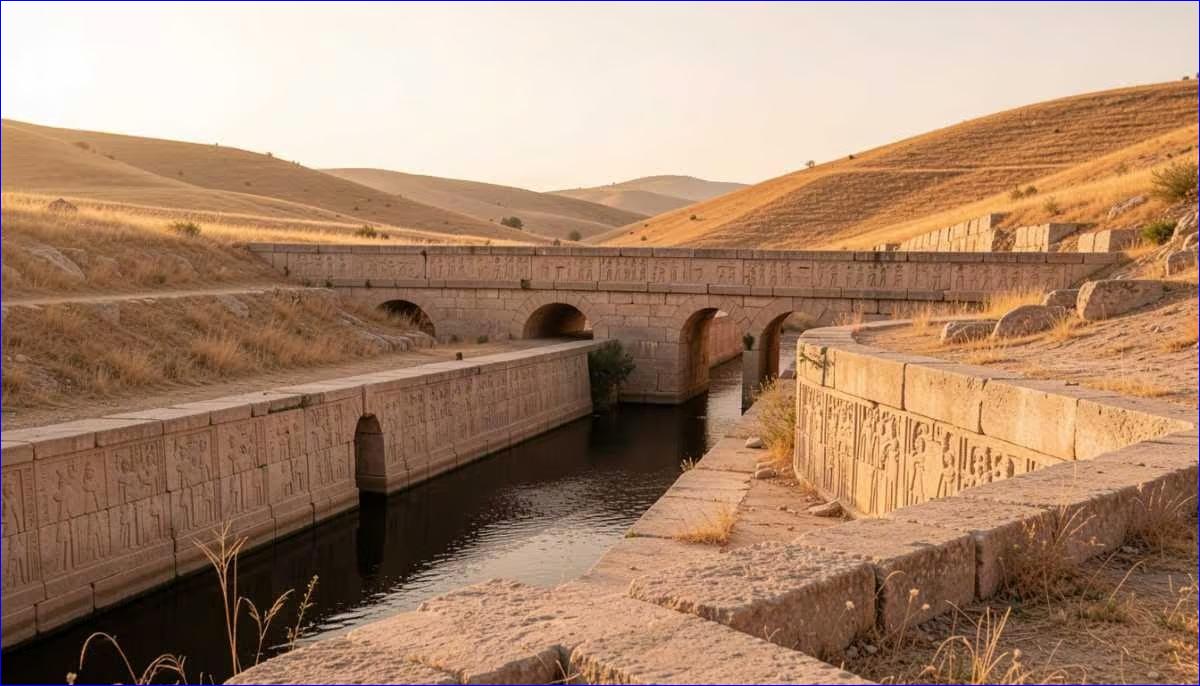
The opening of the Jerwan-Faida Archaeological Park, expected in late October, is seen as much more than the launch of a tourist site. This project has achieved a major milestone in the areas of archaeological preservation and international research. The Kurdistan Regional Government has also set up a long-term strategy for developing sustainable cultural tourism.
An Unprecedented Archaeological Landscape
Approximately 130 square kilometres will be encompassed by the new park, and it will be recognized as the largest archaeological park in both the Kurdistan Region and Iraq. By bringing together some of northern Mesopotamia's most significant historical landmarks--including the Faida canal, the Jerwan aqueduct, and the Khinis archaeological area--a collection of once-scattered sites is being transformed into a unified cultural landscape with international ambitions.
These ambitions are intended to extend well beyond the scope of regional tourism. Efforts are being actively pursued by Kurdish authorities to secure recognition as a UNESCO World Heritage site. Arguments are being put forward that the standards for exceptional historical significance, authenticity, and rarity are satisfied by this archaeological complex. Should this status be granted, the site would be placed among the world's most important protected cultural landscapes, and the profile of the Kurdistan Region would be further elevated as a destination where ancient history is deeply embedded within the modern environment.
Engineering Marvels of the Neo-Assyrians
The heart of an immense water management network, which was constructed during the Neo-Assyrian period in the eighth and seventh centuries BC, is preserved by the park. It is noted that fresh water was supplied by this canal system--stretching roughly 340 kilometres--from the mountains of present-day Duhok to the Assyrian capital near modern Mosul. This was done during periods when the waters of the Tigris River were considered unsuitable for drinking.
The remarkable engineering capabilities of the Neo-Assyrian Empire are illustrated by the sheer scale of this undertaking. Hydraulic infrastructure was transformed by imperial rulers into an essential instrument of urban development. Instead of reliance being placed solely on natural waterways, an interconnected network of canals, tunnels, reservoirs, and aqueducts was designed by Assyrian engineers. This system was capable of transporting water across incredibly rugged terrain. Valuable insights are still being provided by the surviving remains to archaeologists regarding how the expanding cities of one of the ancient world's most influential empires were sustained.
The Jerwan Aqueduct and Faida Reliefs
Among the landmarks that define the park, the Jerwan Bridge is widely regarded as one of the earliest known stone aqueducts. An advanced understanding of construction techniques, which existed centuries before comparable hydraulic works were developed elsewhere, is demonstrated by this structure. A rare opportunity is offered to visitors to examine ancient engineering at a monumental scale and to appreciate the sophistication of the infrastructure that once supported imperial administration and agriculture.
If the technical ingenuity of the Assyrians is revealed by Jerwan, then the discoveries made at Faida illuminate their political and religious world. One of the Middle East's most significant recent archaeological discoveries has been transformed by excavations conducted through a partnership between the Duhok Antiquities Department and Italy's University of Udine. An extraordinary sequence of monumental rock reliefs, which were carved along an ancient irrigation canal during the reigns of King Sargon II and his son, King Sennacherib, was identified by researchers in 2019. More than a dozen large reliefs are portrayed, showing the Assyrian ruler performing rituals before major deities, including Ashur, Ishtar, Shamash, and Nabu. These gods are depicted mounted on sacred animals, symbolizing divine authority and royal legitimacy.
A Painted Past and Future Preservation
The artistic significance of these reliefs extends beyond their iconography. During conservation work, traces of blue and red pigments were identified within the carvings. It was indicated by these discoveries that the monumental scenes were originally decorated in vivid colours rather than left as bare stone.
The legacy of these works is currently being protected with as much rigour as it was uncovered. Advanced three-dimensional laser scanning technologies are being employed by specialists from the University of Udine to record every relief and section of the canal with exceptional precision. These digital archives are being created not only to assist current conservation efforts but also to ensure that the archaeological record is preserved for future generations, even as original stone surfaces are affected by natural weathering.
Sustained Cooperation and Regional Growth
The project is the result of years of continuous international academic cooperation. The joint work of Kurdish institutions and Italian researchers has not only been an excavation but has also resulted in a comprehensive preservation plan that combines archaeological research, conservation science, digital documentation and heritage management.
The park is also part of a wider cultural policy implemented by the Kurdistan Regional Government. The region has over 6,000 registered archaeological sites and authorities have been increasingly focusing on restoration, documentation and responsible access for the public. As archaeological tourism is encouraged, sustainable economic diversification is sought through site management, hospitality and visitor services, and academic research. Hence, the Jerwan-Faida Archaeological Park is a gateway to understand, preserve and share with the world one of the earliest civilisations of mankind.
or register to post a comment.