


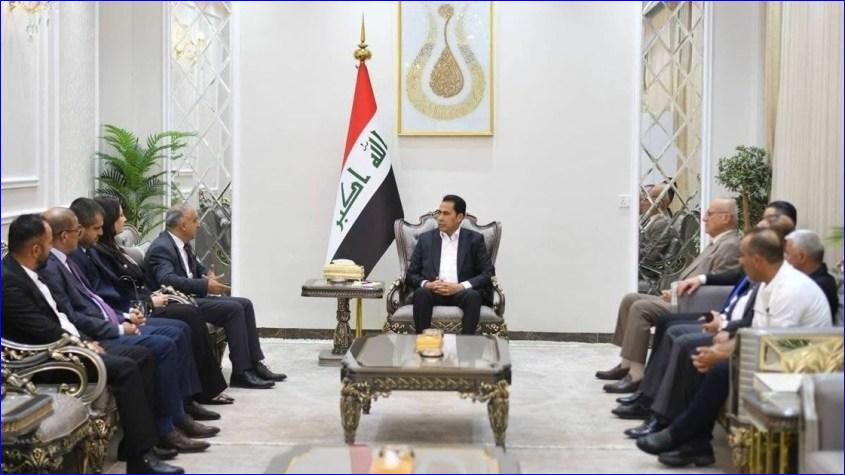
The joint delegation was headed by Secretary-General of the Assyrian Democratic Movement (Zowaa) Yakub Gorgis Yako, and included representatives of Zowaa, the Assyrian Patriotic Party, and Ronak Elias and Samer Khalid on behalf of the Beth Nahrain Patriotic Union (Huyodo d'Beth Nahrain Athroyo, HBA).
The delegation submitted a memorandum signed by the parties and another of the same content from the Council of Bishops of Nineveh demanding that the process of demographic change in Tel Keppe (Tel Kaif) if be halted, in particular the allocation of building lots within the Jaber bin Hayyan project and the Qawsiyat area. "Continuing with the project would have serious repercussions on the composition of the population and the historical rights of the Assyrian people of Tel Keppe and for the entire region for that matter," the delegation stated. It further said that "the projects violate the Iraqi Constitution and all applicable laws that have affirmed the state's protection of ethnic specificities and the prohibition of property acquisition and demographic change in their regions."
The delegation stressed "the importance of protecting the historical existence of our people in the Nineveh Plain, and the necessity of addressing the issues at hand according to legal and constitutional frameworks, in a manner that ensures justice and safeguards the legitimate rights of all components."
Nineveh Governor Abdul Qader al-Dakhil emphasized the importance of following up on these issues and working to resolve them, in a way that contributes to enhancing stability and reinforcing coexistence among the various components of the governorate.
The meeting comes as part of the ongoing efforts of Assyrian political parties to defend legitimate ethnic rights and follow up on matters related to the future of their people's national existence in their homeland, Beth Nahrin (Mesopotamia). Previously, the three parties issued a statement on the Tel Keppe in which they clarified that "the land distribution project -- consisting of 1,600 plots in Section (2) Qabr Maryam -- is fundamentally based on decisions issued by the dissolved Revolutionary Command Council in 1992 and 1993 during the years of the former dictatorial regime, aimed at creating demographic change in the regions inhabited by our people through the confiscation of agricultural lands belonging to the people of Tel Keppe."
It added that after 2003, Governing Council Decision No. 50, issued on 29 May 2003, annulled all laws, decisions, orders, and instructions issued by the Revolutionary Command Council and other official bodies of the former regime that were intended to alter Iraq's demographic, political, and population structure.
The parties said the renewed activation of the Jaber bin Hayyan land project -- including settlement procedures, road construction, and the designation of residential areas -- violates both the Iraqi Constitution and existing official decisions. They argued that the measures ignore the rights of original landowners and undermine the historical and national identity of the Assyrian community in its ancestral towns.
The statement also criticized the continued legalization of roughly 6,000 informal housing units built on agricultural land in the al-Qawsiyat area, saying the process reinforces a policy of imposing a fait accompli at the expense of the indigenous population and its historical and legal rights. The parties described the measures as part of broader demographic change policies that they reject on legal, national, and moral grounds.
The parties stressed that, "what is taking place today in Tel Keppe cannot be separated from the broader process of demographic change that the regions of Nineveh Plains have experienced over recent years, aimed at reducing the national presence of our Assyrian people through unconstitutional and unlawful projects and measures."
or register to post a comment.