


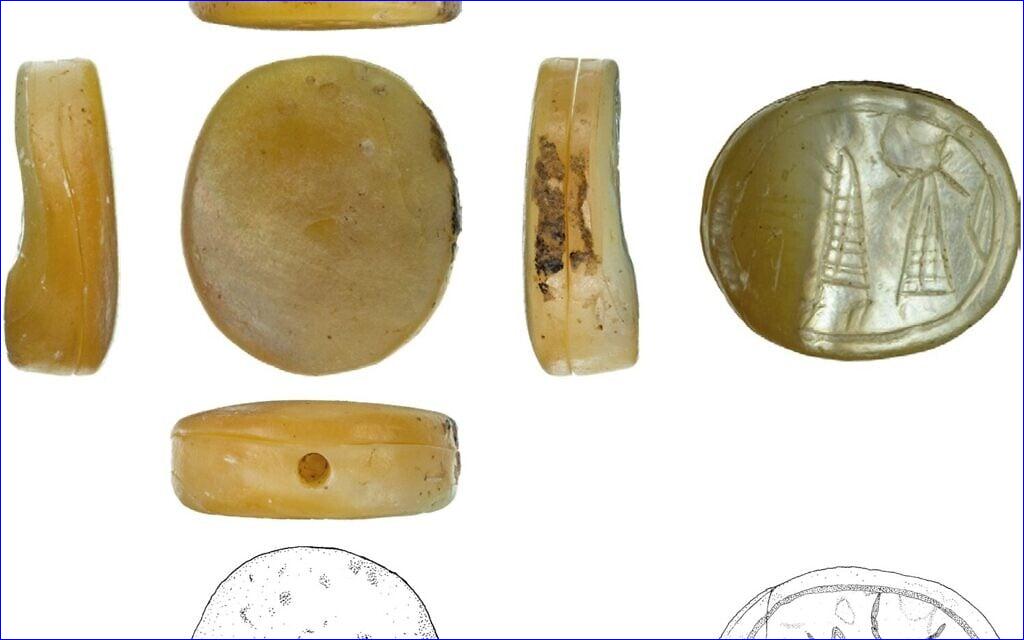
A tiny, iridescent stamp seal found at the Tel Hadid archaeological site in central Israel gives some clues into far-flung trade networks and offers a unique glimpse into life in the years after the ancient Kingdom of Israel was overtaken by the Assyrian Empire 2,600 years ago, according to a study published last month in the journal Levant.
While most seals found in the region are made of stone, this one was delicately fashioned from mother-of-pearl, a fragile substance made from the inner layer of a mollusk shell found thousands of kilometers away, according to the paper written by Tel Aviv University professor Ido Koch and graduate students from TAU's archaeology program.
This rare material, along with the imagery of a deity associated with northern Mesopotamia, suggests possible origins in trade and cultural networks.
"We were interested in understanding the chain of operations that led to the creation of this unique item and how it relates to interregional trade between the Indo-Pacific Ocean and the southern Levant," Koch told The Times of Israel.
"There was significant interest in the trade of seashells during this period, and some are quite beautiful," he said.
The seal was discovered in 2019 in a rock-cut refuse pit on the northeastern slope of Tel Ḥadid, about 25 kilometers southeast of modern-day Tel Aviv. The pit contained dozens of ceramic vessels, animal bones and other debris dating to the Iron Age, likely discarded after a destructive event that affected nearby homes.
One find stood out: an oval-shaped artifact, broken into two pieces, whose shimmering surface hinted at an unusual material. Researchers say the seal, measuring less than two centimeters in length, was carved from the shell of a Pinctada margaritifera, native to the Indo-Pacific.
While mother-of-pearl from such shells was highly prized in antiquity for its iridescent beauty, its use was extremely rare in Levantine seal production, and has not previously been documented in the regional corpus, researchers said.
"To the best of our knowledge... this is the only known stamp seal from the southern Levant produced from this material," Koch wrote in the paper.
Fine craftsmanship on a delicate material
Adding to the mystery, the seal appears to depict a symbol associated with the moon god of Harran, a deity whose cult originated hundreds of kilometers away in northern Mesopotamia.
This symbol was widely used throughout the Neo-Assyrian world and appears on seal impressions and other objects from the 8th and 7th centuries BCE, researchers said.
The moon god's emblem usually consists of a crescent mounted on a pole or standard. In some examples, worshipers stand before it in adoration.
The Tel Ḥadid seal appears to contain similar elements. One triangular figure may represent a worshiper facing the sacred symbol, while another shape may depict an altar or ritual object.
Microscope and chemical analyses of the artifact show that the craftsman likely used a bronze tool to engrave lines on the delicate material. The imagery is not entirely clear, however, and researchers believe the design may have been altered during the engraving process, the report said.
Examination of the seal showed that a hole running through its center was drilled from both ends with remarkable precision. The two tunnels met almost perfectly in the middle, creating a neat perforation that would have allowed the seal to be suspended on a cord.
That means its main purpose was not as an administrative tool, Koch said.
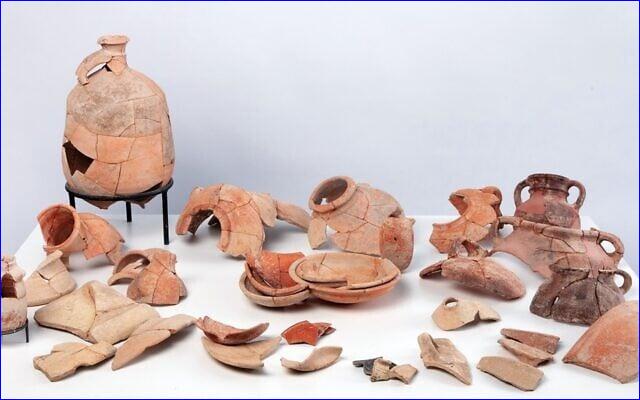
 Sasha Flit, Tel Aviv University)
"Most stamps of this sort functioned as amulets in antiquity," Koch explained. "It's kind of like wearing a pendant today."
The findings indicate several possibilities for the seal's origins, the paper concludes. It may have been manufactured remotely and imported, manufactured locally, or engraved locally on a prepared shell blank imported for this purpose.
"The available evidence does not permit these possibilities to be distinguished," the paper concluded.
Assyrian cultural spread
In any case, though, the artifact offers a window into the spread of Assyrian imagery and cultural influences throughout its kingdom as it conquered new territories, Koch said.
Following the Assyrian conquest of the Kingdom of Israel in the late 8th century BCE, Tel Ḥadid and its environs became part of a vast empire that stretched from Mesopotamia to Egypt.
The Bible (2 Kings 17) records that after the Assyrian king Sargon II conquered the capital of the Northern Kingdom of Israel in 722 BCE, he exiled the Israelite population and brought in foreign ethnic groups to dilute the regional identity.
Evidence of this policy, exhibited in other Assyrian conquests throughout the region, has already emerged at Tel Ḥadid, where archaeologists have previously uncovered cuneiform tablets recording economic transactions conducted according to Assyrian administrative practices, Koch noted.
Seen through this lens, the small seal offers a look at the movement of people, ideas and materials across the Neo-Assyrian Empire, the report found.
"Was the owner of this item someone who was brought from the northern Levant, or a local who was attracted to its iconography? I don't know," Koch said. "But all the possibilities allude to the interregional character of the society living there during the days of the Assyrian Empire."
or register to post a comment.