


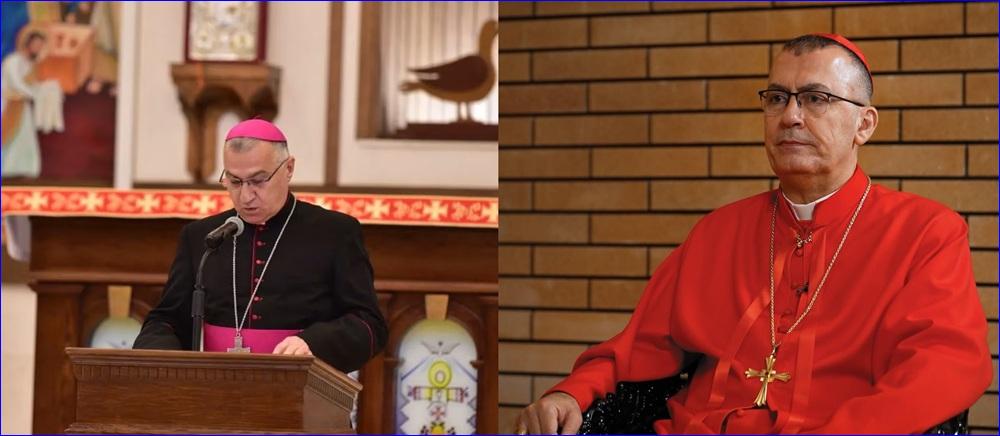
Chaldean Patriarch Paul III Nona (formerly Archbishop Amel Shamon Nona) was elected in April and formally installed at the Cathedral of St. Joseph in Baghdad in late May.
Speaking during a welcoming ceremony for the Chaldean patriarch at St. Joseph Cathedral in Ankawa, Warda said that choosing Ankawa as the first stop in Nona's visits outside his patriarchal eparchy carried a clear message to its people: "You are in my heart."
A Christian identity despite challenges
Warda recalled the deep Christian roots of the historic region of Adiabene -- today's Erbil and its surrounding areas -- and its Church, known for its leaders, martyrs, and perseverance amid persecution.
He particularly remembered the 1310 massacre at the Erbil Citadel, which forced Christians to flee to Mosul and to the towns and villages of the Nineveh Plain.
"Yet the faith was not extinguished," he said.
Ankawa's distinct place
The archbishop praised Ankawa for preserving its Christian identity across the centuries and remaining a living witness of perseverance despite persecution and hardship. By the 16th century, he said, Ankawa had become the only remaining village in the area with a large Christian population.
"In every trial our Church endured, Ankawa was a refuge whose doors were never closed," Warda said, especially during the forced displacement of 2014.
What happened in 2014?
The occupation of Mosul and the towns and villages of the Nineveh Plain by the terrorist organization ISIS caused the forced displacement of Christians, many of whom fled to the Kurdistan Region of Iraq. Ankawa and the towns and villages of the Chaldean Archeparchy of Erbil became among their most important places of refuge.
In his latest pastoral letter, Warda noted that within weeks in the summer of 2014, Ankawa received more than 13,200 displaced families. They were housed in churches, schools, parish halls, and homes of charity. The Joint Episcopal Relief Committee and the Chaldean Mercy Association helped organize the first response, providing temporary shelter, food, water, mattresses, and other basic needs in more than 26 small, medium, and large camps.
The people of Ankawa opened their hearts to welcome their persecuted brothers and sisters, and the town became home to the largest gathering of Christians in Iraq and a safe haven for them.
For years, Ankawa has faced several challenges related to political representation and public services. Many residents believe that the use of agricultural land for residential investment projects is contributing to demographic change and reducing green and cultivated areas. These concerns have grown with the spread of nightlife and entertainment venues in residential neighborhoods.
A deliberate exclusion
The Church believes it is unfair for Ankawa's young people to direct their frustration toward the Church over these issues. Warda stressed that since 2011 the Chaldean Church has been excluded from having the final word on matters concerning Ankawa and its future, despite being, as he put it, "the owner of the land, the history, and the people."
He pointed to several issues that concern public opinion in Ankawa, including the failure to appoint a permanent district mayor for nearly a year and a half "for unknown reasons."
Warda said the truth, which is hidden from those who blame the Church for Ankawa's situation and falsely accuse it of indifference or complicity, is that "our exclusion as a Church was deliberate, serving the narrow interests of beneficiaries at the expense of the good of the city and the future of its people."
"This is my testimony for history," he added. "I place it before God and before you."
He urged the Church's young people, whom he called "its hope and its tomorrow," to remain attached to their land, to work patiently, and to persevere in their demands, saying that their legitimate anger alone cannot build a future.
"Our father the patriarch is with us," Warda said, adding that "the truth will reach the attention of the Kurdistan Regional Government, which sincerely desires the survival and flourishing of Christians."
Warda also emphasized that the Church has not remained idle but has worked to serve its people in practical and effective ways through "achievements accomplished despite the circumstances, not because of them."
"Let actions speak for us, not words," he said.
He highlighted the archeparchy's catechetical programs for all ages, its active youth pastoral initiatives that help young people remain rooted in their faith and land, the construction of four new churches, three of them in Ankawa, as well as four schools, a university, a hospital, and Radio Maryam. Together, he said, these institutions provide more than 800 job opportunities for qualified residents of Ankawa, in addition to relief services and assistance to the poor and needy.
Ankawa includes about 75,000 Christians from the apostolic churches -- Catholic and Orthodox -- as well as evangelical communities. Today, Ankawa faces the challenge of preserving its religious character and safeguarding its historic identity.
or register to post a comment.