


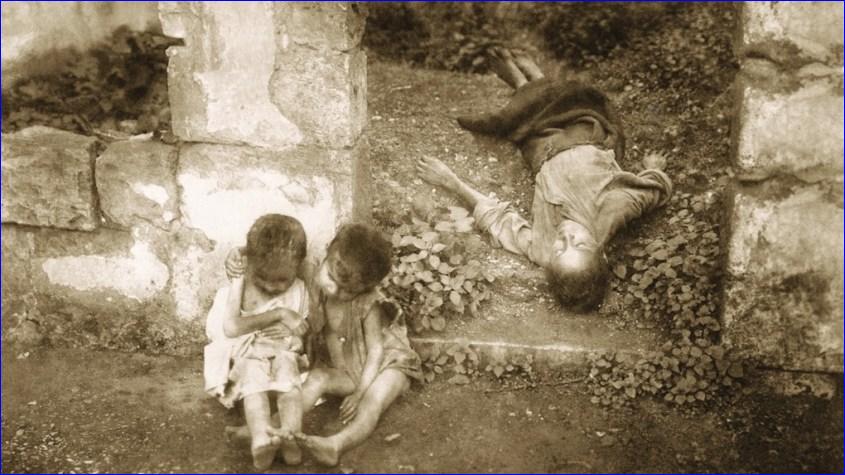
This deadly starvation campaign targeting Christians across Mount Lebanon occurred simultaneously with the Armenian, Greek and Assyrian genocides in Ottoman Turkey.
Many Lebanese Christian advocates are now trying to bring this largely forgotten atrocity to the international community's attention. One such advocate is Mario Dayba, a co-founder of "Christian Lebanon." This grassroots movement aims to rebuild the Lebanese Christian nation by uniting Lebanese Christians worldwide in support of sovereignty. Dayba says that their approach is based on subsidiarity, technology, human resources, and the mobilization of talents across both the diaspora and the homeland.
Related: The Assyrian Genocide
The movement for Christian Lebanon has launched https://syriac.now/ to revive their Syriac language and heritage. They are currently developing AI-based projects to build the first major digital center dedicated to Lebanese Christian history and civilization.
In addition, the website https://kafno.org was launched as a specialized initiative dedicated to reviving the memory of Kafno. It is building long-term awareness, research, and memorial efforts. The legal structuring, partnerships, and fundraising efforts for this initiative began in January 2026.
Dayba says that his community is escalating their efforts to help raise international awareness regarding Kafno. "For our people," says Dayba, "the word Kafno means the years when Mount Lebanon was slowly strangled between 1915 and 1918 under Ottoman rule, while entire Christian villages collapsed into death and silence."
Dayba answered the IDI's questions regarding Kafno, Mount Lebanon, the Syriac language, and the Maronite community of Lebanon.
1.Sadly, the world does not know much about Kafno. Who were the perpetrators and the victims? How many people were affected?
The victims were overwhelmingly represented by the Christian population of Mount Lebanon, especially the Maronites. Entire families disappeared. Villages were emptied. Children died in the streets and by church doors.
The Ottoman authorities, under Jamal Pasha and the Young Turk regime, imposed and enforced policies that perished around 200,000 to 300,000 people. Nearly half of the population of Mount Lebanon died!
2. What were the motives of the perpetrators?
Kafno did not happen in isolation. It took place during the same thirty-year campaign in which the Ottoman regime and the Young Turks targeted the Christian peoples of the region: Armenians, Greeks, Syriacs/Assyrians, and the Christians of Mount Lebanon.
Across the empire, ancient Christian populations were uprooted, massacred, deported, or starved into disappearance. In Mount Lebanon, the method was different because open massacres risked provoking European intervention. So starvation, siege, isolation, confiscation, and exhaustion became the weapon. The objective was the same: the destruction and weakening of a Christian people who were rooted in their ancestral land. This solution to their "Christian problem" resulted in over 3.5 million victims.
3. What were the consequences of Kafno?
The consequences were catastrophic and permanent. Half of the people died from starvation, disease, and social collapse. Entire villages lost huge portions of their population. Epidemics such as typhus and cholera spread among starving civilians. Thousands fled or emigrated forever.
Kafno shattered the demographic, economic, and psychological foundations of Christian Mount Lebanon. It left behind collective trauma, mass migration, orphaned children, destroyed families, and a wound that still lives in Lebanese memory more than a century later.
Kafno did not only kill people. It permanently altered the destiny of Lebanon.
In the aftermath of the famine, the borders of Greater Lebanon were expanded to include the agricultural regions of the Bekaa and the South in order to prevent another starvation catastrophe. But this transformed a largely Christian Mount Lebanon into a far more fragile demographic balance.
Since then, wave after wave of war, instability, emigration, and political erosion has steadily diminished the Christian presence, influence, and rootedness within its own historic homeland.
4. Do you think Kafno constitutes genocide?
Under the legal definition of genocide, deliberately inflicting conditions of life designed to destroy a population constitutes genocide.
In Mount Lebanon, Christians were subjected to organized famine, economic siege, forced conscription of able-bodied men, executions, the elimination of caregivers, and the use of agents to prevent food from reaching starving families.
These were systematic policies that brought mass death upon us.
5. Has any international genocide-research organization or government officially recognized Kafno?
To this day, no major international genocide-research institution or government has formally recognized Kafno as genocide. However, many Lebanese scholars, Maronite organizations, writers, and researchers openly describe it as such. They increasingly connect it to the broader Ottoman destruction of Christian minorities in the early twentieth century. A special mention to non-Lebanese scholars who researched and wrote about Kafno, among which Prof. Benny Morris, Melanie Tanielian, and Tylor Brand.
6. Has the government of Lebanon officially recognized Kafno?
No. The Lebanese state has never officially recognized Kafno as genocide, despite the scale of the catastrophe and despite the existence of memorial initiatives and growing public awareness.
7. Why do you think there is so little awareness about Kafno in the international community?
After WWI and the French mandate, Lebanon joined the Arab League and became part of the wider Islamic Umma, even if not officially declared as such. Systematically, new narratives were imposed in our schools, while the media was forbidden from openly discussing Kafno. Authors and journalists who raised their voices faced pressure, marginalization, or persecution. For three to four generations, Lebanese were raised on distorted versions of history blaming the locust infestation and the Allies for our genocide, while whitewashing the Ottoman's responsibility.
I do not blame our people. Since Kafno, Lebanese Christians have endured war after war, crisis after crisis, and were never truly left alone to rebuild themselves, preserve their memory, and demand recognition for what happened to their grandfathers.
8. What are the ambitions of your organization and the Maronite community regarding Mount Lebanon?
Our sole focus is the preservation and renewal of a strong Christian Lebanese nation in its historic homeland. After the fall of Jerusalem, Antioch, Alexandria, and later Constantinople, Mount Lebanon inherited the role of becoming the last major Christian stronghold in the East.
We believe Lebanese Christians have the legitimate right to protect their existence, identity, security, and future through self-determination. Our immediate goal is to stop the demographic, political, economic, and cultural collapse occurring under the current failed and corrupt system. We support serious discussions around decentralization, federalism, or special free-zone models. But our conviction remains that separation is the only long-term real protection of our people.
9. What is the identity of Mount Lebanon in terms of its language, ethnicity and religion?
At first, the region now known as Lebanon, Northern Syria, and Israel was known as the land of Canaan. Over centuries, three main peoples inhabited what is now Lebanon: the Canaanites, the Aramaeans, and the Amorites. The Greeks later referred to these peoples collectively as Phoenicians. Their language evolved through a mixture of Canaanite and Aramaic influences. The Canaanites also gave the region its alphabet and maritime civilization, which spread across the Mediterranean, North Africa, and parts of Europe.
With the advent of Christianity, the coastal cities of Lebanon adopted the faith very early through the preaching of the Apostles Peter, James, and Paul. Later, beginning around the 4th century, the Maronite faith spread deeply into Mount Lebanon and converted the pagan Phoenician populations of the mountains, giving birth to what became the Maronite people.
The language of the region evolved as well. Aramaic became heavily influenced by Greek theology, Christian liturgy, and biblical expression, eventually developing into what is known as Syriac, the historic liturgical language of the Maronites.
Today, Maronites proudly consider themselves as the direct descendants of the ancient Canaanite and Phoenician populations who embraced Christianity nearly two millennia ago. This continuity is supported not only by historical records and cultural continuity, but also by increasingly modern DNA studies which show strong genetic continuity with the ancient populations of the Levant.
10. What is the cultural significance of the Syriac language for Mount Lebanon?
I have been studying Syriac for the past few months, and I deeply regret not beginning years earlier.
To me, language is not just a communication tool. It is the memory, psychology, and collective consciousness of a people. Learning and teaching Syriac is therefore an act of cultural and spiritual decolonization. There is even a scientific principle related to this idea: the Sapir--Whorf hypothesis, which suggests that language shapes the way a person perceives reality and experiences the world.
Reviving Syriac is also a strategic necessity. Today, Maronites are scattered across the world speaking Arabic, French, English, Portuguese, and Spanish. Syriac can become once again the common civilizational thread that reconnects us across continents, the language of our grandfathers, our liturgy, and our memory.
or register to post a comment.