


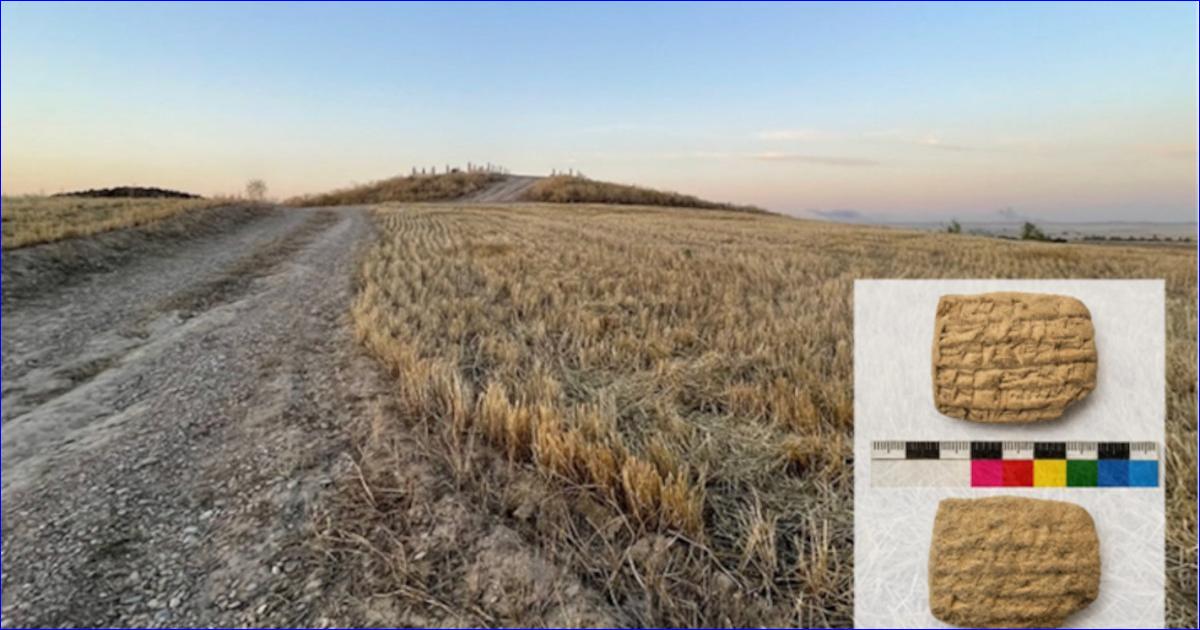
 Kurd Qaburstan Project/UCF)
The U. S. National Science Foundation supports the archaeological team, and the research is conducted in collaboration with the Directorate-General of Antiquities and Heritage in the Kurdistan region of Iraq. The series of funded excavations took place during two summer seasons in 2024 and 2025.
Historical Context Most historians classify Shamshi-Adad I, who reigned from 1809 BC to 1776 BC, as an Assyrian king because he ruled the city of Assur (as Governor) and appears in later Assyrian king lists. However, in origin, he was not ethnically Assyrian. Shamshi-Adad I was one of the most important early Assyrian rulers, but not the earliest known king of Assyria. He was an Amorite ruler who conquered Assyria and founded a powerful kingdom centered on Assyrian territory. He began his rule by consolidating his position in the upper Tigris Valley. One of his first official acts was enhancing the capital of Ashur and spreading Assyrian authority from the Zagros Mountains to the banks of the Euphrates River. The Kingdom of Mari would soon fall under his control. During Shamshi-Adad's reign, Hammurabi of Babylon was still consolidating power in Babylon and maintained diplomatic relations with the Assyrian ruler. Though Shamshi-Adad I commanded the most respect at first, a political upheaval occurred after he died in 1776 BC.
The fall of the Assyrian civilization occurred when it suffered assaults from several directions, and even its great capital of Ashur was captured by its Babylonian enemies. Later, the Assyrians fell under the dominion of a new kingdom led by Hurrian invaders to the immediate north of Assyria. Unfortunately, the centuries following Shamshi-Adad were less documented than later Neo-Assyrian history, though important textual and archaeological evidence survives. As noted, the modern understanding of Mitanni emerged through cuneiform discoveries made during the nineteenth and twentieth centuries. It is quite fascinating to learn that the Mitanni became renowned for their sophisticated chariot warfare and horse-training traditions.
Historical inscriptions describe multiple military campaigns against rival cities, including the city of Qabra. Archaeologists now believe the newly discovered evidence may represent one of several documented military conquests on the path to forge an extensive kingdom in the larger Mesopotamian region and even into the Levant.
Substantial Administrative Tablets Emerges Researchers recently recovered 20 cuneiform tablets and more than 100 administrative sealings from destruction layers within the Lower Town East Palace. These numerous artifacts are being studied by epigraphers Paul Delnero, working with Johns Hopkins University, and Parker Zane in cooperation with Yale University, along with art historian Marian Feldman, who works at Johns Hopkins University.
Preliminary readings suggest that one letter may refer to an official associated with Qabra. Researchers have also suggested possible links between the archaeological destruction layers and events described on Dadusha's Victory Stele.
Siege Warfare When making assessments of sieges, it is often difficult to describe the conduct of that type of warfare during the reign of Shamshi-Adad I, and especially after his passing. A series of excavations in the Greater Erbil region has revealed to archaeologists on site and throughout the scholarly community at large, examples of siege warfare, such as collapsed structures, burned layers, and concentrated debris, which suggest a coordinated and possibly prolonged assault.
Although separated by more than a millennium, later Assyrian siege reliefs from Sennacherib's reign provide valuable visual evidence for Near Eastern siege warfare traditions. The Assyrian King Sennacherib had already subdued all the fortified cities of the Kingdom of Judah except for Jerusalem. In the grand palace of Sennacherib (the Palace Without Rival), located at Nineveh, one can still find bas reliefs recording Sennacherib's campaign at Lachish, and these reliefs demonstrate how siege warfare was conducted by the Assyrians.
Sieges were only regarded as a last resort and avoided as much as possible. The reasons are broken down into two separate points. First, a direct assault would cause heavy casualties. Next, in the absence of an assault; the attacker would be forced to starve the defenders out. This tactic was tried in 701 BC, but the outbreak of an epidemic among Sennacherib's soldiers forced the King to withdraw. It's critical to note, though, that sources offer different explanations for Sennacherib's withdrawal, including disease, divine intervention, or strategic considerations. To the King of Judah, Hezekiah, it seemed that Yahweh had saved his city. Ironically, even though the Hebrews had once been slaves of the Egyptians, the Kingdom of Judah would at certain times have to choose between the rival powers of Babylon and Egypt. Judah preferred to side with Egypt.
Though Jerusalem evaded the grasp of the Assyrians, the same couldn't be said for the other Palestinian cities that defied Sennacherib. Special machines were built to fracture city walls, and assault troops advanced under the cover of archers and slingers. Further, roofed battering rams on wheels were defended by archers who were positioned on top in select turrets, where they picked off defenders stationed on the city walls. This tactic was implemented due to the enemy archers' attempting to burn the machines with torches or trying to dislodge the rams with chains. Other siege tools in the Assyrian toolbox were scaling ladders and earthen ramps, which were constructed so that battering rams could roll up and demolish the upper enemy defenses. These siege techniques would allow the Assyrian infantry to rush up and enter the city. A final siege tool was burrowing under or through the enemy fortifications, in addition to burning wooden gates down.
Within the destroyed palace layers, researchers have discovered the remains of 17 individuals. The research on this element of the excavations was examined by bioarchaeologist Andrea Zurek-Ost at Michigan State University.
Researchers were able to uncover a preserved street with an engineered drainage system, along with domestic spaces used for food processing and textile production. This evidence points to sophisticated infrastructure and economic activity.
Survey Reveals Extensive Fortification During the extensive work and research undertaken at this site, the team completed a magnetometer survey covering about 180 acres. This survey measures changes in Earth's magnetic field to detect buried structures. Andrew Creekmore III led this segment of the research on-site in coordination with the University of Northern Colorado.
The survey revealed a monumental wall with bastions encircling the site. The same fortifications correspond with those depicted on the Victory Stele of Dadusha and strongly support the identification of Kurd Qaburstan with ancient Qabra.
Giving a New Light into the History of Northern Mesopotamia Since the deciphering of cuneiform tablets in the 19th century, the region known as Mesopotamia in antiquity has often been associated with southern cities like Uruk, in part by established research and by those who trace biblical understanding in connection with Abraham. Southern Mesopotamian cities such as Uruk and Ur often dominate public attention, while northern Mesopotamian centers have received comparatively less attention outside specialist scholarship. These recent discoveries at Kurd Qaburstan are helping rediscover the incredible historical value of Northern Mesopotamia.
In Conclusion For decades, historians relied principally on royal inscriptions and victory monuments to understand how Mesopotamian warfare was conducted. At Kurd Qaburstan, archaeologists have now uncovered the physical remains of a city called Qabra that appears to have experienced exactly the kind of sieges described in numerous ancient texts, such as the Assyrian siege of Jerusalem in 701 BC. This evidence includes burned buildings, abandoned archives, unburied victims, and shattered defenses. This discovery offers one of the most complete archaeological snapshots currently known for a Middle Bronze Age city destroyed during warfare.
or register to post a comment.