


A Community at the Crossroads
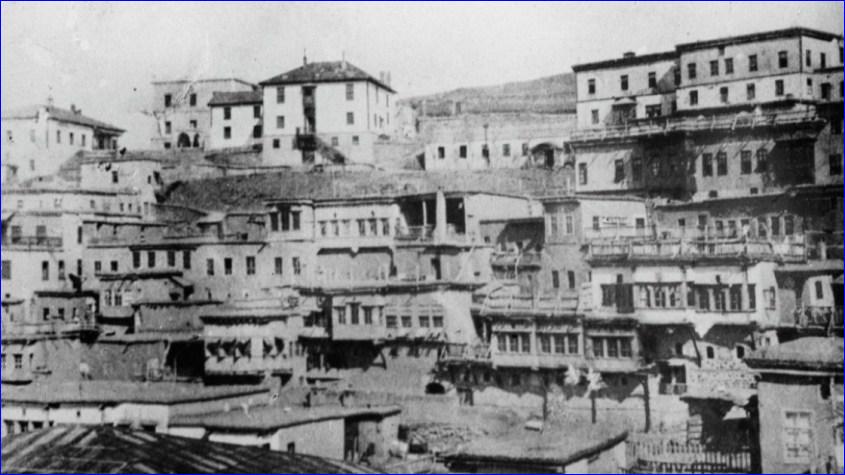
Khartbert's Syriacs were neither monolithic nor isolated. They belonged to the broader family of Ottoman Syriac Christians -- a population that scholars estimate at roughly 619,000 before the First World War -- and within that family they represented a distinct local tradition. In Khartbert, they lived in a recognizable quarter, the "asorwots tagh," where Syriac households worked as craftsmen, dyers, and merchants, and where a handful of wealthier families owned notable properties and gardens. The community's economic life was visible in the city's markets and in a specialized textile craft known as "red Syriac chintz," a canvas decorated with red and black flowers red-dyed fabric prized across the region.
Related: The Assyrian Genocide
Religious life anchored identity. The Syriac Orthodox Mart Maryam Church stood as the spiritual heart of the quarter, its services conducted in Classical Syriac even as most laypeople no longer spoke the language in everyday life. Pilgrims -- Christian and Muslim alike -- came to the church seeking cures and blessings, a reminder that sacred places could cross confessional lines in practice even when communal boundaries remained firm.
Language, Education, and the Millet System
One of the most striking features of the Khartbert Syriacs was their linguistic profile. For generations many had shifted from Aramaic to Armenian and Turkish as their primary spoken languages. Armenian, in particular, functioned as a public tongue: it was the language of schools, newspapers, and much of the community's written life. Syriac script survived in liturgy and in occasional Garshuni texts -- Armenian or Turkish written in Syriac characters -- but the living vernacular had largely changed.
This linguistic shift was shaped by the Ottoman millet system, which recognized communities by confession rather than by language or ethnicity. Syriac Orthodox Christians were often administratively grouped with Armenians, a reality that eased some civic interactions but also blurred distinctions and created tensions over representation and property.
Education became both a battleground and a bridge. Syriac children attended Armenian and missionary schools, and a small but vibrant local press published periodicals in Armenian, Turkish, and Garshuni. These institutions fostered literacy and civic engagement but could not insulate the community from the political storms to come.
Cultural Life and Intellectual Ferment
Khartbert produced a surprising number of Syriac intellectuals and activists who wrote in Armenian, Turkish, and Syriac script. Figures such as Ashur Yusuf, a Protestant teacher and editor, embodied the hybrid cultural world of the town: educated in missionary institutions, fluent in Armenian literary forms, and committed to a Syriac sense of national belonging. Local periodicals -- some produced by clergy, others by lay intellectuals -- debated language revival, education, and the community's future. The pages of journals like Babylon and Assyrian Progress reveal a community wrestling with loss, aspiration, and the practicalities of migration.
Women's associations and female schools also emerged in the early twentieth century, signaling a social transformation. A ladies' association founded a girls' school that by 1912 enrolled dozens of students and employed female teachers. These developments show how Syriac civic life had modernized in ways that mirrored neighboring Armenian communities.
Shared Fate with Armenian Neighbors
When the Ottoman state moved against Armenian populations in 1915, the Syriacs of Khartbert found themselves caught in the same machinery of dispossession and deportation. Local decrees ordered the exile of Armenians and Syriacs, and the practical problem of distinguishing one group from the other complicated the implementation of those orders. Syriac boys were forced to gather abandoned Armenian property; waves of arrests and expulsions followed. For many Syriac families, the result was dispossession, forced flight, and death -- a fate that paralleled and intersected with the Armenian catastrophe in the same districts.
Survivors who escaped often did so by joining existing diasporic networks. From Worcester and Boston to Fresno and Los Angeles, Khartbert Syriacs reconstituted communities in the United States, publishing newspapers, founding associations, and preserving fragments of liturgy, memory, and manuscript culture. These expatriate networks became custodians of a vanished local world and of the stories that might otherwise have been lost.
Why This History Matters
Recovering the Khartbert Syriacs' history restores texture to the record of 1915. It reminds us that that the discussion of genocide and mass violence should not overly focus on numbers and statistics, but also the particularities of daily life -- the dye-works by the brook that no longer function, the schoolroom debates now silenced, the pilgrim's candle at Mart Maryam that, once extinguished, will not be relit.
Today, scholars and descendants draw on archival records, periodicals, and oral testimony to reconstruct that world. Their work matters because it refuses the flattening of history into statistics and instead insists on the human scale: the craftspeople, teachers, priests, and children whose lives were interrupted. In telling the Syriacs of Khartbert's story we honor those lives and sharpen our understanding of how communities survive, adapt, and sometimes vanish under the pressure of politics and war.
or register to post a comment.