


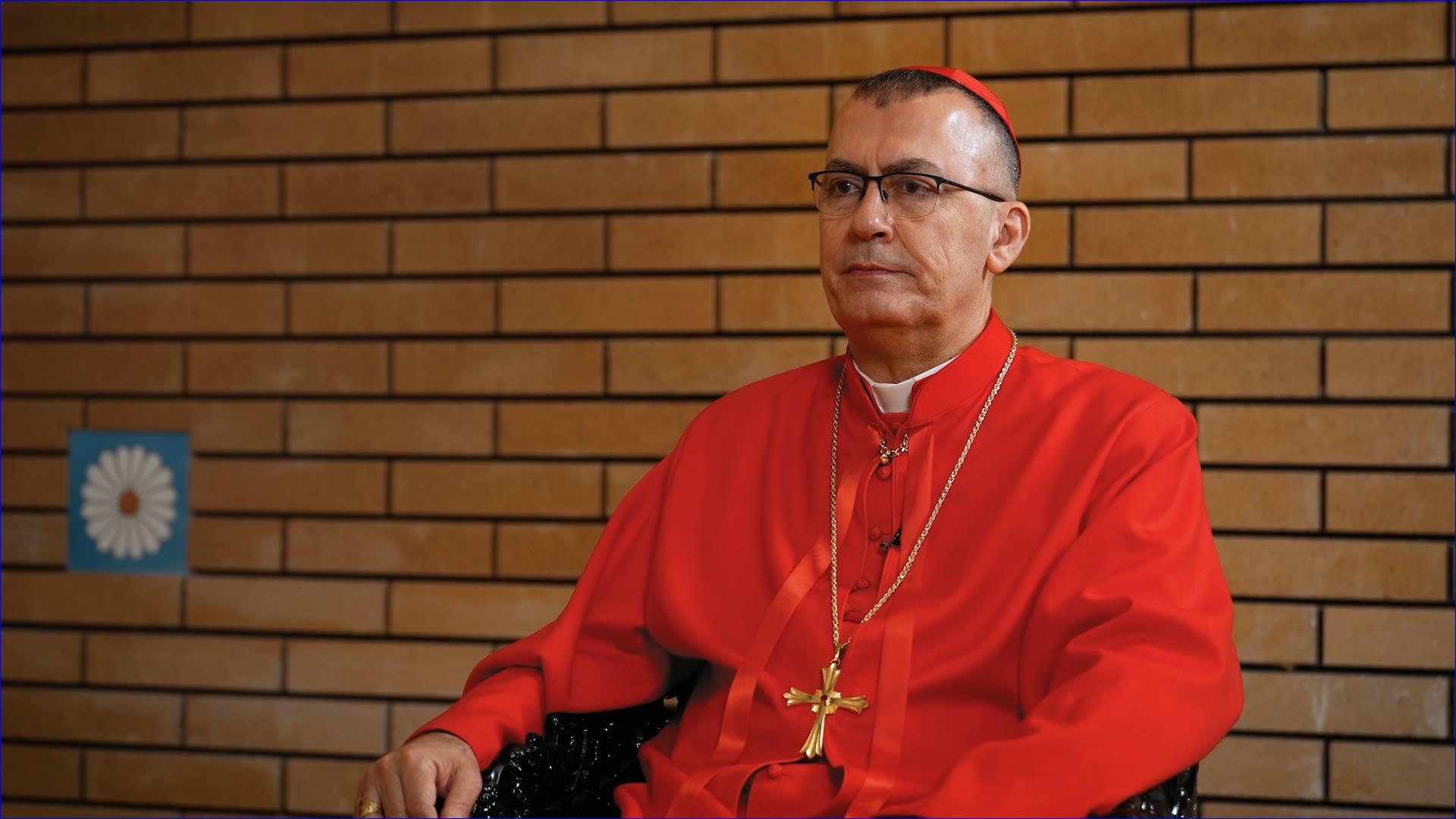
In an exclusive interview with EWTN News, the new Chaldean patriarch described his return to serve as patriarch in his homeland more than a decade after leaving it as part of the Church's mission of service.
"The Church sends us wherever there is a need," he said. "We served in Mosul during difficult years, when the Church needed us there. We do the same whenever the Church sees a need for our service in another place. The purpose of our service is to fulfill our mission: to be wherever the Church sends us and to do the will of Our Lord in that place."
Nona served as bishop of the Chaldean Eparchy of Mosul in extremely difficult circumstances for nearly four years, before the city fell to terrorist groups in 2014. He accompanied the displaced faithful of his eparchy and continued serving them in the villages and towns where they took refuge after their displacement. In 2015, the Chaldean Synod appointed him to serve the Eparchy of Australia and New Zealand, where he remained until his election as patriarch this past April.
Speaking about his experience in Mosul, Nona said the years before ISIS as well as the period marked by the terrorist group's advance shaped him deeply.
"I think the experience of Mosul before ISIS, and also the experience with ISIS, enriched my personality and made me more mature as a person and as a Christian," he said.
He recalled living with the faithful in Mosul during a very difficult period, saying their faith was "very strong." He also described the displacement of Christians to the Kurdistan Region of Iraq as a painful but spiritually powerful experience.
"It was sad to see all these people in that situation," he said. "But on the other hand, it was very good to see that their faith was the first and most important thing for them."
Fear and faith
Asked about his patriarchal motto, "Do not be afraid, just believe," Nona said fear is not limited to the Middle East but is present throughout the world.
"I believe that fear is the most common aspect in all the world, not just in the Middle East," he said. "I lived in Australia, in what we can call the Western world, and the fear there is the same as here -- of course, with different challenges. But there is always fear. So we have to face our fear with faith."
Safeguarding rights and dignity
Asked about the expected relationship between the new patriarch and Iraq's new government, whose formation coincided with his installation, Nona said the Church has historically defended the rights of its faithful and remains committed to participating in building the country on sound and legal foundations that respect the dignity of all people and freedom of religion.
He highlighted the Church's essential role in society wherever it is present, through educational, healthcare, and other institutions, as well as through serving its people and working to secure their rights and protect their dignity.
Challenges of being rooted in faith
Regarding the challenges facing members of the Chaldean Church in diaspora countries -- whether in terms of being rooted in the faith and preserving identity or in facing moral challenges -- Nona drew on his experience of service in Australia. He stressed that confronting these challenges, and succeeding in doing so, is possible by deepening the meaning of faith in the lives of believers, especially among new generations born and raised in diaspora countries.
He said the challenges facing young people have pushed their families to return to the Church. When these young people come to know their faith properly and hear meaningful answers to their complex and important questions, he said, they give the Church strength and support and become the strongest defenders of its faith and identity.
On strengthening dialogue among the three Churches that share the heritage of the Church of the East today, and on efforts toward the desired unity, the Chaldean patriarch said that a true relationship of human fraternity is the foundation of unity and common action.
While stressing respect for the different traditions and distinct heritage of each Church, he said the shared heritage and tradition of the three Churches open doors to joint work in cultural and liturgical fields while respecting the particular identity of each.
Magnifica Humanitas
Nona also addressed the issue of artificial intelligence and its threat to human dignity, citing Pope Leo XIV's recent encyclical Magnifica Humanitas. He stressed the need for technology to remain at the service of the human person and human dignity, and to be used properly to promote a sound humanity built on upright values and principles -- not one that demeans human beings and their dignity or encourages violence.
He encouraged people to read and study the pope's teaching, saying its timely importance led Leo to choose it as the subject of his first encyclical.
Peoples longing for peace
Nona assumes his responsibilities amid the current challenges facing the Middle East, which he described as complex and painful. Wishing peace and stability for the countries and peoples of the region, he said: "I believe and think that all the peoples of the Middle East want to live in peace and security. Years of wars, divisions, and violence have exhausted them."
Asked where he sees the future of the region heading amid ongoing conflict, Nona said major changes appear to be underway in the Middle East.
"Something is happening now that will change the Middle East a lot," he said. "We hope it will be for the good, not for the bad. So we pray that everything will be good."
He said taking on any responsibility in such a complex situation is a serious matter that requires responsible discipline in words and actions, directing them toward achieving peace and stability and defending the rights and dignity of peoples.
On the possibility of Christians returning to the Middle East, Nona said their return and continued presence depend on peace, stability, and a genuine sense of citizenship.
"When there is peace in this region, when there is stability, when they feel that they are citizens of this land and of these countries, they will come back, and they will stay here," he said. Asked whether he hoped Christians would one day return, he replied: "I hope that. Of course, we pray for that also."
A message to Catholics in the West
Nona also addressed Catholics in the West, asking them first to pray for the Chaldean Church.
"We need them to pray, because we are all Christians and Catholics," he said. He also asked them to learn more about the Chaldean Church and the reality of Christians in the Middle East, and to help support efforts that allow Christians to remain in the region.
He emphasized the role of Chaldean youth, and Christian youth in general, as the foundation of the Church and a firm pillar of its mission. He stressed the need to give young people the place they deserve in the Church.
Nona concluded with a message to Christian youth, based on his personal experience: "Our Christian faith is our foundation, our strength, and our life. In the Chaldean Church, we live it through our Chaldean identity, distinct in language, liturgy, and tradition. The closer young people come to knowing their identity of faith in its proper form, the more they will become a tremendous force of faith and humanity, capable of defending faith and humanity."
In a final message to Catholic youth around the world, Nona said: "Prayer is the most important thing. And also try always to live your faith with joy."
or register to post a comment.