


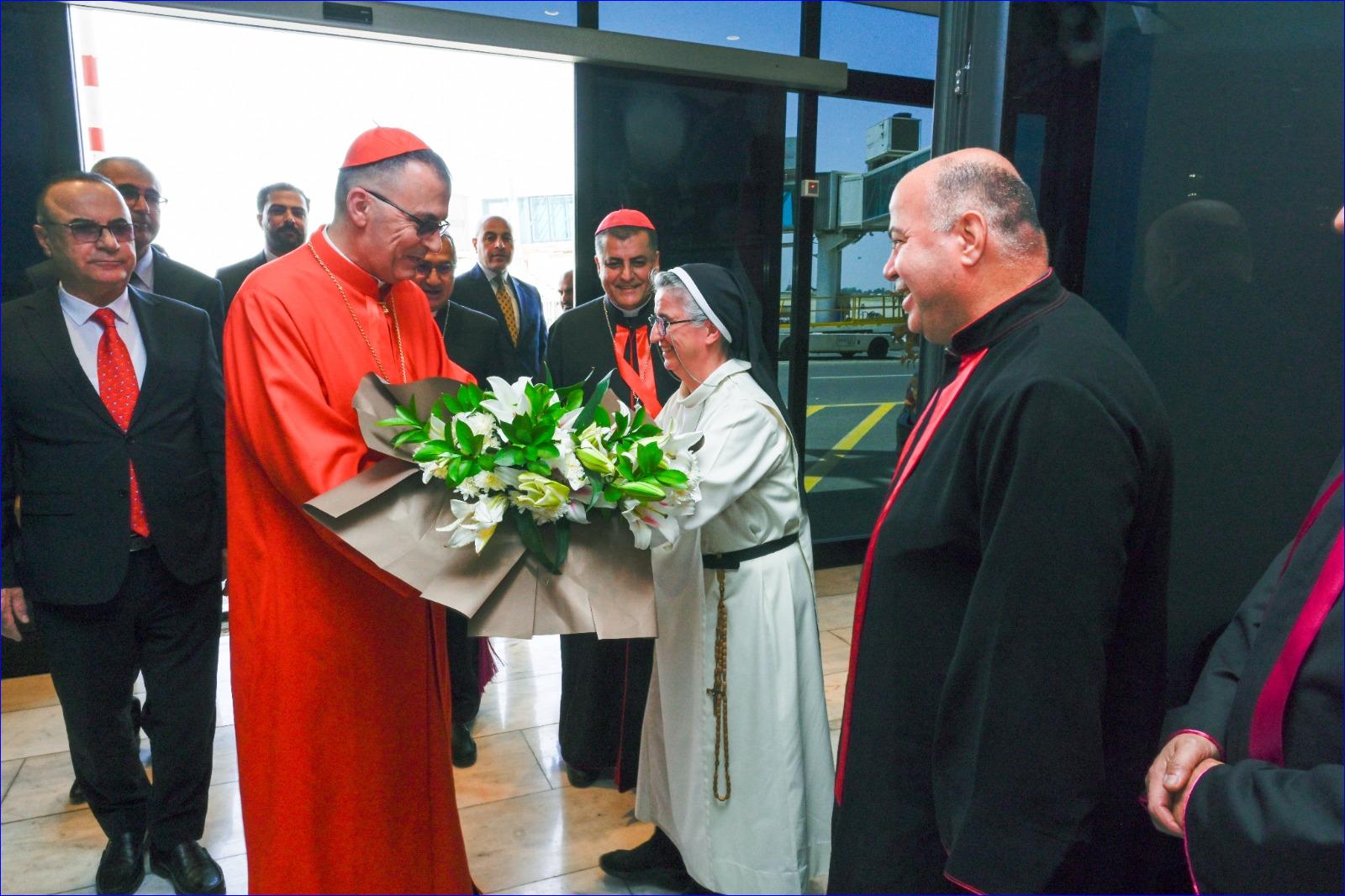
Born in 1968 in Alqosh, in northern Iraq, Patriarch Nona is a leading figure in the Chaldean Church. Since 2009, he has served as Archbishop of Mosul, succeeding Bishop Paul Rahho, who was killed in 2008, guiding the community through one of the darkest periods in its history: the rise of ISIS in the summer of 2014 and the displacement of hundreds of thousands of Christians from the city and the Nineveh Plain. He was subsequently appointed Eparch of St Thomas the Apostle of Sydney for the Chaldeans in Australia, expanding his pastoral responsibilities within the diaspora communities.
The Chaldean Catholic Church descends from the Church of the East, tracing its origins to ancient Mesopotamia and to Saints Mar Addai and Mar Mari, disciples of St Thomas the Apostle. The patriarchal see is located at St Joseph's Cathedral in Baghdad and comprises several eparchies and dioceses in Iraq and around the world. The faithful number over 600,000, the majority (around 300,000) in Iraq, although at one time the number exceeded 1.3 million. Since the US invasion of Iraq in 2003, the majority have chosen to flee, swelling the ranks of the diaspora communities. Below is the full interview with Patriarch Nona for AsiaNews:
Your Beatitude, when Pope Leo XIV met you at the start of the Synod, he expressed the hope that "the new patriarch would be, above all, a father in the faith and a sign of communion with all and amongst all". What is the meaning of these words and how do you intend to put them into practice?
The Holy Father expressed a very profound vision, directing all of us towards what needs to be done for our Church. He certainly intended to emphasise that the Patriarch is the father of all, despite differences of opinion and diversity among people, but must look after everyone, without distinction. This call is important today in the Church in general, and in our Chaldean Church in particular, especially given the current situation in the Middle East, which is experiencing great difficulties. In this sense, it is not easy to maintain unity, but it is an essential task: the new patriarch's most important responsibility is to be a father to all.
In recent years, the Chaldean Church has experienced moments of tension and internal divisions, even amongst its bishops. How important is the Pope's call for unity?
The path towards unity had already begun to emerge during the synod that led to my election. There was a profound reflection on what had happened in the past, on the lessons to be learnt from those events. And then to move forward, trusting in God's will, which is also what our Church and our people desire. It is simply not possible, in the current situation--which affects the whole world but above all the Middle East--for there to be divisions within the Church. I believe the most important work has already begun during the Synod, which I view in a positive and constructive light: everyone spoke openly about the various issues and what we must do for the future.
Patriarch Nona, referring to what you have just emphasised: what are the main challenges and priorities in this initial phase?
Honestly, there are several outstanding issues: we must first and foremost look to the Church in Iraq and the Middle East in general, to its needs, whilst maintaining good relations amongst ourselves, working for the priests and the faithful, making them understand that our Church belongs to everyone and that the Patriarch is for everyone. Then there are also relations with the other Catholic and Orthodox Churches; we need to work on this aspect, which is very important because we are a minority in these countries, so it is all the more urgent that we be united as Christians. Finally, there are other unresolved issues concerning the diaspora and links with communities around the world, from Australia to the United States, Canada and Europe. These are all challenges we must face; there is no shortage of work!
Coming from Australia, where you have lived for the past 11 years, you are first and foremost the Patriarch of the 'diaspora'; but you are also the bishop who has personally suffered the tragedy of the Islamic State in Mosul. How do these two elements influence your mission?
I thank God for the experiences I have had in my life as a bishop. In the diocese of Mosul, with everything that happened after the ISIS invasion [and the mass exodus of Christians to Iraqi Kurdistan, ed.]. Then in the diaspora in Australia, with our people who have chosen to migrate and live different experiences, fostering connections between people or with the Church. It is a huge challenge because we have generations in the diaspora who know nothing of their country of origin. So we must find that common ground, bringing out what is shared between our homeland, the Middle East, and these new realities, whilst also taking into account their respective differences. Because the situation varies depending on whether we are talking about Europe, Australia, the United States or Canada. For the younger generations, it is important to rediscover the connection with their homeland, but the vast majority of our faithful in the diaspora are themselves first-generation migrants--people born in Iraq, Syria or Lebanon who need to maintain this bond.
The atrocities committed by ISIS represent one of the darkest chapters for Christians in the Middle East; they are perhaps the culmination of an escalation of persecution and killings.
What is the state of the Christian community in Iraq today, and what are relations with Muslims like?
I have only just arrived, so I am currently trying to gain a deeper understanding of the situation and learn more about the issues and urgent needs. Certainly, relations with Muslims, but also with the faithful of other religions, will be one of our priorities, because we must work on the basis that they are citizens of this country, of this land. This is why I believe it is very important to cultivate good relations. I too had forged bonds with many Muslims in Mosul, and that experience made me realise the importance of working, today and even more so tomorrow, to strengthen interfaith dialogue and relations with Islam.
In the weeks since your appointment, have you received messages from prominent figures in the Islamic world in Mosul?
Certainly! They are tokens of esteem that have given me great pleasure, but I prefer to keep them private.
Mosul, incidentally, is the city that has paid the heaviest price in terms of bloodshed: how vivid is the memory of your predecessor, Bishop Paul Faraj Rahho, and of Fr Ragheed Ganni, both killed in different circumstances by extremists? How relevant is their message of sacrifice and martyrdom today?
The first and most important message is that love is stronger than hate. Respect is stronger than hatred and the denial of others' rights. Fr Ragheed and Bishop Rahho sacrificed their lives for this message. Love is stronger than pain, than those who annihilate humanity, than those who create only pain and hatred. This message is still relevant today, just as their memory remains within the Christian community. In recent years, I believe the city and its inhabitants have learnt that we must work for the good of others, not hate. I believe the situation in Mosul today is better than it was before 2014: reconstruction is underway, work is being done, even if it is a long road.
Your Beatitude, why did you choose the motto "do not be afraid, believe"?
During my time in the Diocese of Mosul, I often thought that fear was linked to persecution, the lack of rights, and violence. However, when I moved to Australia, within the diaspora communities and in the Western world, I discovered just how strong and ever-present the element of fear was there too. A fear of everything, from death to other people, of being abandoned, of not having good relationships with others, of illness. Ours is a world that lives immersed in fear. That is why I believe that this very issue represents, today, the greatest challenge across the globe. In this sense, Christ's message is all the more valuable: do not be afraid, but nurture your faith; respond to fear with faith in Jesus.
Iraq is often at the centre of regional tensions and proxy wars between Iran and the United States (and Israel); these days we are witnessing the laborious birth of a new government. What kind of country did you find on your return?
I arrived just a few days ago and do not yet have a clear picture of the situation, but I sense among the people a great desire for normality, to return to living in peace. People are tired of war, of this hatred between nations, of conflicts, of internal tensions within Iraq or with other countries in the region. This desire to live a normal, everyday life is the strongest feeling I have seen so far.
Your Beatitude, there is one week to go until your installation Mass. To conclude this interview, I ask you: how important is it to try to preserve the Christian presence in Iraq and the Middle East, and what message do you wish to send?
For the message to the Christian community, I refer you to the Mass on 29 May, which will be an opportunity to speak to the entire Chaldean community, in Iraq and in the nations of the diaspora. We certainly want to work for the good of Iraq, for our country, for our neighbours and, above all, for Christians. From this perspective, it will be essential to stem the exodus and ensure a presence in the future.
or register to post a comment.