


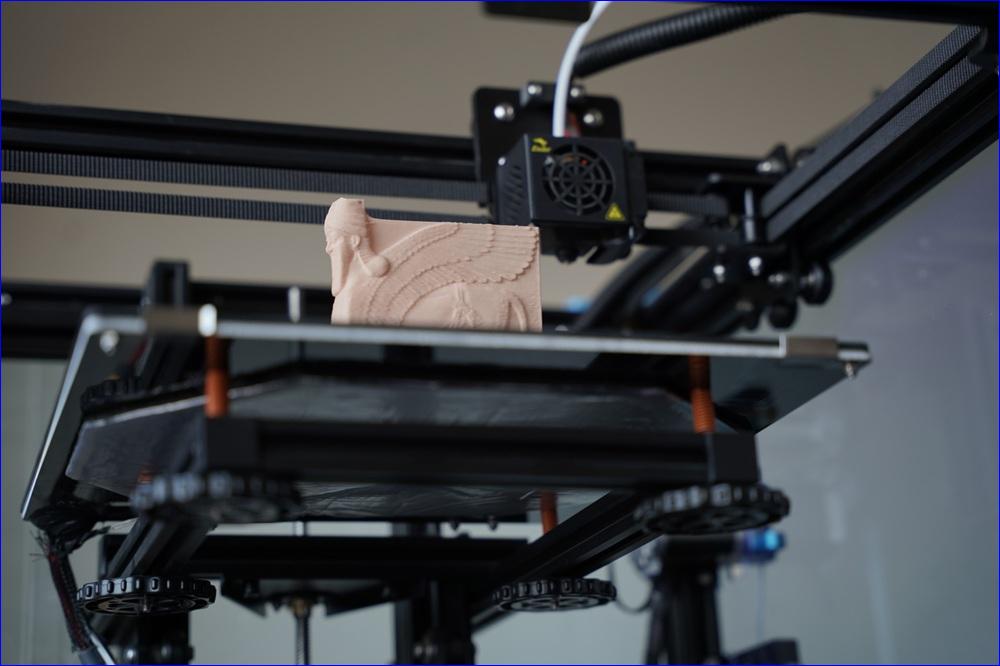
For Yahya Mohammed, watching war tear through Mosul's fabric was a personal wound that sharpened into a professional calling.
"Since I was an architecture student, I needed 3D models for my department," Yahya explains, his eyes still carrying the excitement of someone who cannot quite believe his own story. "I couldn't stop thinking about this idea -- why not use modern technology to build these models?"
Iraq's architectural heritage runs deeper than old. It is ancient in a way that few places on earth can claim. The land between the Tigris and the Euphrates gave birth to the first urban civilizations, to the ziggurat and the courtyard house, to the towering ambitions of the Abbasid Caliphate, when Baghdad was the beating heart of the known world.
Mosul itself sits on layers of memory that stretch back thousands of years. Minaret and arch, carved stone and muqarnas: this was never mere decoration. It was identity.
Then came 2014. Daesh swept through northern Iraq, and Mosul fell. What followed was a human catastrophe with a cultural dimension just as devastating. Monuments that had survived empires, invasions, and centuries of upheaval were deliberately erased.
By the time the city was liberated in 2017, much of what had defined it -- physically, historically, spiritually -- was rubble.
Yahya was finishing his architecture degree when liberation came. He had seen what destruction looked like up close. He had also just discovered 3D printing.
"I enrolled in several courses and competitions," he recalls. "In one of those courses, I won first place, and as a result, I was awarded a 3D printer."
It was a single machine. But it was enough to begin.
In 2019, Yahya founded Imagine 3D -- a Mosul-based company that transforms digital designs into precise physical models using 3D printing technology. From architectural scale models and heritage replicas to custom prototypes and spare parts fabrication, the company offers a range of services that sit at the intersection of technology, design, and craft.
In the early days, Yahya worked alone, project by project, building a client base and a reputation at the same time. The market for 3D printing in Iraq was, at that point, almost nonexistent.
One of Imagine 3D's first major milestones came through a collaboration with QAF Lab, Al-Noor University, and the Baytuna Foundation, which launched the first tactile museum of its kind in Iraq -- an exhibition featuring precise 3D-printed models of Ninewa's historical and cultural landmarks.
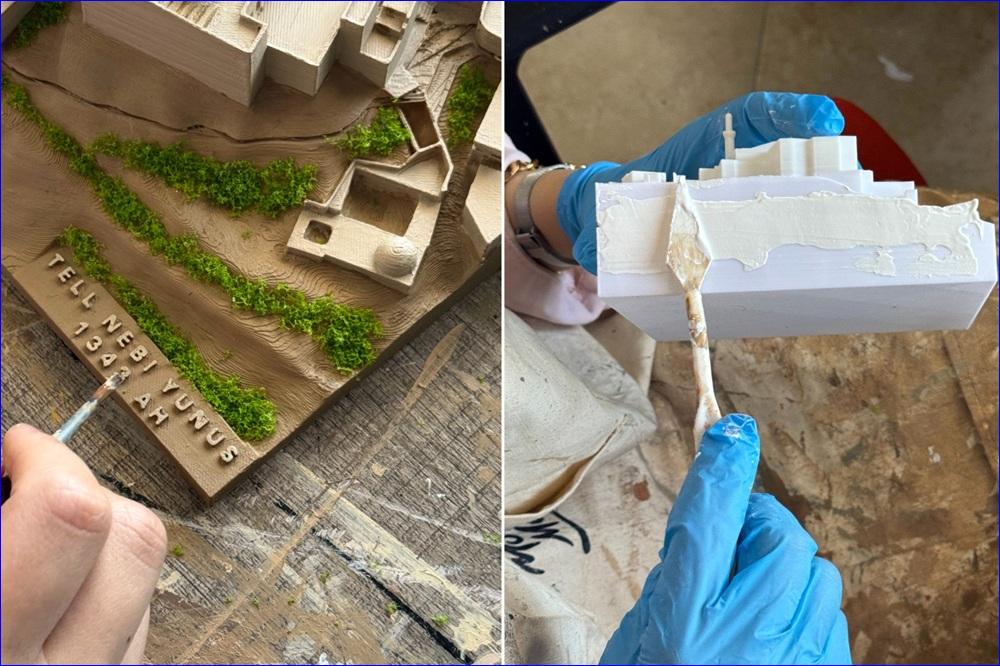
For many visitors, it was the first time they had been able to hold, in their hands, a piece of heritage that had seemed forever lost. Yahya's machines had made memory tangible.
By 2023, Yahya aspired to expand his business. Still, like many small enterprises in Iraq, Imagine 3D faced the challenge that every ambitious entrepreneur in a post-conflict economy is often confronted with: access to capital.
"Access to capital in Iraq is limited or non-existent," Yahya says simply. "It's very difficult for businesses to find funds to start or grow."
That changed in 2025, when Imagine 3D received a grant through the International Organization for Migration's (IOM) Enterprise Development Fund Innovation (EDF-i), supported by the German Federal Government via the German Development Bank (KfW) -- a programme designed specifically to support technology and digital start-ups and small businesses in Iraq.
"It was an excellent grant that allowed us to scale up the work," Yahya says. "We now have more than ten 3D printers and a team of nine employees."
Those nine positions -- in 3D design, machine operation, and production -- represent exactly the kind of skilled, technology-focused employment that remains difficult to find in post-conflict Mosul.
Within six months of receiving the grant, Imagine 3D's sales nearly doubled and its customer base grew significantly. The support also opened doors that capital alone cannot buy. Imagine 3D participated in ITEX, Iraq's premier technology exhibition in Baghdad -- a platform that connected the company with new clients and placed a Mosul start-up firmly in the national conversation about innovation.
Shortly after, in November 2025, IOM selected Imagine 3D among five EDF-i businesses to represent Iraq at the Saudi Startup Expo in Riyadh, where Iraqi entrepreneurs entered a regional pitch competition for the first time.
"It was exciting to explore the latest trends, network with investors, and understand new markets," Yahya reflects. "Overall, it added a lot to us."
He came home with contacts, ideas, and potential partnerships with Saudi companies now under discussion. A regional expansion, once an abstraction, is now a plan being mapped.
Back in Mosul, the printers run. Models of ancient gates and mosque facades take shape layer by layer, hour by hour. Yahya still thinks like the architecture student who first imagined all of this -- someone who understood, before almost anyone else in his city, that the best response to destruction is to rebuild.
Yahya's story is one of more than 120 businesses the EDF-i programme has financed to date, since 2020, collectively creating 555 jobs across the country.
"Our next goal," he says, "is to establish a solid presence in the regional market while expanding our client base and enhancing our company's technical, human, and production capabilities on all levels."
The road is long. But in Yahya's workshop, the past and the future are printed side by side -- proof that innovation, in the right hands, can be its own form of resilience.
or register to post a comment.