


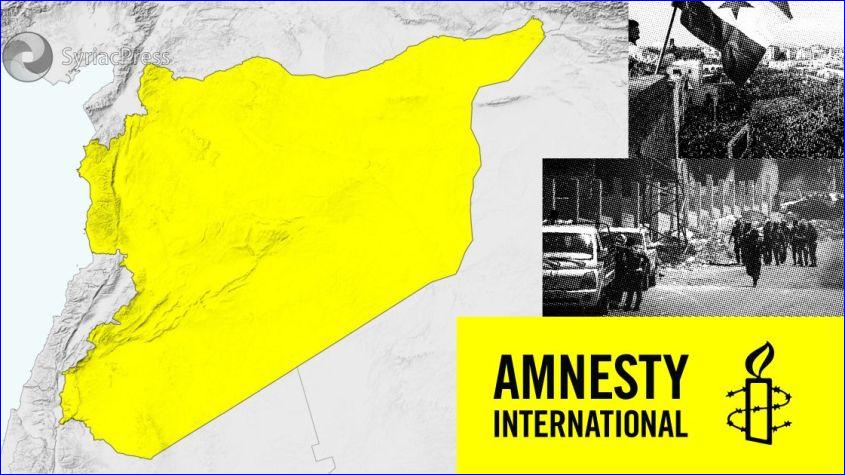
In its section on Syria, Amnesty addressed the fall of the Baathist regime of Bashar al-Assad and the subsequent formation of a government led by Ahmad al-Sharaa. The report also documented massacres affecting Alawite and Druze communities in Suwayda and along the Syrian coast, including killings, kidnappings, and the burning of property.
The report further referenced the bombing of the Greek (Rûm) Orthodox Church of Mar Elias in the Douileh neighborhood of Daramsuq (Damascus), which resulted in more than 25 deaths and over 60 injuries, according to the Syrian Ministry of Health.
Amnesty also noted an agreement between al-Sharaa and Mazloum Abdi, General Commander if the Syrian Democratic Forces (SDF), providing for the integration of institutions of the Democratic Autonomous Administration of the Region of North and East Syria (DAARNES) into state structures.
The organization pointed out that most sanctions on Syria have been lifted by the European Union, the United Kingdom, and the United States. However, it stressed that the humanitarian crisis remains severe, with more than 16 million people in urgent need of assistance. Funding for the United Nations humanitarian response plan has reached less than 10%.
According to the report, the US's sudden suspension of a significant portion of its humanitarian funding in January led to the closure of some medical facilities and human rights organizations, as well as cuts to food aid and staffing levels among local NGOs.
Amnesty added that although new civil society organizations and independent media outlets have begun operating in Daramsuq and other areas after years of restrictions under the former government, repressive legislation remains in place, including laws that allow prosecutions related to freedom of expression.
Regarding the judiciary, the report stated that while the government has taken limited steps toward reform, the appointment of judges remains under executive control, the death penalty has not been abolished, and international crimes have yet to be incorporated into the constitution.
At the same time, the Ministry of Justice announced the annulment of at least 287,000 rulings issued by anti-terrorism and military courts under the Assad regime. These included verdicts based on charges commonly used to criminalize basic rights, such as insulting the head of state, insulting the army, and participating in protests.
On transitional justice, Amnesty reported that the National Transitional Justice Commission has pledged to address violations committed by all parties, not only the former regime.
The report also highlighted the issue of enforced disappearances, noting that families of the missing have organized demonstrations across Syrian cities, demanding action to uncover the fate of their relatives, recover remains, and hold perpetrators accountable. The number of forcibly disappeared persons is estimated to exceed 100,000 between 2011 and 2024.
Amnesty further documented arbitrary arrests of individuals from the Alawite community without warrants or clear charges, often accompanied by denial of access to legal counsel.
A dedicated section of the report examined massacres along the Syrian coast, stating that government forces and allied militias carried out an offensive resulting in more than 1,400 deaths in Latakia, Tartous, and Baniyas, citing findings by the United Nations Commission of Inquiry on Syria. The violations included killings, torture, inhumane treatment of the dead, widespread looting, and the burning of homes, primarily targeting the Alawite community.
Although a Syrian government fact-finding committee identified hundreds of suspects from both government-affiliated forces and armed groups linked to the former regime, the report noted that authorities have neither published the findings nor taken action against those responsible.
Regarding events in Suwayda, Amnesty stated that clashes in July 2025 between Druze armed groups and Bedouin tribes escalated into widespread violence, including killings, abductions, displacement, and destruction of property affecting Druze and Christian residents.
Finally, the report highlighted worsening environmental conditions, noting that Syria experienced its lowest rainfall levels in three decades. The resulting drought caused a 40% decline in wheat production, further exacerbating food insecurity, which now affects more than half the population.
Farmers have called on the government to rehabilitate agricultural infrastructure, promote drought-resistant crops, adopt water-efficient farming methods, and invest in sustainable agriculture. However, Amnesty noted that no significant steps were taken in this regard during the year.
or register to post a comment.