


The modern date, 1 April, was chosen because it is close to the vernal equinox in the ancient Mesopotamian calendar. Despite the coincidence, the celebration has no connection to the Western tradition of April Fools' Day.
As Lucian of Samosata expresses it: "Among all the festivals in Syria, Akitu was the greatest. Under Arab rule it was called Al Mahhtaba."
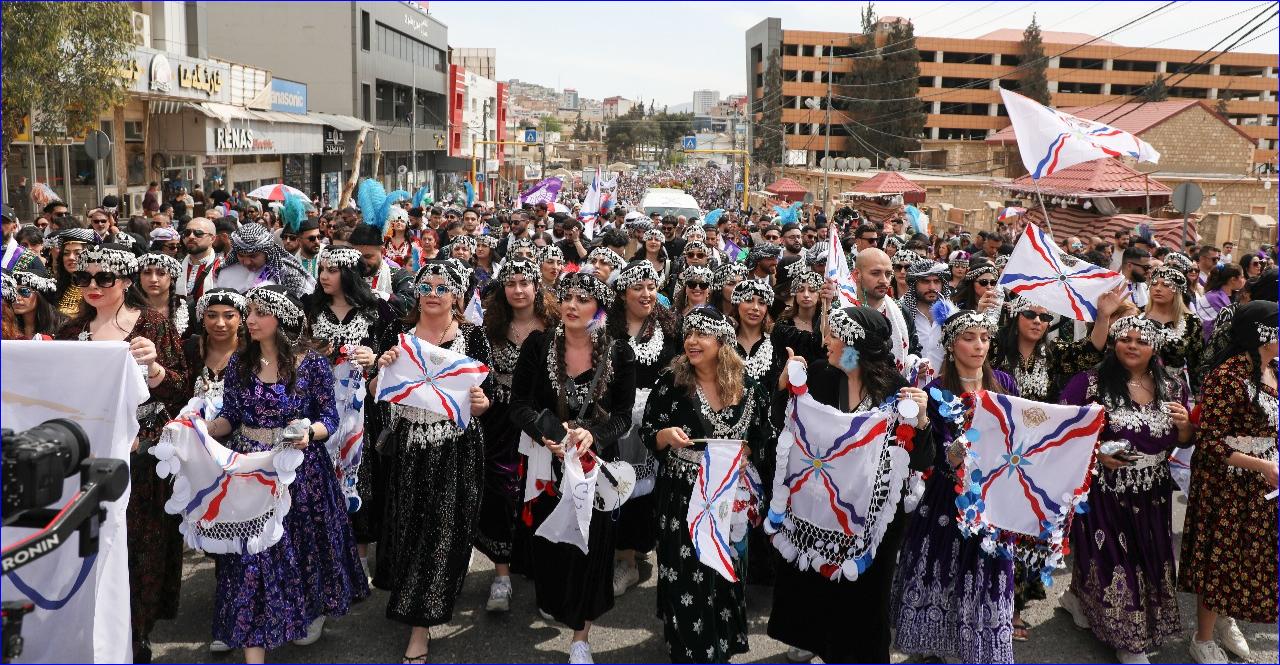
Today, Akitu is celebrated around the world, especially in the diaspora, with parades, traditional clothing, music, dance, and Assyrian flags.
Akitu in Ancient Mesopotamia In ancient Babylon, Akitu was celebrated over 12 days and consisted of religious, political, and cosmic rituals symbolizing the renewal of the world.
The celebration began with prayers and purification rituals during which priests recited parts of the creation epic Enuma Elish. These ceremonies aimed to secure the protection of the gods for the new year.
A central part of the celebration was the retelling of how the god Marduk defeated the chaos force Tiamat -- a symbolic act in which order triumphs over chaos.⁷ This was followed by the king's ritual trial, during which he publicly submitted to the will of the gods.
In the middle of the festival, statues of gods from different cities were gathered in Babylon, symbolizing a divine council that determined the fate of the world.⁹ The celebration culminated in processions in which Marduk's statue was carried to the Akitu temple, accompanied by festivities with music, dance, and offerings.
Finally, Marduk returned to the temple, marking that the cosmos had been restored and that a new year could begin.⁵
From Religion to Tradition -- Akitu and Christianity When the Assyrians began adopting Christianity during the first century AD, the celebration gradually changed. The Church replaced many of the old rituals with Christian holidays, and Akitu lost its central religious role.
At the same time, several elements lived on within Christian tradition. Symbolism and ceremonies can still be traced in ecclesiastical expressions, such as:
- The scepter in the hands of the patriarch
- Liturgical vestments
- Ritual purification
- Psalm singing
A particularly interesting parallel is the celebration of Palm Sunday, which in Akkadian was referred to as Gish Tamaru ("festival of the palm tree"). This connection between palms, processions, and religious symbolism clearly demonstrates continuity from ancient traditions to Christian celebrations.
Scholars such as Simo Parpola (2000) and Jean Bottéro (2001) have emphasized how several Mesopotamian religious elements continued in later religious practices, particularly through symbols, rituals, and calendar festivals.
During the Middle Ages and later under the Ottoman Empire, Assyrians were subjected to severe persecutions and massacres. This led to Akitu surviving primarily in private homes and village communities.
Revival in the Diaspora During the 20th century, Assyrians spread across the world through emigration to Europe, the United States, and Australia. In exile, Akitu gained new significance as a symbol of identity and belonging.
Initially, the celebration took place in homes, but over time Assyrian organizations began arranging public celebrations. Parades, festivals, and cultural events became important expressions of community and continuity.
Today, Akitu is an international celebration that unites generations and strengthens ties to historical heritage.
Enuma Elish and the Meaning of Creation Akitu is closely connected to the Babylonian creation epic Enuma Elish, in which the world is created out of chaos through Marduk's victory over Tiamat.⁶ The narrative reflects a cosmology in which order emerges through struggle.
In this tradition, humanity was created from the blood of a defeated god in order to serve the gods.⁷ This differs significantly from the biblical creation account, in which humans are created in the image of God and are given a more elevated role.
The similarities between these accounts demonstrate a shared cultural background in the ancient Near East, while the differences reflect distinct theological perspectives.
Conclusion Akitu is more than a New Year celebration, it is a living symbol of survival, identity, and cultural resilience. Despite millennia of change, religious transformation, and historical trials, the tradition has been preserved and developed.
From ancient temples in Babylon to modern parades in the diaspora, Akitu continues to unite people with their history and culture. It is a celebration of both the past and the future -- a reminder of a heritage that has never been lost.
or register to post a comment.