


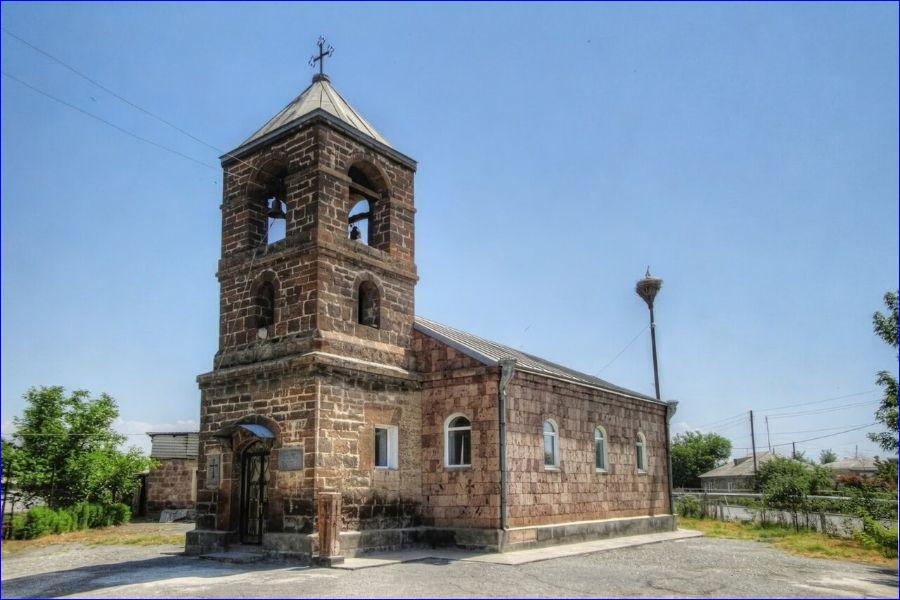
 Vahe Martirosyan)
Assyrians are indigenous to Mesopotamia, where they have lived for thousands of years. Historically, they were settled mostly in areas that now form modern-day Turkey, Syria and Iraq. Assyrians speak Neo-Aramaic varieties and practice Christianity; however, they are divided among several churches, including the Ancient Church of the East, the Assyrian Church of the East, the Chaldean Catholic Church, the Syriac Orthodox Church, the Syriac Catholic Church, the Assyrian Evangelical Church and the Assyrian Pentecostal Church. The group has faced persecutions and massacres throughout its history, particularly under the Ottoman Empire -- which carried out a genocide known as Sayfo -- and by ISIS militants.
One of the few places where Assyrians have been able to live in relative peace is Armenia. Assyrians arrived in the Caucasus during the 19th century, when the Russian Empire defeated the Persian Empire in two wars. At the time, most of present-day Armenia and Azerbaijan was part of the Caucasian khanates, semi-independent entities under the sovereignty of Persia's Qajar dynasty. During the conflict, Assyrians living on Persian territory -- mainly in Iranian Azerbaijan -- assisted the Russian army and fought for St. Petersburg. As a result, Emperor Nicholas I viewed them as useful allies. After the Treaty of Turkmenchay in 1828, Russia allowed hundreds of Assyrian families to relocate from Iran to newly acquired territories. Most settled in the Armenian Oblast, later reorganized as the Yerevan Governorate.
Between the 19th and early 20th centuries, more Assyrian families -- mainly from the Ottoman Empire -- settled in Russian Transcaucasia after leaving their homelands. World War I brought a significant influx of refugees from Anatolia and Iran, as the Ottoman government -- aided by some Kurdish tribal forces -- carried out mass killings of Assyrians in what is known as the Assyrian genocide.
In 1886, there were 1,800 Assyrians in Armenia, but the number rose to 2,500 in 1914 and 3,280 in 1939. During the Soviet period, they lived in relative stability in the Armenian Soviet Socialist Republic, where their population reached 6,183, according to the 1989 census. However, the dissolution of the Soviet Union negatively affected the community. The newly independent Republic of Armenia faced severe social and economic difficulties, prompting high levels of emigration. As a result, thousands of Assyrians left the South Caucasus for Russia, Ukraine, North America and Western Europe in search of better opportunities.
or register to post a comment.