


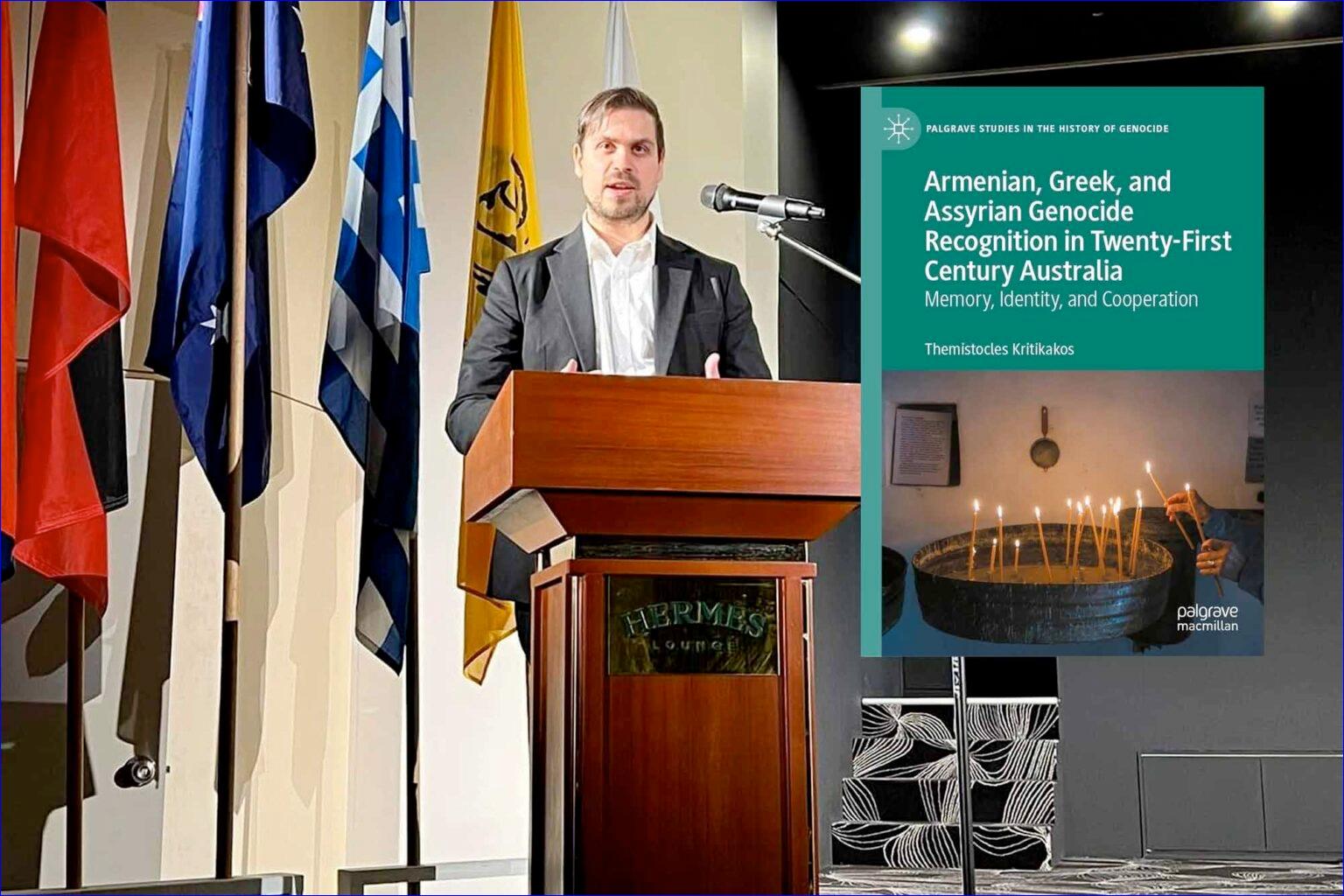
Historian Dr Themistocles Kritikakos will present his latest book, Armenian, Greek, and Assyrian Genocide Recognition in Twenty-First-Century Australia: Memory, Identity, and Cooperation, at a public seminar at the Greek Centre in Melbourne on Tuesday, 10 March.
Related: The Assyrian Genocide
Published by Palgrave Macmillan in January 2026, the work offers what scholars describe as the first comprehensive comparative analysis of how the legacies of the Armenian, Greek and Assyrian genocides of the late Ottoman period (1914--1923) have been remembered and discussed in Australia.
During the event, Dr Kritikakos will outline the central themes of his research before joining Professor Joy Damousi for a discussion exploring questions of historical justice, intergenerational memory and cooperation between communities whose histories of suffering have often been treated separately.
Exploring overlooked histories
A key focus of the book is the uneven international recognition of the genocides. While the Armenian Genocide has achieved widespread global acknowledgment, the mass persecution and destruction of Greek and Assyrian communities during the same period remain far less widely understood.
Dr Kritikakos examines how these histories have been remembered by diaspora communities, drawing on oral interviews with descendants of survivors as well as scholarship in genocide and memory studies. His research explores themes of silence, trauma and commemoration, and how once separate community narratives are increasingly converging into shared campaigns for historical recognition.
The book also highlights Australia's historical connection to these events. Australians were not merely distant observers during the period of violence; soldiers, journalists and humanitarian workers witnessed and documented atrocities, while Australian relief organisations provided assistance to refugees and survivors across the region.
However, the study argues that Australian national narratives shaped by Gallipoli and later reconciliation with Turkey have often created tensions around genocide recognition, influencing how these histories have been publicly discussed.
Academic background
Dr Kritikakos holds a PhD in History from the University of Melbourne and has worked in both academic and professional roles. His research interests include modern Greek history, diaspora studies, historical memory and the politics surrounding genocide recognition.
The Melbourne seminar forms part of the Greek History and Culture Seminar Series, hosted by the Greek Orthodox Community of Melbourne and Victoria, which regularly brings scholars and historians together to explore issues connected to Hellenic history, identity and diaspora experience.
Event details
The launch will take place at the Greek Centre, 168 Lonsdale Street, Melbourne (Mezzanine Level) on Tuesday, 10 March at 7:00pm and is open to the public.
The evening is sponsored by Mary Tsaganas, in memory of her mother Olympia and ancestors from Asia Minor.
or register to post a comment.