


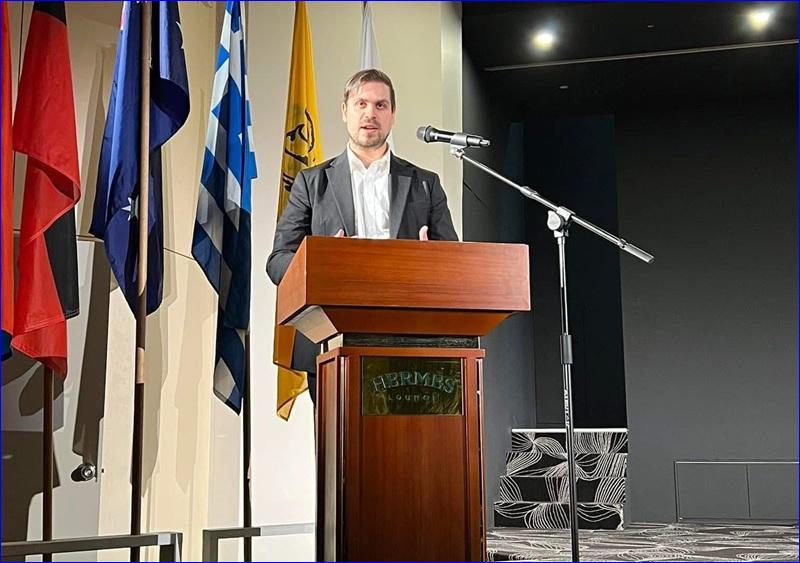
Dr. Kritikakos is a writer and historian born and raised in Melbourne. He holds a PhD in History from the University of Melbourne, where he has served in both academic and professional roles.
Related: The Assyrian Genocide
His Greek heritage stems from his mother, whose family comes from Kastellorizo, and his father, whose family is from Elos, a village near Sparta. His research focuses on memory, diaspora communities, and the politics of genocide recognition in Australia.
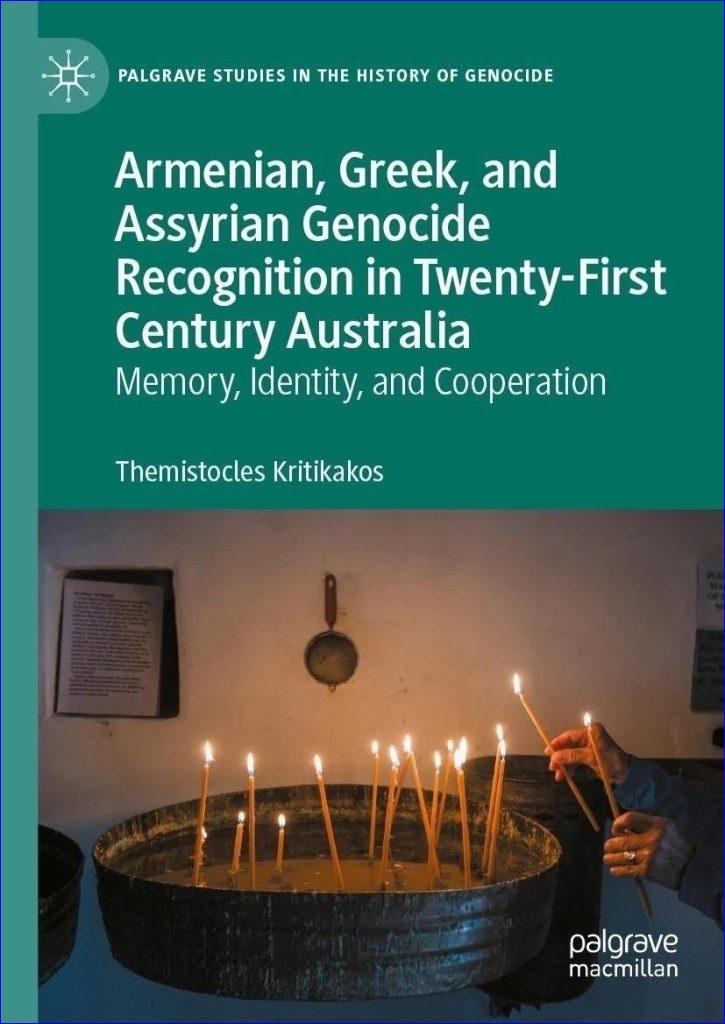
With a deep passion for history, he revealed in an interview with TNH how on January 30, he released a new book titled -- 'Armenian, Greek, and Assyrian Genocide Recognition in Twenty-First-Century Australia: Memory, Identity, and Cooperation'.
He explained that the book was developed from his PhD thesis and examines the ways in which Armenian, Greek, and Assyrian communities within Australia pursued recognition of the genocides which were experienced in the late Ottoman Empire between 1914 and 1923.
"The Australian context is unique because of the persistent tension between genocide recognition and national narratives of reconciliation with Turkey centered on the Gallipoli Campaign during the First World War, a story that has long shaped ideas about the birth of modern Australia and modern Turkey," Dr. Kritikakos told TNH.
"Australians witnessed and reported these atrocities and provided humanitarian assistance to survivors between 1915 and 1930, yet this history has been largely overlooked."
"Drawing on oral interviews with descendants and research in memory and genocide studies, the book explores the intergenerational effects of silence and how memories of violence and displacement are transmitted within families and diaspora communities."
Dr. Kritikakos also noted how his book examines how these three communities have increasingly developed shared narratives of the past, while also strengthening their collective pursuit of recognition.
When asked what inspired the Greek-Australian author and historian to write the book, he explained how dispite the Armenian Genocide receiving significant recognition across the world, the Greek and Assyrian experiences remain almost overlooked in comparison.
This is what led to Dr. Kritikakos wanting to examine the three communities closely.
"On a personal level, my mother inspired me to examine this topic from a young age by sharing whatever stories she had heard about my grandparents and their experiences in Asia Minor," he explained.
"Growing up, I encountered fragments of stories of migration, loss, and survival within my family and the wider community. These included accounts relating to my Asia Minor heritage on my mother's side and the horrors of the Second World War on my father's side. Much, however, remained unspoken because of the traumatic nature of these events."
He added how silence was the key to sparking his curiosity.
"As I learned more about the Armenian Genocide and the recognition efforts, I began to consider the Greek and Assyrian cases within the same framework and became interested in why they were less well known," Kritikakos continued.
"This question led me to explore the different historical trajectories and post Ottoman experiences that shaped how each community remembered and articulated its past."
"The Armenians, as the largest victim group, led the recognition efforts, and the genocide had a major impact on their identity. The Greeks and Assyrians had experienced other traumas that suppressed their memories of the late Ottoman period."
Although Dr. Kritikakos' book has now been released for almost three weeks, he expressed how the reality of his work being officially published, still hasn't sunk in.
He revealed how this book was a ten-year project that involved him studying for a master's degree, then completing a PhD thesis, which finally resulted in him putting together a book. He reflected on how this achievement felt for him.
"I am very proud of the work. It required a great deal of sacrifice and dedication, and I was fortunate to have strong support along the way," the Greek-Australian author said.
"I am deeply grateful to the interviewees who shared their stories. Bringing these overlooked experiences into public and academic conversation is deeply meaningful. For many descendants, family histories have remained private, fragmented, or shaped by silence."
"I am proud to have been able to present a more complete picture of the late Ottoman period and its long-term consequences for all three communities."
Addressing his hopes and goals for Armenian, Greek, and Assyrian Genocide Recognition in Twenty-First-Century Australia: Memory, Identity, and Cooperation, Dr. Kritikakos shared -- "I hope readers come to understand that the consequences of genocide persist."
"Descendants inherit not only stories, but also unresolved grief that can shape their identity in profound ways. Understanding how trauma is transmitted across generations and borders, sometimes even through silence, was one of the most important findings of my research," he stated.
"The book demonstrates that communities can work together without diminishing each other's traumatic pasts. Cooperation can strengthen advocacy and influence new ways of remembering."
In a final comment to TNH, Dr. Kritikakos revealed how the issues he presented in his book remain highly relevant today, and need to be discussed.
"We have recently witnessed the ethnic cleansing of Armenians from Artsakh, demonstrating that the attitudes and processes that drove the genocide of 1915 have not disappeared and continue to threaten vulnerable populations. Similarly, Assyrian communities faced genocidal violence in Iraq and Syria between 2014 and 2017," he added.
"Australia is yet to recognize the genocides at a national level. This is not solely due to geopolitical considerations, but also to shared narratives with Turkey surrounding Gallipoli, which have become tied to continued access to annual commemorations and Anzac graves in Turkey. Therefore, the question remains: which histories are remembered, and whose are marginalized?"
"As diaspora communities worldwide undergo significant change, yet are leading the efforts for recognition, an important question remains. How will these memories be passed on to future generations, and how will they be understood? Forgetting would erase the past, making this an issue with lasting consequences."
or register to post a comment.