


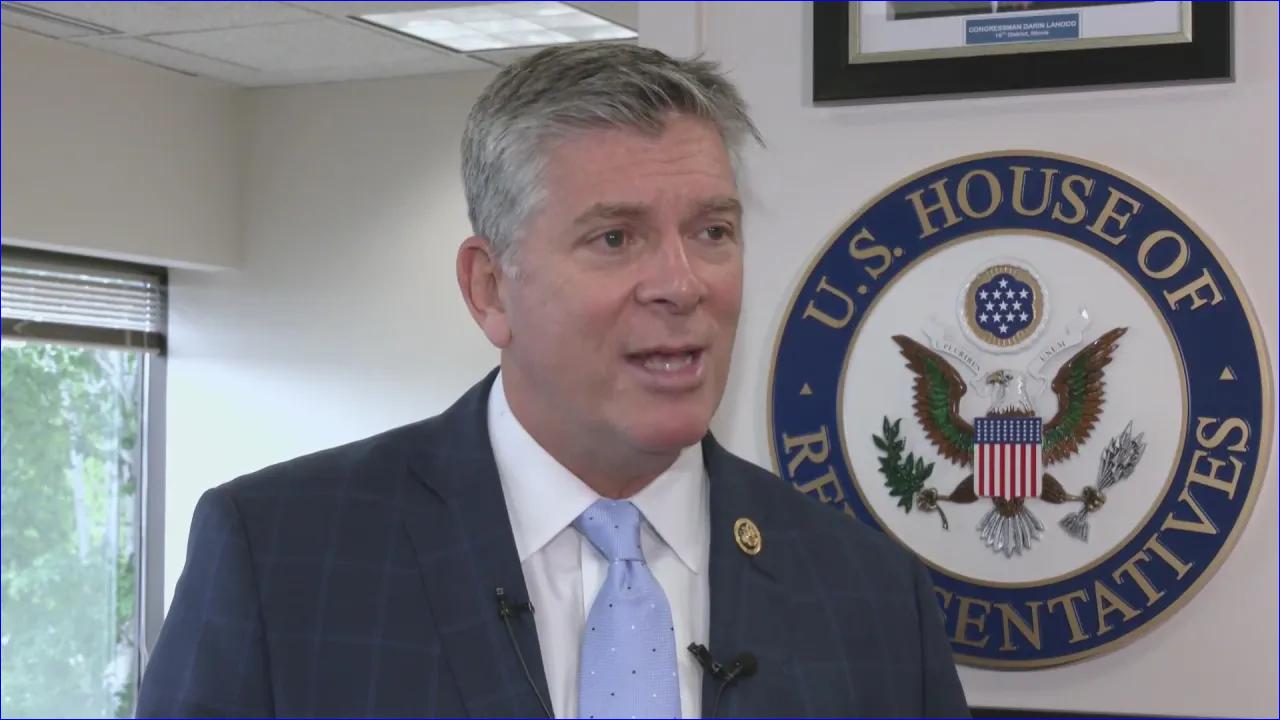
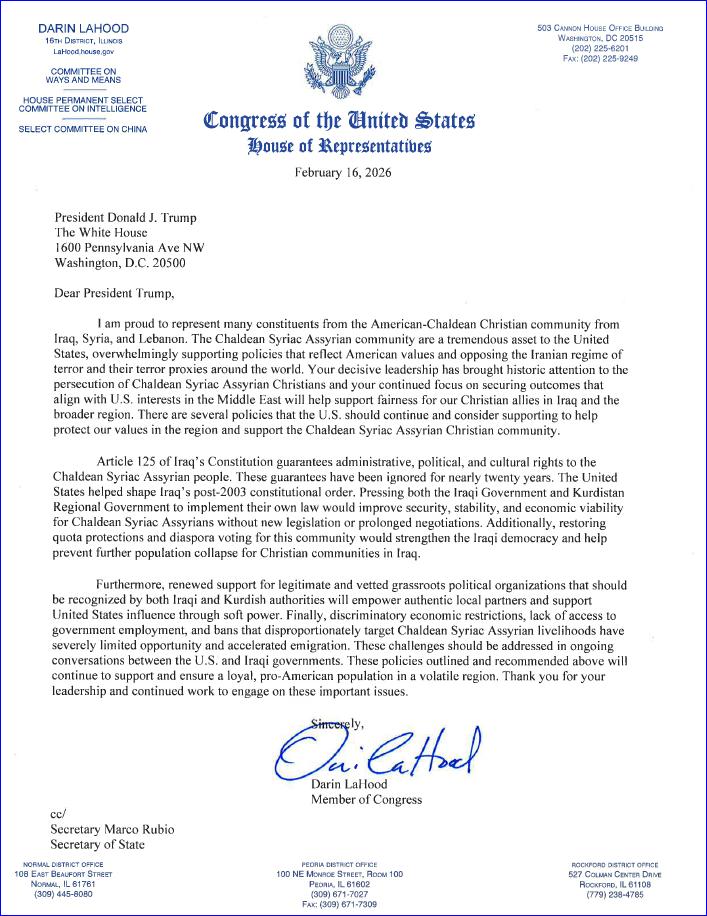
In a February 16 letter, Rep. Darin LaHood, a member of the U.S. House of Representatives, urged the White House to press both Baghdad and the Kurdistan Regional Government to fully implement long-ignored constitutional protections for Iraq's indigenous Christian population.
LaHood, who represents a district with a significant Chaldean Syriac Assyrian constituency, described the community as "a tremendous asset to the United States," emphasizing their significance. He credited Trump's leadership with drawing historic attention to the persecution of Middle Eastern Christians and argued that renewed U.S. engagement could help reverse the demographic collapse of Iraq's Christian population.
Article 125 and Unfulfilled Guarantees
Central to the congressman's appeal is Article 125 of Iraq's Constitution, which guarantees administrative, political, and cultural rights to the Chaldean Syriac Assyrian people. According to LaHood, those protections have gone largely unimplemented for nearly two decades. LaHood's letter follows strong advocacy for Article 125 by the Chaldean Community Foundation, the Assyrian American National Federation, Vote Assyrian, and the Assyrian American Chamber of Commerce.
The Congressman noted that the United States played a central role in shaping Iraq's post-2003 constitutional order. For that reason, LaHood contends, Washington has both leverage and responsibility to ensure that constitutional commitments are honored. Rather than calling for new legislation, he recommends that U.S. officials press Iraqi and Kurdish authorities to enforce existing law, a move he argues would strengthen security, stability, and economic viability in Chaldean Syriac Assyrian Christian areas without reopening complex political negotiations.
He also calls for the restoration of electoral quota protections and diaspora voting mechanisms for Christian minorities. Such measures, he argues, would not only reinforce Iraq's fragile democratic framework but also help stem the steady emigration that has hollowed out historic Christian communities across the Nineveh Plain and beyond.
Soft Power and Political Legitimacy
Beyond constitutional enforcement, the letter urges renewed U.S. support for what LaHood describes as "legitimate and vetted grassroots political organizations" within the Chaldean Syriac Assyrian community. Recognition of authentic local leadership by both Baghdad and Erbil, he suggests, would strengthen U.S. influence through soft power while empowering partners aligned with American interests.
The appeal reflects longstanding concerns among Assyrian advocates that externally backed militias, patronage networks, and factional politics have distorted minority representation in Iraq. By encouraging direct engagement with community-based actors, LaHood signals a preference for bottom-up stabilization over reliance on dominant regional power brokers.
Economic Discrimination and Emigration
The letter also highlights economic grievances. LaHood points to discriminatory restrictions, barriers to public-sector employment, and measures that disproportionately affect Christian livelihoods. These constraints, he argues, have accelerated emigration and undermined the long-term survival of one of the Middle East's oldest continuous Christian populations.
Addressing such inequities, he writes, should be part of ongoing diplomatic conversations between Washington and Baghdad. The strategic rationale is clear: preserving a "loyal, pro-American population in a volatile region" aligns with broader U.S. security objectives.
A Test of U.S. Commitment
The letter was also copied to Secretary of State Marco Rubio, underscoring the expectation that the State Department play a direct role in advancing these priorities.
For Assyrian Christians in Iraq and the diaspora, the appeal represents a renewed effort to anchor their survival not only in appeals to history or humanitarian concern, but in the language of constitutional enforcement and American strategic interest.
As Iraq continues to navigate political fragmentation and regional pressures from Tehran and Ankara, the question remains whether Washington will translate rhetorical support for persecuted Christians into sustained diplomatic leverage and whether Baghdad and Erbil are prepared to honor the constitutional commitments that have, until now, remained largely aspirational.
Chaldean Syriac Assyrian organizations across the United States have intensified their coordination, committing to a more deliberate and unified strategy to advance the security, rights, and long-term viability of their community in Iraq and throughout the broader Middle East. For too long, they assert, Christians of the Middle East, including their ethnic and cultural value, have been ignored.
"Iraq without our community cannot be a viable state," an activist stated, "For millennia, we have contributed to its cultural depth, economic vitality, and pluralistic fabric. We stand ready to help build a stable, prosperous, and unified country. But that future depends on the recognition and enforcement of our collective rights. We have waited far too long for promises to be honored."
or register to post a comment.