


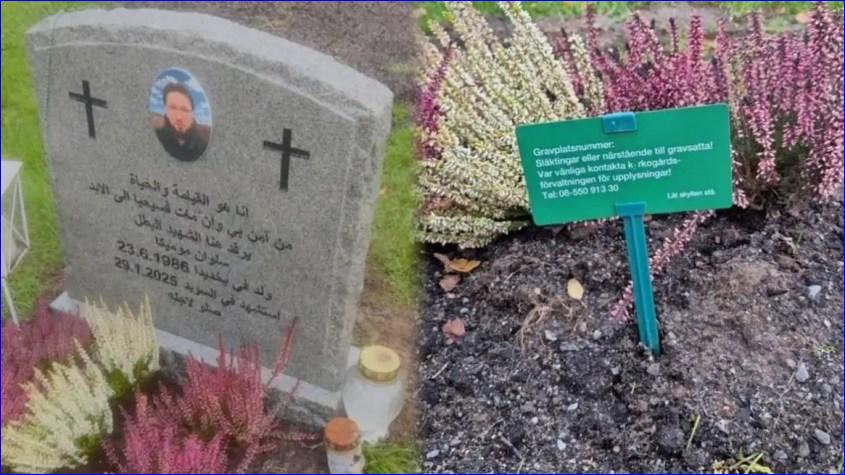
According to his father, Sabah Momika, the family was shocked after receiving a recent photo of their son's grave showing that the headstone had been replaced with a green sign instructing them to contact the cemetery administration.
Sabah said the family received conflicting explanations for the removal. "We were told that no official request had been submitted to place the headstone, but the person responsible for the grave, who holds official authorization, confirms that he did submit the request to the cemetery administration," he said.
"This is very strange," he added. "At first, we were allowed to install the headstone, and then suddenly it was removed. It seems they became afraid." He emphasized that the headstone met all the conditions set by the county administrative board.
Expressing his disappointment, Sabah Momika said, "Sweden failed to protect my son when he was alive, and now it is struggling to protect him even in death."
The cemetery director said the administration received an official request regarding the headstone on 20 January and confirmed that it is still under review. Decisions related to grave markers, he explained, are based on several criteria, including compliance with guidelines on size, design, and installation methods, ensuring safety within the cemetery, and assessing the risk of vandalism or sabotage.
Sabah Momika said the grave's caretaker informed him that there were concerns the site could become a target if its location became widely known. "Salwan defended Swedish values and sacrificed his life for them, yet we did not see even a single minute of silence from any Swede in mourning for him," he said. "How are we supposed to identify the grave when we come to visit and pray for him?" He stressed that the family will not give up.
Momika, known for publicly burning copies of the Quran, was shot dead in an apartment in Södertälje during a live broadcast on TikTok. Swedish police detained five individuals for questioning in connection with the killing.
Originally from the Assyrian town of Baghdede (Qaraqosh) in Iraq's Nineveh Plains, Momika gained notoriety for burning the Quran, which led to charges of incitement to hatred in Swedish courts. After the Islamic State (ISIS) seized Mosul in June 2014, he joined the Popular Mobilization Forces (PMF) and appeared in videos as a member of the Christian Kataib "Ruh Allah Issa ibn Maryam." In the footage, he was seen carrying weapons and declaring loyalty to Kataib al-Imam Ali, a faction linked to the armed wing of the Islamic Movement in Iraq that has faced allegations of war crimes and sectarian violence.
Nine months after his killing, Swedish police announced that they had identified the suspected perpetrator and issued an international arrest warrant seeking his detention and extradition to Sweden. Swedish prosecutor Rasmus Öman, who led the initial investigation, said in a statement on 17 October 2025, that authorities had requested the suspect's detention in absentia on suspicion of murder but did not disclose the individual's identity. "We have a clear picture of the sequence of events, and after extensive forensic examinations and a review of surveillance footage ... the suspect's whereabouts are currently unknown," he said.
At the time, Sabah Momika expressed relief at the news, saying:
"We will not give up my son's blood, no matter the cost. My son was expressing his opinion. These criminals must be brought to justice and receive their fair punishment. I have been waiting for this moment with great anticipation after a long and exhausting wait. I hope justice will now be served."
or register to post a comment.