


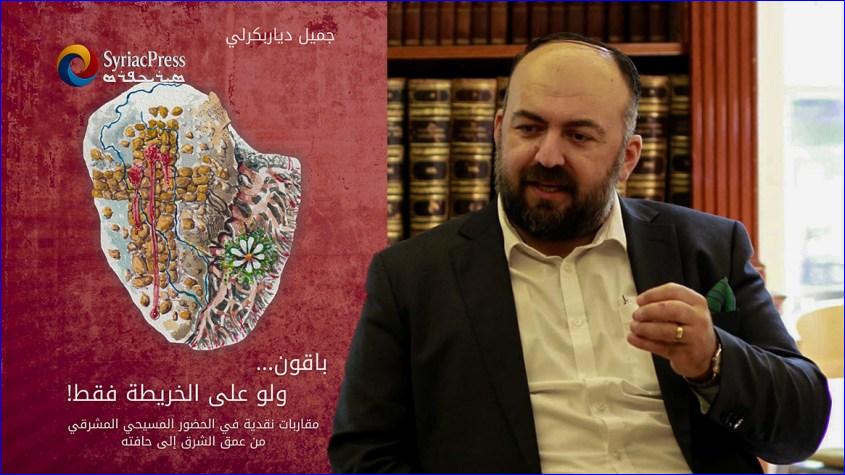
Diarbakerli, an Assyrian from Syria living in Sweden, also delves into the status of the Christian presence in the Arabian Gulf, Palestinian territories, and Israel, and offers a study of the challenges faced by Middle Eastern Christians in the diaspora.
Our news desk conducted an interview with the author to learn more about his new book and his activist work.
SyriacPress -- Could you give a brief overview of your new book and why it was published at this particular time?
Jamil Diarbakerli -- The book is my research journey into the current conditions of Christians in ten Middle Eastern countries, moving beyond statistics or emotional narratives. It was published now because the region is undergoing rapid changes that are reshaping identities. I felt the urgent need to document the Christian presence and propose a legal and intellectual vision to protect what remains.. before it becomes history, a mere memory.
SyriacPress -- Your book's title carries a powerful existential dimension. What did you intend to convey with this title?
Jamil Diarbakerli -- I want to sound the alarm. We may take pride that every inch of these lands bear the marks of our ancestors. However this holds no value if we cling to stones and forget the people. For example, what is the point of having hundreds of villages in Syria with authentic Assyrian names if their current inhabitants are unaware of the Assyrians as a living people and civilization. Existence "on the map" is in danger of becoming a silent, "stone-like" existence, and we do not want to become a museum of memories. We want to be the living human force that breathes life back into this map.
SyriacPress -- Did you observe common denominators for the crisis in the Middle East despite the differences between countries, or does each case have its own "particular tragedy"?
Jamil Diarbakerli -- Despite the varying political and legal circumstances in each country, the common pain is the absence of "full citizenship." The Christian in most of these countries lives in a state of "citizen anxiety" about his own future and that of their children. This sense of instability is the primary driver of migration across the Middle East.
SyriacPress -- In the book, you criticize the "discourse of fear." What practical step is required from the elites to break this discourse?
Jamil Diarbakerli -- The first step is to free ourselves from the "mentality of dependency" that led some among us to adopt dependency policy. This logic does not protect existence; it undermines it. For generations, we have endured a form of concealed political subordination--a disguised second-class status--that led us to accept the roles of docile followers or a superficial, symbolic presence in return for unsteady guarantees of security. True equality arises from recognizing that we are rightful inhabitants of this shared space, and a true home is not maintained by placating those with power at the expense of our self-respect, but through confident and meaningful engagement that naturally earns the respect of all.
A large part of our failures is due to "us" and the way we have dealt with our reality.
SyriacPress -- Regarding the diaspora, does it represent a historical opportunity to save the Christian existence in the Middle East, or does it accelerate its dissolution?
Jamil Diarbakerli -- In my opinion, the diaspora is now the foundation for all our people's projects. With over 75% of our people in diaspora countries, emigration is no longer just "emigration." It has become the determining factor with strategic significance. The issue today is clear: if our communities remain fragmented, our cause will remain fragmented. The diaspora offers a historic opportunity for salvation, provided we organize it effectively, provide strong support for those at home, and be a global voice for the cause.
SyriacPress -- Can readers anticipate more future publications, and what has been the focus of your written work until now?
Jamil Diarbakerli -- This book is my first publication and represents the culmination of an experience that began years ago. In the past, through my work as Executive Director of the Assyrian Observatory for Human Rights, I supervised and contributed to the preparation of numerous human rights reports, research papers, and field studies. Our ongoing effort through the Observatory has been to be the "voice of the voiceless.
This book marks my transition from technical documentation and research to an intellectual vision, and it will surely be followed by other publications that further explore this path.
or register to post a comment.