


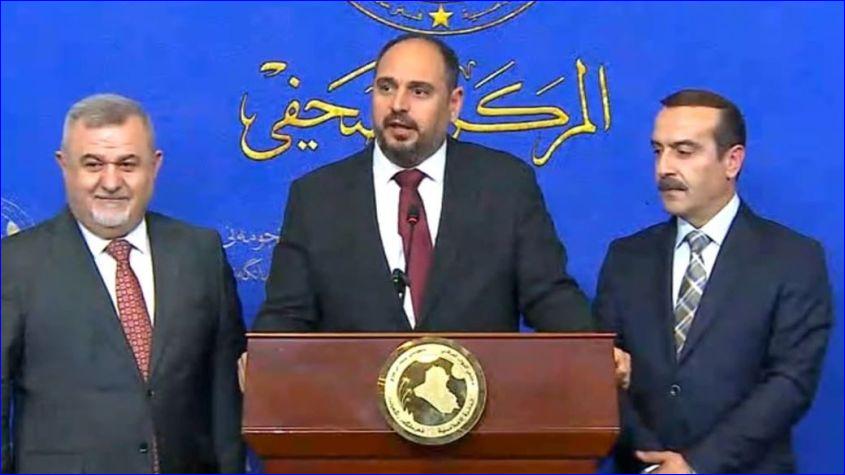
With 309 lawmakers present, the Council of Representatives elected Haibat al-Halbousi as speaker, a position traditionally allocated to a Sunni Arab under Iraq's informal power-sharing arrangement. Al-Halbousi secured 208 votes, signaling broad parliamentary support. Two deputy speaker posts were partially resolved, while the position of second deputy remained undecided after two inconclusive rounds of voting, leaving negotiations ongoing.
Beyond the chamber's leadership contests, Christian lawmakers announced a notable development of their own. A new parliamentary bloc, "Suyana," meaning "Our Identity," was formally established, presenting itself as the largest Christian bloc in the Iraqi Parliament. The bloc brings together three elected Christian deputies from three different provinces, an uncommon step toward unified parliamentary coordination.
In a statement, the Suyana bloc said its formation was driven by what it described as a "historical responsibility" toward a community that has faced severe challenges over recent decades, including intimidation, loss of rights, and forced displacement. These pressures, the statement noted, have contributed to a sharp decline in the Christian population and demographic changes in historically Christian areas.
The bloc includes Kaldo Ramzi Oghanna, elected from Arba'ilo (Erbil); Sami Oshana, elected from Nohadra (Duhok); and Imad Youkhanna, representing Christians in Kerkheslokh (Kirkuk). The lawmakers selected Kaldo Ramzi Oghanna as head of the bloc. All three received support from Kurdish political parties in the November elections, reflecting established political alliances in northern Iraq.
The two remaining Christian quota seats in parliament are held by representatives of the Babylon Movement, led by US-blacklisted Rayan al-Kildani, a Shiite-backed political force, leaving Christian representation divided across differing political currents.
In its founding statement, the Suyana bloc emphasized that its aim is not merely numerical aggregation, but to act as a parliamentary voice for Iraq's ancient Assyrian Christian communities while also affirming its commitment to defending the identity and rights of Armenians in Iraq.
The bloc outlined an ambitious legislative agenda, including the protection of constitutional rights for all components, addressing demographic changes in Christian areas, establishing a constitutional balance between the federal government and the Kurdistan Regional Government, and advancing long-standing legal demands. Among its priorities are a personal status law specific to Christians, amendments to the national identity card law to ensure respect for religious identity for Christians, Yazidis, and Sabians, and the passage of a law safeguarding minority rights under Article 125 of the constitution. The bloc also called for reforms to the election law to guarantee genuine representation and restore voting rights for Iraqis living abroad.
These announcements came as parliament's opening session underscored both continuity and negotiation within Iraq's political system. Lawmakers took their oath in two official languages, a constitutional recognition of diversity, even as the Assyrian language, one of Beth Nahrain (Mesopotamia)'s oldest living languages, remains outside formal parliamentary practice.
In brief remarks after his election, Speaker al-Halbousi pledged national unity and constitutional governance. For Christian lawmakers, the test of those pledges will be legislative follow-through: land rights protection in the Nineveh Plain and Ankawa, safeguards for returnees, and meaningful inclusion in reconstruction and governance decisions.
The constitution now requires parliament to elect a president within 30 days, followed by the formation of a new government. These steps will define Iraq's political trajectory in the coming years. For Assyrians, the emergence of a coordinated parliamentary bloc signals an effort to engage that process more strategically, seeking influence not through symbolism alone, but through structured participation.
As the Suyana bloc concluded in its statement, its presence in parliament will not be "symbolic or ceremonial," but intended as a "genuine partner in national decision-making." Whether that ambition translates into lasting political weight will depend on alliances, legislation, and the ability of Iraq's institutions to accommodate one of the country's oldest living communities within its modern state.
or register to post a comment.