


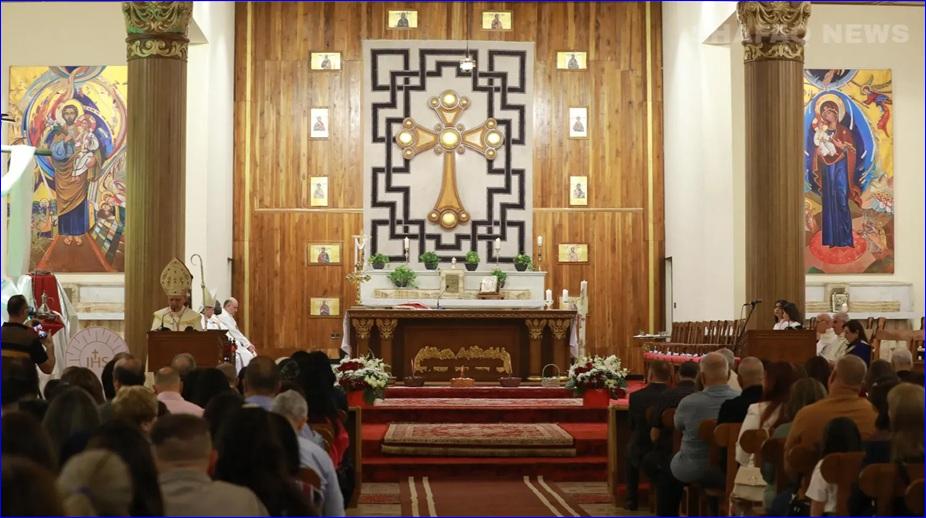
Here, where prayer once rose in many languages, Christmas was never a fleeting ritual. It became a memory layered with faith, joy, loss, and survival. For Iraq's Christians, the season now carries the weight of history and the uncertainty of a future that has steadily narrowed.
Roots Before Borders
Each year on December 25, Christians around the world commemorate the birth of Jesus Christ, a religious and human occasion officially adopted in the fourth century AD. In Iraq, the date resonates differently, bound to a community whose roots predate the modern Iraqi state by centuries.
To coincide with Christmas, Shafaq News examined the current reality of Christians in Iraq, tracing their historical presence, demographic decline, and the challenges threatening their survival. Academic and expert on religious diversity in Iraq, Saad Salloum, outlines a story that stretches back nearly two millennia--one marked by continuity, transformation, and repeated ruptures.
Christianity entered Mesopotamia in the first century AD, spreading among Syriac, Assyrian, Chaldean, and Armenian communities. Over centuries, Christians established deep roots in cities such as Mosul and the Nineveh Plain, as well as Baghdad and Basra. They played a prominent role in education, culture, and commerce and contributed to building modern Iraqi state institutions.
For much of Iraq's modern history, Christians lived across most provinces. That geographic spread began to collapse after 2003.
A Map that Keeps Shrinking
Waves of violence and terrorism following the US-led invasion reshaped Iraq's social fabric, with Christians among the most heavily affected. Large numbers moved north to the Kurdistan Region, particularly to Erbil and Duhok. Others sought refuge in neighboring countries such as Jordan, Lebanon, and Turkiye, while a significant portion migrated to Europe and the United States.
This movement was not gradual. It was abrupt, cumulative, and often permanent. Entire neighborhoods emptied. Long-standing social and economic networks unraveled. Local civil society institutions--schools, clinics, charities, and professional associations--lost a community that had been deeply involved in sustaining them.
According to the latest circulating estimates, Salloum says the number of Christians remaining in Iraq today ranges between 200,000 and 250,000, compared with more than 1.5 million before 2003--representing a demographic decline of nearly 85% over two decades.
The variation in figures, he explains, reflects more than statistical uncertainty. Political, psychological, and social factors all play a role. In some cases, numbers are inflated to avoid spreading fear and despair among Christians still inside the country or to preserve a sense of reassurance and communal stability.
In others, population estimates are used to support political or legal demands, particularly those tied to parliamentary representation, quota allocations, and minority rights.
Faith under Attack
For Iraq's Christians, recent Christmas seasons have been overshadowed by trauma.
Since 2003, the community has faced repeated attacks, culminating in one of the darkest moments of its modern history. In October 2010, Al-Qaeda gunmen stormed the "Our Lady of Salvation Church" in central Baghdad, taking dozens of worshippers hostage before opening fire. Sixty people were killed, and dozens were wounded in one of the deadliest attacks ever carried out against Christians in Iraq.
Moreover, according to a report issued by Iraq's High Commission for Human Rights in March 2021, around 1,315 Christians were killed between 2003 and 2014. And during ISIS control of Mosul between 2014 and 2017, around 130,000 Christians were displaced, and 161 were kidnapped.
Despite this history, Christian leaders continue to stress that the community remains an integral part of the Iraqi national fabric.
The Chaldean Archbishop of Kirkuk and Al-Sulaymaniyah, Archbishop Yousif Thomas, told Shafaq News that Christians are "an inseparable part of the authentic components of the Iraqi people, with a deep-rooted history and an active national presence.
In the absence of precise census data, he estimates the Christian population at about 500,000. Like other minorities, he notes, Christians face religious persecution alongside social and political marginalization.
The most dangerous challenge, Thomas warns, is existential: persistent insecurity and forced displacement driven by religious identity, particularly at the hands of extremist groups. He further called for strengthening coexistence and social peace and for guaranteeing the rights of all Iraqi components without discrimination to protect the country's religious and cultural diversity.
Hollowed Holiday Joy
Iraq officially recognizes 14 Christian denominations, concentrated in Baghdad, Nineveh Province, northern regions, and the Kurdistan Region. The Chaldean, Syriac, Assyrian, and Armenian churches are the most widespread.
In Baghdad, there are three Greek Orthodox churches and four Coptic Orthodox churches, alongside 57 Greek Catholic churches across various provinces. A small Protestant presence also remains.
Yet numbers do not capture the emotional weight of loss.
Christian citizen Tony Zaya says Christmas no longer feels as it once did. Widespread migration has scattered families, leaving celebrations punctuated by absence rather than gathering.
The joy, he explains, has become incomplete. Anxiety over the future--limited job opportunities, declining services, and persistent instability--hangs over daily life. Still, Zaya stresses that Christians remain attached to their land and Iraqi identity and look toward a state that guarantees security, equality, and full rights for all citizens.
For Haya Zakaria, this year's Christmas arrives burdened with memories of fear, displacement, and lost safety. Protection, fair representation, and preserving historical presence in ancestral areas remain unresolved challenges.
She describes a lingering sense of marginalization and a lack of serious attention to daily suffering, at a time when genuine support is urgently needed to ensure dignity and stability. Yet despite everything, she says, "Christians continue to mark their holidays with prayer, love and peace, holding onto hope that security will return and that Iraq will one day allow all its citizens to celebrate freely in a country that respects diversity and protects everyone's rights."
Amid these challenges, moments of international solidarity have offered hope. One such moment came in March 2021, when the late Pope Francis visited Iraq on a historic first journey. The pontiff issued a humanitarian call to silence weapons and listen to the voices of peace, signaling international support for coexistence and the protection of religious minorities.
At the constitutional level, Iraq's legal framework formally guarantees these principles. Article 125 ensures administrative, political, cultural, and educational rights for various nationalities. Article 41 affirms Iraqis' freedom to follow personal status laws according to their beliefs, while Article 43 guarantees the right to practice religious rituals and manage religious endowments and institutions, as regulated by law.
Stolen Heritage
Beyond violence and displacement, Christians have faced another crisis since 2003: the systematic seizure of their properties.
The community laments that Christian-owned homes and lands became easy targets for influential actors and armed groups that exploited weak protection and the absence of justice, using forgery, intimidation, and political influence to impose new realities. These abuses extended beyond material loss, accelerating the emptying of historic Christian areas and pushing thousands more families toward migration.
Justice Ministry spokesperson Ahmed Laibi explains to Shafaq News that special attention is given to minority properties, particularly those belonging to Christians. All related transactions are subject to strict procedures designed to prevent manipulation or forgery and protect owners' rights.
"Any transaction involving Christian properties receives special handling, including formal communication with the Christian Endowment Diwan, which verifies the legitimacy of sales--whether conducted directly or by proxy--and checks all financial details and documentation," he adds.
Approval is granted only after receiving an official "confidential" letter from the endowment confirming the validity of procedures. The transaction is then referred to the relevant sub-department and cross-checked with the Civil Status Directorate, including verification of barcodes and legal data.
Laibi points out that powers of attorney must be issued either to close relatives or licensed lawyers as an additional safeguard. Files related to Christian properties, he says, receive close monitoring at every stage as part of the ministry's obligation to protect minority rights under the law.
However, estimates point that more than $20 billion worth of public and private Christian properties have been seized since 2003. And despite repeated announcements by successive governments about forming investigative committees, tangible results remain elusive.
According to previous statements by Christian clerics, armed groups continue to exert dangerous influence over large numbers of Christian properties--leaving one of Iraq's oldest communities still searching for justice and a secure future in the land it helped shape.
or register to post a comment.