


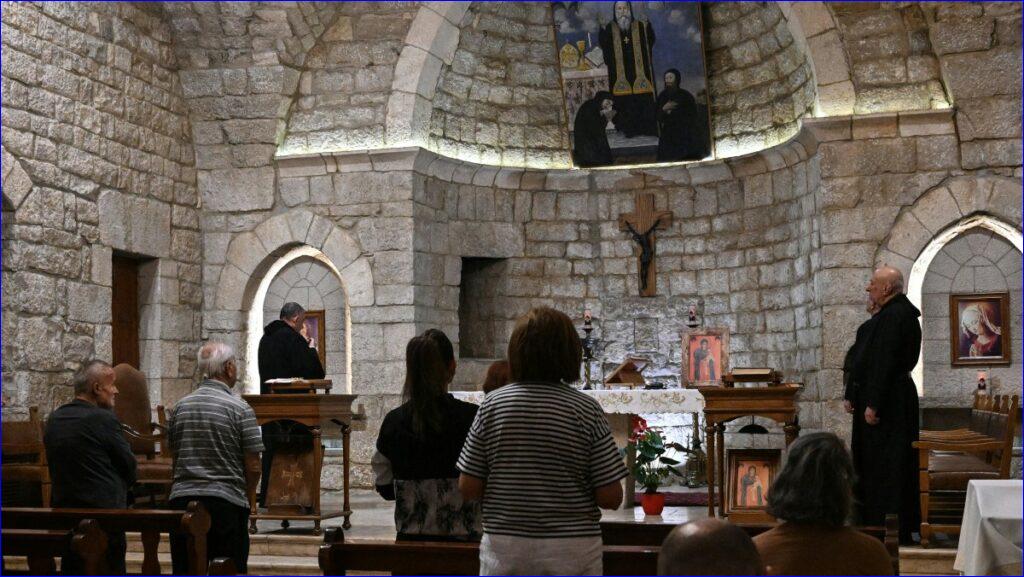
Lebanon was majority-Christian starting from the first century (when Christianity was introduced by figures such as St. Peter and St. Paul) until the mid-20th century. Mount Lebanon, which remains the Christian heartland of the country, is frequently mentioned in the Bible.
Lebanon was conquered by the Arab Islamic Rashidun Caliphate in 636 AD following the defeat of the Christian Byzantine (Eastern Roman) Empire at the Battle of Yarmouk.The Ottoman Empire later occupied Mount Lebanon from its conquest in 1516 until the end of World War I in 1918. Lebanon gained independence from French rule in 1943.
Maronites are the largest Christian denomination in Lebanon, historically centered in Mount Lebanon. They are known for their unique Eastern Catholic Church (which remains in communion with Rome) and their usage of the Syriac language in liturgy, although they primarily speak Lebanese Arabic today. Maronites played a key role in founding modern Lebanon. Today, they maintain distinct cultural and religious traditions, tracing their roots to St. Maron in the fourth century.
The Greek Orthodox community is the second largest Christian group. Other historical Christian communities include Catholic (Chaldean, Greek, Latin, Armenian, and Syriac), Oriental Orthodox (Armenian Apostolic, Syriac, and Coptic), and the Assyrian Church of the East.
Until the 1980s, Christians still constituted a demographic majority in the country. Today, the once-thriving Christian community has plummeted to roughly one-third.
The case of Lebanon represents a warning to Europe, which appears to be quickly Islamizing as a result of mass migration and declining European birth rates.
Henry Zakaria, a Lebanese activist who advocates for a Christian nation in Mount Lebanon, told europeanconservative.com,
The main reasons for the declining Christian population in Lebanon are the [1975--1990] civil war, emigration, and the loss of sovereignty. Christians left after decades of instability, economic collapse, and occupation by Islamic forces. The current political system favors demographic imbalance and makes Christian life unsustainable. It can only be reversed by restoring autonomy and self-rule in Mount Lebanon.The demographic shift toward a Muslim majority accelerated after the Arab war against us. Christian emigration rose sharply, while Shia and Sunni families expanded demographically and moved into areas that were once Christian. The change wasn't natural growth; it was a replacement through invasion, occupation, ethnic cleansing, and political manipulation.
Zakaria also pointed out the effects of the Syrian and Palestinian invasions against Lebanon:
Palestinian terrorist groups invaded Lebanon after the 1948 war in Israel and again in the 1970s, turning their camps into terror zones. Syria invaded in 1976 under the pretext of peacekeeping and remained for 30 years. Both waves have destroyed Lebanon's stability and its Christian identity.Hezbollah grew in the 1980s with Iranian funding and Syrian protection. When Christian forces disarmed after the war, Hezbollah kept its weapons under the excuse of "resistance." Over time, it captured the state, the army, and all key institutions. It is now the true ruler of the Republic of Lebanon, which has effectively become an extension of the Islamic Republic of Iran.
The Iranian-backed Hezbollah, founded in 1982, maintains a strong hold on Lebanon through its Shia supporters and the government, including parliament. As journalist and writer Daniel Greenfield notes:
Christian politicians may officially hold high and, in some cases, reserved positions in the Lebanese government, but they are often little more than fronts and puppets for Islamic terror groups.The Shiite [Shia] Islamic takeover of Iran, the growth of Islamic terrorist groups in the region, and the spread of regional Shiite Jihadism out of Tehran has effectively turned Lebanon from a Christian country into an Islamic puppet regime.
Over the years, Christians in Lebanon have faced multiple attacks as the country has become increasingly controlled by Hezbollah, which exercises its power through violence and intimidation.
According to the human rights organization Open Doors, the main fears of Christians in Lebanon reflect the demographic shrinking of Christian communities with an accompanying fear that it may become increasingly difficult to maintain long-standing levels of demographic presence and political influence. This fear is especially relevant in light of the growing strength of Shia communities and, in particular, Hezbollah's influence.
Christians in Lebanon face the most faith-related opposition in predominantly Islamic areas, such as Tripoli, the Bekaa Valley (particularly where Syrian refugee camps are located), South Beirut (such as the Shia suburb of El Dahye), Palestinian refugee camps (close to Tripoli and Beirut), and Hezbollah-controlled areas south and east of the Bekaa Valley.
As a result, Christian communities in traditionally Christian areas increasingly feel political pressure. In addition to Shia Hezbollah, there is also a Sunni community, many members of whom are radical, especially in areas where the Islamic State (ISIS) retains popularity. In the past, there have also been suicide attacks by Muslims against Christians. In June 2016, for instance, eight suicide bombers launched two waves of attacks on the Christian town of Al Qaa in northeastern Lebanon, killing at least five people.
In recent years, Christian communities and holy sites have been increasingly targeted through acts of aggression such as robbery, theft, and rape. These mainly occur in majority-Christian areas that border predominantly Sunni and Shia areas. The perpetrators are often Shia gangs or Syrians who live and work in Lebanon. There is also the alleged involvement of some Palestinians from nearby refugee camps. Christian women in these areas may be harassed by Muslim men because of their non-Islamic clothing. Islamic oppression mainly affects converts from Islam to Christianity, especially in predominantly Muslim areas. Christians from a Muslim background do not usually reveal their faith and often continue to adhere to Islamic dress codes.
In addition, several churches and Christian properties in Lebanon have been damaged by Muslims. In January 2024, for instance, a group of Muslims burglarized and vandalized at least ten churches in Beirut and Mount Lebanon.
According to Open Doors, churches in Muslim areas often choose not to display religious symbols and iconography to avoid provoking hostility from the Muslim communities in which they are located. In 2021, clashes between Shia and Christian villages in southern Lebanon's Hezbollah-controlled territory left six people injured. Christian religious symbols were attacked by Shia armed elements during the clashes.
In recent years, various other Christian symbols or shrines in public spaces were damaged or destroyed by Muslims. In December 2019 and 2020, Christmas trees were burned in Dinniyeh, a Muslim town in northern Lebanon. Also in Tripoli, Christmas trees were burned in December 2019 and 2023. In November 2024, a nativity scene in Faraya was vandalized when the figure of the baby Jesus was removed and a handgun was placed nearby.
It can be risky for churches and Christian organizations in Lebanon to speak out against discrimination and oppression, notes Open Doors. Criticism of certain groups, such as Hezbollah, can lead to threats, libel campaigns, or other serious consequences.
Zakaria told europeanconservative.com:
Lebanon is effectively divided. Christians mainly live in Mount Lebanon and the north, while Muslims dominate the south and the Bekaa Valley. Day-to-day relations are mostly civil, but trust is weak, and coexistence is more geographic than social.Most Christians view Hezbollah as an occupying force that has destroyed Lebanon's sovereignty. A few political figures cooperate with it out of fear or personal interest, but among ordinary people there is deep resentment.
As a solution, Zakaria advocates for a Maronite state in Mount Lebanon:
Our vision is to restore Mount Lebanon as the homeland of the Maronites, the rest of the Christians, and the Druze, a sovereign state built on peace, cultural revival, and Western-Mediterranean alliances. What Lebanese Christians need is unity, a strong diaspora network, and the courage to rebuild a new model of governance.
Journalist and writer Daniel Greenfield also notes:
The rising power of Islam means that the fates of the Christian and Jewish populations are intertwined in the Western world and in the Middle East. The story of Lebanon in the 19th century is a forcible reminder that Christian and Jewish rights anywhere in the Muslim world depend on the political and military fortitude of Western nations. Ideally, those nations might have the courage of their 19th-century counterparts to step in and make Lebanon, Christian.But in the absence of such a willingness to directly intervene and remove a colonial Muslim settler population back to its original territories, a two-state solution could preserve a Christian Lebanon which is otherwise likely to disappear within a generation. Silence will make it so.
Is the majority-Muslim Lebanon the future awaiting Western Europe? The West should prevent this disastrous outcome by rearranging its immigration policies and, at the same time, support Lebanese Christians either by helping them establish a two-state solution in Lebanon or a federal system that will help preserve the Christian presence there.
or register to post a comment.