


 Ilan Stulman)
Ekron's story is fascinating. In the Iron Age, it was the final of three Philistine cities that held the ark of the covenant. In the late eighth century BC, Ekron was controlled by Judean King Hezekiah, and then later dominated the trade of olive oil under the Assyrian Empire. Ekron's significant archaeological remains show that the Philistines were a well-known people for much longer than initially believed and that culturally they had a talent for adapting to the people around them.
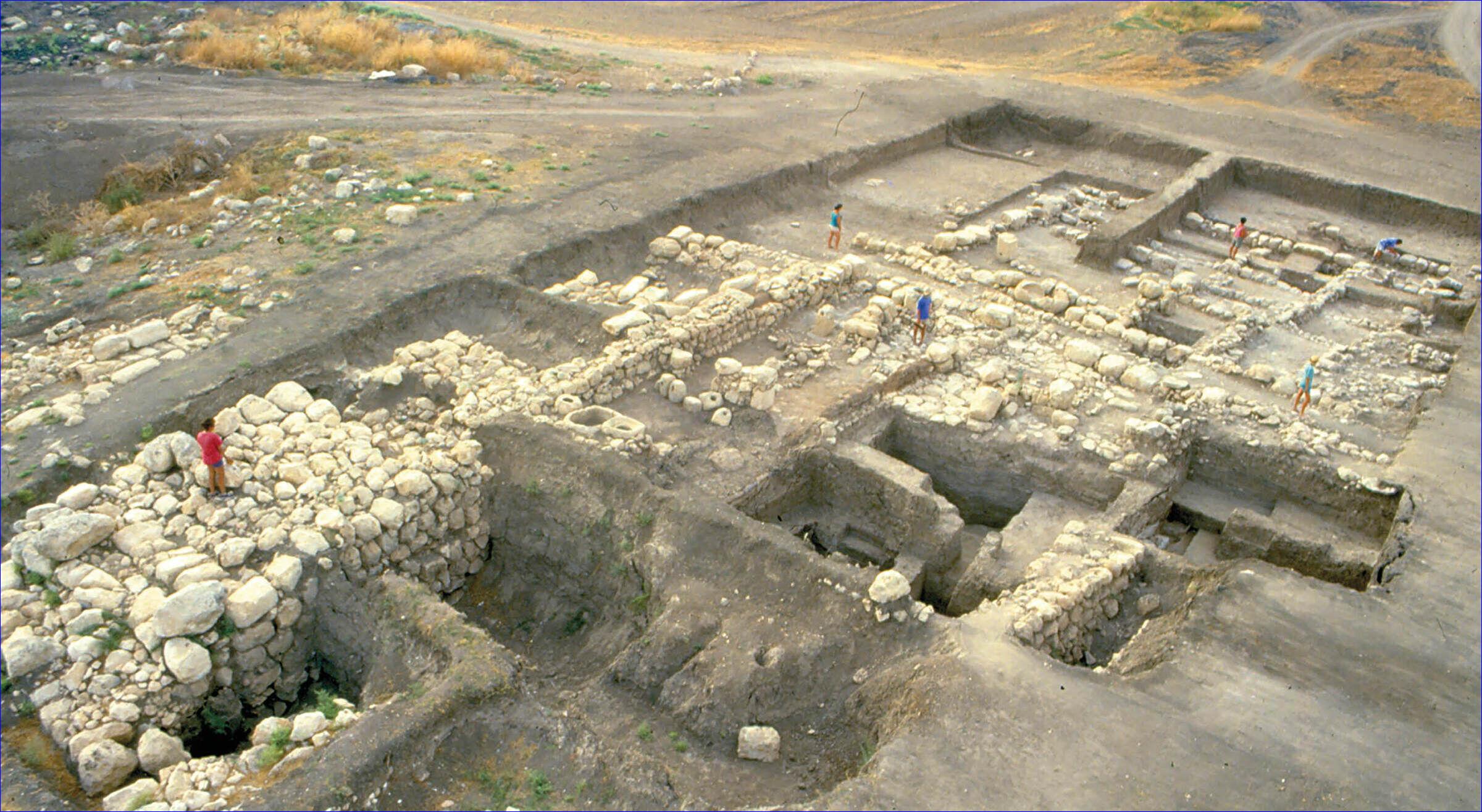
Ekron, or what is Tel Miqne today, is about 35 kilometers (22 miles) southwest of Jerusalem, near Kibbutz Revadim, in the Judean lowlands. It was excavated over 14 seasons between 1981 and 1996 by archaeologists Prof. Seymour Gitin of the Albright Institute of Archaeological Research and the late Prof. Trude Dothan of Hebrew University of Jerusalem. Since 1996, the primary focus has been on publishing the many remarkable finds from this fascinating site.
Let's dig in.
Early Ekron--Migration of the Philistines
The biblical text records that during Israel's conquest of the Promised Land "Ekron, with its towns and its villages" was allotted to the tribe of Judah (Joshua 15:12, 45) but later transferred to Dan (Joshua 19:40, 43).
In addition to the many later Iron Age discoveries, excavations revealed evidence of occupation from the Chalcolithic to Late Bronze Age, which was earlier than the excavators expected. Some of the earliest strata contain Canaanite remains with imported Mycenaean and Cypriot pottery, revealing far-reaching international trade before the 12th century BC (the Late Bronze Age). No fortifications surrounded the city at this time.
Then a stark change occurs: In the next layer, the pottery shifts from the imported pottery of the Late Bronze Age to locally produced Mycenaean pottery of Iron Age i. Local production of the pottery is evidenced by a number of kilns found in the city's southern industrial region.
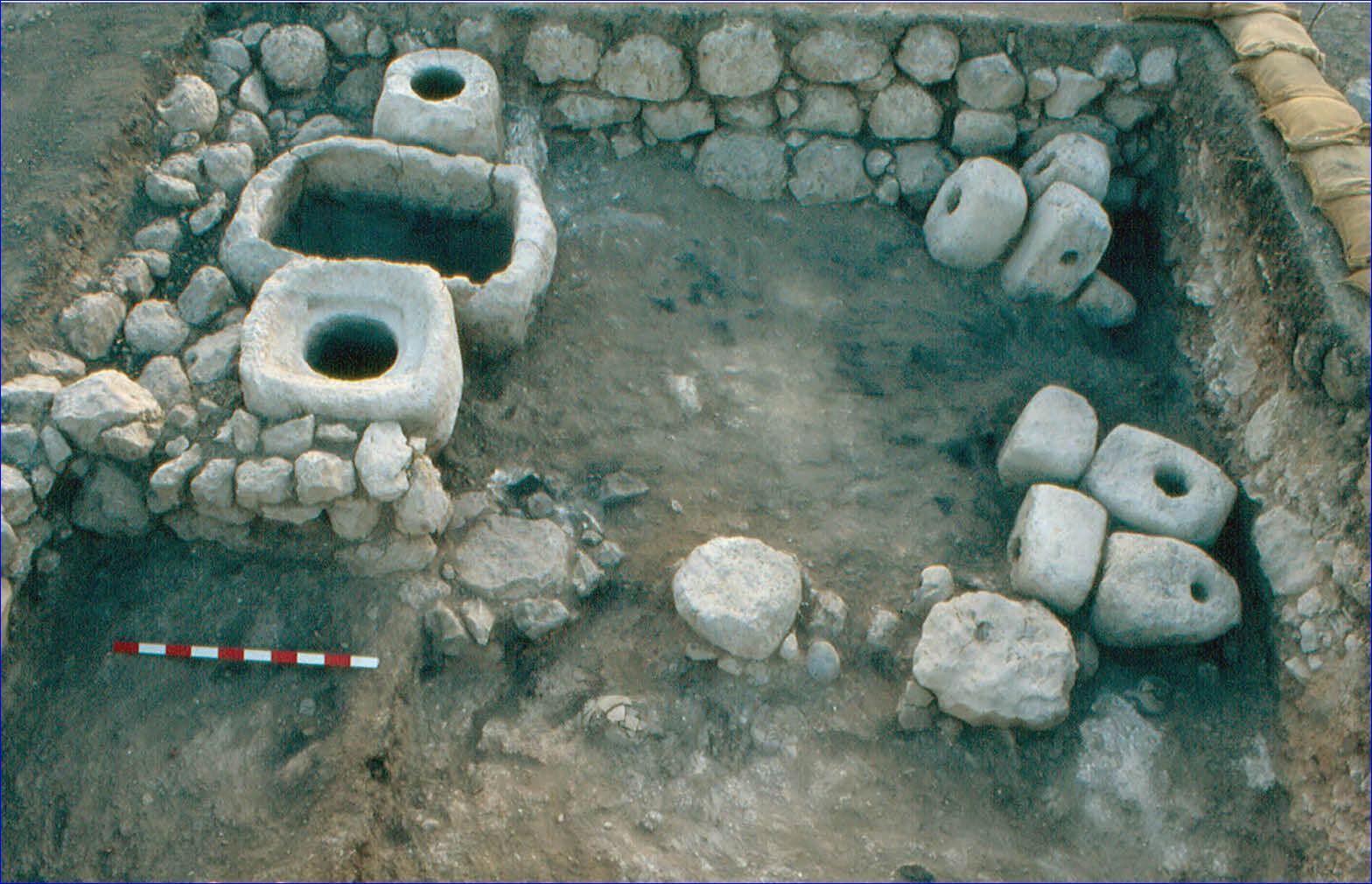
This change marked the beginning of a foreign migration into the southern coastal region of the Levant at the start of the 12th century BC This change, and the destruction associated with the previous layer, reveal the main influx of the Philistines into the region. The transition takes place around the same time the Peleset Sea People (often associated with the Philistines) are first mentioned by Ramesses iii in the beginning of the 12th century BC Incidentally, a large portion of the animal bones found at Iron i Ekron were of pigs--common to all Philistine sites. Several pebbled hearths in the domestic area also reveal a Philistine presence, as this is a typical feature of Philistine culture.
The first layer of the clear Philistine occupation (Stratum vii) reveals that they inhabited all 50 acres of the tell, including the upper 10-acre acropolis at the northeast corner of the mound.
Analyzing the pottery finds from the site, Professor Dothan wrote that "the distinctly Mycenaean characteristics of this locally made pottery show the Sea People's strong inclination to re-create in Canaan--at least in their pottery--the home environment of the Aegean world they came from." The Aegean includes parts of Greece, Crete, Cyprus, Syria and Turkey. This parallels Amos 9:7, which says the Philistines came from "Caphtor," which is identified with the island of Crete; dna analysis on Philistine skeletons has also confirmed this.
As the Philistines migrated, they did not lose their connection with their homeland. The Aegean origin of the inhabitants of Ekron is corroborated by many of the finds around Tel Miqne.
 Ilan Stulman)
David's Destruction?
Following the period of the judges, Ekron and the other Philistine cities were subdued by the Israelites in the battle that resulted in the death of Goliath (1 Samuel 7:14). Although Israel successfully defeated the Philistines, the archaeological record suggests Israel didn't destroy or maintain a presence in the city. 1 Samuel 17 records that the Philistines came up against Israel during the reign of King Saul (late 11th century BC) but were defeated and driven back to Ekron and Shaaraim.
Like some of its neighboring cities, archaeological evidence shows that Ekron was completely destroyed between 1000 and 975 BC, either by Pharaoh Siamun of Egypt or the Israelites under King David. Professor Gitin believes we can confidently identify Ekron's destroyer: "No doubt the decline in the fortunes of Ekron was related to the ascendancy of David and his son Solomon and to the fact that Israel was now able to dominate the Philistines."
After this destruction, Ekron became greatly diminished in size and power. It shrunk from a 50-acre city to a 10-acre acropolis at the northeastern corner. This event marked the end of the Iron i city. It remained a small, relatively inconsequential settlement for the next 270 years.
Because the monochrome and bichrome Philistine wares and hearths disappear in the post-1000 BC layers of strata iii-ii, scholars believed this was evidence that the Philistine occupation of the southern coast ended. Many believed, at this point, the Philistines became lost to history. Professor Gitin disagrees.
In "Excavating Ekron," Gitin wrote, "As the archaeological evidence piled up ... it became clear that the Philistines continued to exist, although they had adopted features of other cultures" (emphasis added throughout). This is just another example of a pattern that Professor Gitin identified. The Philistine inhabitants of Ekron had a talent for what he calls acculturation and continuation: They adopted the characteristics of their subjugators.
"Between about 1000 BC and the late seventh century BC, the Philistines survived and sometimes thrived, absorbing cultural characteristics of their neighbors--the Israelites, the Phoenicians and, finally, the Assyrians," he wrote.
After roughly 270 years of relative obscurity, the city of Ekron flourished again under the Assyrians.
Ekron, Assyria and Hezekiah
To understand Ekron in the seventh century BC, it is important to consider it in the context of Assyria. Several societies or cultures collide in Ekron under the Assyrian Empire.
The Neo-Assyrian Empire started to invade the land of Israel in the latter half of the eighth century BC It conquered Samaria between 721 and 718 BC before setting its sights on Judah.
It appears Ekron was first sieged in 721 BC by Sargon ii, as shown on his wall reliefs at Khorsabad. A wall relief mentions Ekron by its Assyrian name, Amqarrûna, and specifically speaks of the Palaštu (Philistines) who lived there. The fact that the Assyrians mention the Philistines and their cities by name "indicates that the Philistines were still recognized as a distinct group with their own land and cities as late as the seventh century," wrote Gitin.
Toward the end of the eighth century BC, Ekron was sieged by another Assyrian king, Sennacherib. This too was documented. On his prism inscriptions, Sennacherib described the story of Padi, the Assyrian-installed ruler of Ekron who was put "into fetters of iron and given over to Hezekiah, the Jew" by the "officials, nobles and people of Ekron" when King Hezekiah conquered the city (2 Kings 18:8). Sennacherib then marched against Ekron on his campaign into Judah. "I drew near to Ekron and slew the governors and nobles who had rebelled," Sennacherib recorded.
Archaeology attests to this recorded history. A small occupation layer dated to around 700 BC shows that the long-abandoned lower city was used for a short period before the Assyrian hegemony associated with the final stratum. This is interesting, as it lines up with Hezekiah's occupation of Ekron described by the Assyrians.
More evidence of this was found in three storage jars in the upper acropolis that contained lmlk inscriptions, which means "belonging to the king." Such inscriptions are typical of the late eighth-century reign of Hezekiah. (For more information, see "'To the King' Seals Point to Hezekiah"). The presence of these jars provide additional proof that Hezekiah did, in fact, have some measure of control over Ekron.
or register to post a comment.