


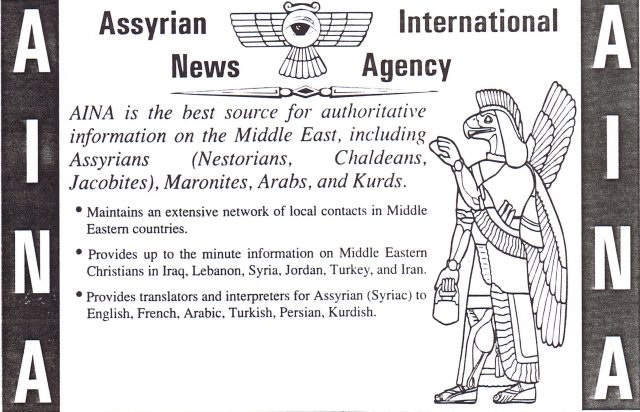
As an independent news agency devoted exclusively to Assyrian-related issues, AINA has achieved remarkable global reach. Its publications circulate among thousands of institutions, journalists, academics, and policymakers, and have been cited by leading international media--including the Wall Street Journal, International Business Times, The New York Times, United Press International, and many others--underscoring AINA's reliability and importance.
Over the past thirty years AINA has expanded into an exceptional digital archive. Beyond news reporting, AINA contains hundreds of in-depth reports, documentaries, research papers, and rare digitized books that cover the ancient, classical, and modern historical periods of the Assyrian people. A particularly remarkable contribution is AINA's extensive documentation of the great catastrophes that shaped the modern Assyrian experience:
- The Assyrian Genocide of 1915, preserved through eyewitness accounts, missionary sources, demographic studies, and rare archival texts;
- The Simmele Massacre of 1933 in Iraq, presented through political analyses, survivor testimonies, and original documents seldom available elsewhere; and
- The modern genocide committed by ISIS between 2004 and 2018 against Assyrians, and other minorities in Iraq and Syria, documented through on-the-ground reporting and human-rights reports.
Because these materials are curated with scholarly precision, the archive has become a significant resource for academic research, benefiting universities, think tanks, and human-rights organizations across the world.
Related: About AINA
AINA's independent journalism has consistently illuminated political, social, and humanitarian developments across the Middle East. Whether covering conflict, displacement, or cultural endangerment, AINA has offered clarity and depth where mainstream coverage was often insufficient or entirely absent. A core focus of AINA's work is the careful documentation of human rights conditions in the Assyrians' historical homelands, with most reports concentrating on Turkey, Iraq, Syria, and Iran.
AINA has highlighted issues such as discrimination, targeted violence, demographic engineering, confiscation of church properties, cultural suppression, and the destruction of heritage. Reports, interviews, and articles have informed global advocacy efforts and increased international awareness of the threats that ancient Christian communities of the Assyrians continue to face.
Through this work, AINA has strengthened the preservation and global recognition of the Assyrian historical narrative. Its research-based content has chronicled the Assyrian journey from ancient Mesopotamian civilizations and early Christianity to the struggles and achievements of the modern diaspora, reinforcing a shared identity and collective memory. At the same time, AINA has served as an important cultural platform, showcasing Assyrian artistic and literary achievements, archaeological discoveries, liturgical traditions, and language-preservation efforts. Its cultural reporting has supported pride, unity, and continuity among Assyrians worldwide.
A distinctive and invaluable aspect of AINA's mission is its comprehensive documentation of the religious life of the Syriac-speaking Churches, which together form the spiritual and cultural heart of the Assyrian people. AINA has reported extensively on all major ecclesiastical traditions, including the Assyrian Church of the East, the Syriac Orthodox Church, the Chaldean Catholic Church, the Syriac Catholic Church, the Syriac Protestant Church, and the Ancient Church of the East. By covering theological developments, church leadership, monastic life, liturgical traditions, diaspora activities, and the challenges faced by these communities, AINA has been able to preserve the diversity and richness of one of the world's oldest Christian heritages. This inclusive approach ensures that the spiritual traditions of every Syriac-speaking denomination are represented with accuracy, respect, and depth.
As the Assyrian International News Agency celebrates its 30th anniversary, its achievements stand as a testament to integrity, dedication, and cultural responsibility. In fact, AINA has grown far beyond a news service--it is a guardian of Assyrian history, a comprehensive digital archive of international significance, a defender of human rights, and a trusted bridge connecting the Assyrian people with the global community.
The following interview was conducted with Peter BetBasoo, the co-founder and editor of AINA.
Origins and Vision
Abdulmesih BarAbraham (AB): First of all, congratulations on the 30th anniversary of AINA. Your tireless work, commitment to quality, and vision have made this publication an indispensable voice in its field for three decades. Let us start looking back to 1995. What inspired you to establish the Assyrian International News Agency, and what were the core goals you hoped to achieve at that time?
Peter Pnuel BetBasoo (PPB): There was a lack of representation of Assyrians in the Western media, no voice representing the Assyrian perspective. The mission statement was, and has always been, to bring the Assyrian perspective to the non-Assyrian, English speaking world. That is why AINA does not cover internal, community Assyrian news.
The idea was proposed to me by Firas in a hallway conversation (we lived in the same building). He and I began it, and were shortly joined by John Michael, Matay Arsan and Raman Michael; this was the board of AINA until 2005, after which I remained as solitary chief cook and bottle washer.
AB: What did the Assyrian media landscape look like in the mid-1990s, and what gaps did you feel AINA needed to fill?
PPB: The Assyrian community had many magazines and journals but they were mostly focused on internal news and not aimed at non-Assyrians.
AB: What were the biggest obstacles you faced in the early years of building an Assyrian-focused global news agency?
PPB: There were no major obstacles. We had a clear mission statement and executed it faithfully. Do one thing and do it well. That is all it takes.
AB: While living in Silicon Valley, I witnessed the emergence of Zinda magazine by Wilfred Alkhas (1995) and Nineveh.com administered by Albert Gabriel; both ceased during the 2000s. What was the recipe for success that has enabled AINA to endure for three decades?
PPB: The secret to AINA's longevity is it produces original content not found elsewhere. AINA does this by remaining true to its mission statement, which is delivering Assyrian news to the English-speaking, non-Assyrian world. Also, AINA has always been politically and culturally neutral. It cultivated an open atmosphere, recruited reporters and writers from across the world, who trusted AINA because of its neutrality.
In fact, AINA and Zinda had an unofficial agreement, Zinda would cover community news for Assyrians and AINA would cover political and national news for non-Assyrians.
AB: How has the shift from early internet platforms to modern digital and social media changed the way AINA works and reaches global audience?
PPB: AINA was always a digital platform. It has evolved with the technical standards. It maintains a classic, vintage look and feel, focusing on substance rather than style; its objective and function have not changed.
Development and Achievements
AB: Over the past three decades, AINA has grown into a widely recognized, valuable resource on all kind of Assyrian matters. What milestone or achievements stand out to you the most?
PPB: There are many milestones and achievements, and all can be exemplified by governments and news agencies using AINA content in their reports, policy decisions and news stories. For example, when AINA published the secret memo by Saudi Arabia which showed the Saudi government was sending death-row inmates to fight Jihad in Syria (AINA 2013-01-20), the story was picked up by USA Today. AINA stories have also been picked up by The Wall Street Journal, International Business Times, The New York Times, CNN, Fox News, The Christian Post, United Press International and others.
AB: Indeed, AINA's content is frequently referenced by major international outlets while AINA's news became a reliable source for human rights reports and religious portals reporting on the situation oft he Christians and their Churches in the Middle East. How has this external recognition influenced AINA's work and credibility?
PPB: AINA is trusted because it adheres to journalistic standards. AINA strives to present accurate and factual information. When AINA content is used by others it reinforces our commitment to these standards.
AB: What proportion of AINA's content today consists of syndicated news versus original reporting, editorials, and research produced in-house?
PPB: I do not have an accurate statistic, but roughly 50/50.
AB: AINA now maintains an extensive digital archive--including rare books, historical documents, and reports on critical events like the Assyrian Genocide of World War One, the Simmele of 1933 and the ISIS genocide (2004-2018). How did this archival mission develop over time?
PPB: The decision was made shortly after AINA's founding to build an archive. Becoming an archive not only reinforced the veracity of AINA's reporting and increased its credibility, it made rare and difficult to find resources easily available. For example, many of the online books on AINA have been used and referenced in books published by scholars.
Human Rights and Reporting
AB: Much of AINA's reporting focuses on human rights conditions in Turkey, Iraq, Iran, and Syria. What challenges exist when documenting sensitive issues in these regions, and how does AINA navigate them?
PPB: The biggest challenge is obtaining the information. Assyrians from those areas are often reluctant to share information for fear of retribution. AINA is very careful to protect its informants.
AB: Has AINA ever faced pressure, pushback, or threats--direct or indirect--because of its reporting? If so, how did you navigate those situations?
PPB: Not directly. AINA was the subject of a Denial-Of-Service attack once which lasted 24 hours. We do not know who made this attack. We also learned from informants in Turkey that Turkish intelligence had placed AINA on the list of "anti-Turkish" organizations to monitor.
AB: How does AINA ensure accuracy, neutrality, and the safety of sources when reporting on human rights abuses and conflict zones?
PPB: As I stated above, we adhere to journalistic standards. We verify sources and information.
Community and Cultural Impact
AB: AINA covers the entire spectrum of Syriac-speaking Churches (from the Assyrian Church of the East, Chaldean and Syriac Catholic and Orthodox churches). Why is it important to represent all these denominational traditions, and how do you balance their diverse perspectives?
PPB: The churches are part of the Assyrian nation, which has many denominations. The Assyrian nation is not a monolith. AINA is politically and culturally neutral. To reiterate, AINA does not cover internal, community news, so this is not a problem for AINA.
AB: In your view, how has AINA contributed to preserving Assyrian identity, language, culture, and historical memory--especially for younger generations in the diaspora?
PPB: Simply put, it has done this just by being Assyrian -- warts and all, as Oliver Cromwell said. To preserve the Assyrian identity and culture, just be Assyrian. Preserving does not mean unchanging. Before World War One Assyrians were mostly farmers, in twenty five years there will be Assyrians on Mars. As I always say: Assyria is where I stand.
Technology and Media Evolution
AB: With the rise of misinformation and the rapid spread of unverified content online, what role does AINA play in providing reliable and verified information about Middle Eastern Christians in general and Assyrians in particular?
PPB: AINA remains a trusted source of information because of, as I said above, its adherence to journalistic standards.
AB: Many scholars now use AINA as a reference for academic research. How do you feel about the agency's growing role in academia?
PPB: I am delighted. This is only possible because AINA produces quality original content; it stems from our dedication to accuracy and integrity.
Reflections and Challenges
AB: What have been the greatest challenges over the past 30 years--whether organisational, financial, or editorial--and how did you overcome them?
PPB: The challenges are not for AINA, they are for the Assyrian nation, including internal and external issues.
AB: Are there moments when you felt AINA's work had a direct impact on policymaking, academic research, or public awareness?
Yes, many times. For example, when referring to the Turkish genocide of Assyrians in World War I, AINA always quotes 750,000 for the number of Assyrians killed. This is a reasonable estimate based on population growth data (see here). When other media outlets speak of the Assyrian genocide, they quote 750,000 Assyrians killed. This is the influence of AINA.
Several governments in Europe, such as Sweden and the Netherlands, have issued policy positions based on AINA's reporting. During the American occupation of Iraq, we learned from a source in the U.S. government that various agencies monitored AINA's content for information.
Future of AINA
AB: As you look ahead, what are your aspirations for AINA in the next decade? Are there new initiatives, technologies, or partnerships you envision?
PPB: AINA will continue its mission of delivering the Assyrian perspective to the non-Assyrian, English-speaking world. It will continue to strive to keep up with the latest technology.
AB: What message would you like to convey to AINA's readers, contributors, and supporters as the agency celebrates its 30th anniversary?
PPB: Thank you for your contributions and support. To Assyrian individuals and organizations I would say this, do one thing and do it well.
Abdulmesih BarAbraham is a freelance journalist and has been contributing to the Assyrian International News Agency since 2008. He has authored more than eighty articles, editorials and Interviews with AINA. His work has focused on reporting and analyzing the political situation and the state of human rights affecting Christians in the Middle East, particularly in Turkey, Syria and Iraq, with special emphasis on the Assyrian people and their Syriac-speaking churches.
or register to post a comment.