


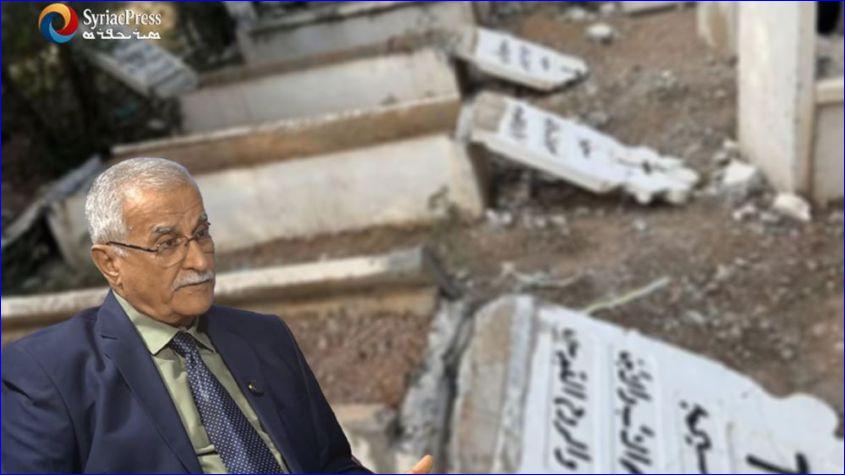
This phenomenon is not merely an attack on silent stones; it is an assault on the memory of a nation and on the existence of an indigenous community whose roots stretch back thousands of years.
First: Historical and Social Roots of the Phenomenon
Following the fall of the former regime, Iraq witnessed a security collapse and a surge in extremist ideology, particularly in Mosul and the wider Nineveh region. Even after the terrorist organization ISIS was militarily defeated, remnants of this mindset continued to linger -- a mindset that rejects religious diversity and readily targets its symbols, including cemeteries.
When those who vandalize, exhume, and desecrate graves face no accountability -- when such incidents pass without firm legal action -- the message conveyed to society is that these violations are permissible or at least unimportant. The lack of serious criminal follow-up has emboldened certain actors to commit these acts.
In Mosul, Najaf, and parts of the Kurdistan Region, demographic changes have introduced new groups unfamiliar with the Christian community's history or the significance of its burial grounds.
Meanwhile, the presence of influential local factions or informal groups often affects control over public spaces and may be linked to some of these transgressions.
Some extremist individuals or groups draw on distorted religious interpretations that consider the graves of non-Muslims as "not sacred," leading them to disrespect or exhume them without recognizing that such actions violate human dignity and universal human rights.
Second: Why Now? Understanding the Timing and the Broader Context
As the number of Christians continues to fall -- with families scattered between displacement and emigration -- certain groups find it easier to target them. Cemeteries that were once regularly visited and maintained have become relatively neglected, leaving them vulnerable and exposed.
In some cases, the motive behind exhuming graves is to clear the cemetery and convert the land into private property or an investment project. This has occurred in more than one city, where some have claimed that "Christians are now few," and therefore their lands can be seized.
Are certain actors seeking to send a message that Christians are no longer welcome? Is this a form of psychological pressure aimed at completing the process of displacement These questions are being raised with high urgency -- especially after the Aramota incident, which shocked the Christian community due to its occurrence in an area considered safe and stable.
Third: Why Was the Aramota Incident So Shocking?
Because Aramota is neither an extremist city nor a troubled region -- it is a small village in a part of the Kurdistan Region known for coexistence. This indicates that the phenomenon is no longer confined to areas of security tension; it has entered a broader and more dangerous social sphere. The incident also raised an important question: Has a culture of disrespecting Christian sacred sites begun to infiltrate even the regions that once stood as models of tolerance?
Fourth: The Devastating Consequences of This Phenomenon
An attack on cemeteries is an attack on the identity and privacy of the "other," and it is one of the clearest signs of fragile coexistence. These incidents sow fear and deepen the divide between communities.
When a Christian realizes that even the deceased are not spared violation, how can he trust in his present or his future? This phenomenon pushes many to consider emigrating or selling their property.
At a time when Iraq is striving to restore its international reputation, such incidents deliver a painful blow in the eyes of the world, as they openly contradict human-rights standards.
People are asking: Where is the law? Where is the state? Where are the entities that boast of protecting minorities? There is often a public perception that the authorities respond slowly or indifferently, which only heightens frustration and resentment.
Fifth: What Next? And What Must Be Done?
Enacting a Law to Protect Cemeteries and Religious Sites of All Communities. A clear legal framework with strong deterrent penalties that ensures no violator escapes accountability.
Establishinga Special Protection Force for Historic Cemeteries. Particularly in mixed areas and villages where the Christian population is small.
Registering Christian Cemeteries as Heritage Sites. This would place them under formal state protection and require official monitoring.
Launching Awareness Campaigns to correct misconceptions and promote respect for the burial sites of all religions.
Church and International Organizations must document these attacks by submitting official files to the government and parliament, documenting every incident with photographs and reports and advocating for international oversight on the protection of minorities.
Conclusion
The phenomenon of exhuming Christian graves is not merely an attack on stones -- it is a resounding cry that exposes the deep flaws in respecting religious diversity in Iraq. The causes range from extremism to weak law enforcement to struggles over land, but they all lead to the same outcome: The weakening of the Christian presence and the erosion of trust in the environment of coexistence.
To prevent this behavior from turning into a normalized culture, Iraq urgently needs:
- Rule of Law.
- Awareness.
- Accountability.
Before we reach a stage where the memory of an entire people is erased -- both above the ground and beneath it.
Ablahad Hanna Saka is a member of the Bethnahrin National Council in Iraq.
or register to post a comment.