


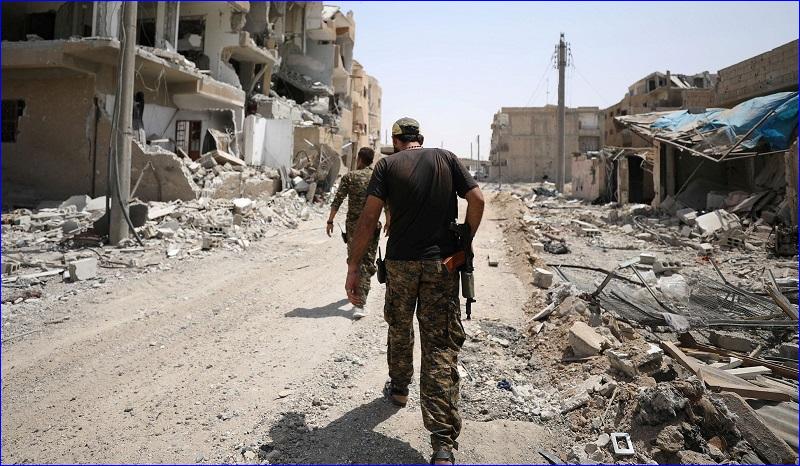
 Rodi Said/Reuters)
The Syriac unit has Muslim volunteers, Kurd and Arab. They fought together to liberate Christian and Kurdish areas from ISIS; now they fight together to drive ISIS out of a predominantly Sunni Arab city.For their part, those fighting for ISIS -- Saudis, Chechens, Afghans, French, Turks, Pakistanis, Germans, and Americans, among others -- are under no illusions that they are in the last days of the geographical caliphate. The coalition hope was to kill every member of ISIS in Mosul and Raqqa, to prevent them from returning to their countries to carry out attacks. It is certain, however, that many have already escaped. One sees many bearded young men among the caravans of refugees of fleeing Mosul and Raqqa. The ISIS fighters who don't blow themselves up in suicide bombings may fight to the death. Or they may try to return to their countries of origin to carry out lone-wolf -- or perhaps coordinated -- attacks. The latter would be in keeping with the spirit of Abu Musab al-Zarqawi, the true founder and visionary of ISIS. Zarqawi carried out such attacks with lethal efficiency in Iraq -- against defenseless civilians in public places, including houses of worship and even elementary schools. These forms of terrorism have already become somewhat commonplace in the Western world and are certain to increase in the months and years ahead. The end of the caliphate war will not mean the end of ISIS or of al-Qaeda-linked terrorism. Indeed, the global support network has been scarcely disrupted. Wahhabi Islam, the foundational ideology for ISIS and al-Qaeda, continues to be disseminated around the world by Saudi Arabia. The Saudis have spent untold billions exporting their radical religious ideology. A Syriac soldier shows me a photo of himself with his foot on what he claims is the corpse of an ISIS Saudi sniper, whose face is bloated, almost a shade of green, the eyes rotted out. Many of the Islamist foreign fighters are only too happy to die here, as their brethren did in Mosul -- as on September 11, 2001. But the killing of Saudi terrorists here will mean little to the greater struggle. The foreigners are a fact beyond the control of the Syrian people. Many have instead begun to put energy into healing their communities after the foreigners are dead or departed. Reconciliation among Syrian communities, especially those alienated Sunni Arab communities that welcomed ISIS, has even begun to take root in the region, perhaps more earnestly in Syria than in Iraq. It is understood that many locals were essentially conscripted into ISIS, as soldiers or laborers. For these, an amnesty of sorts is likely. The Arabs, Kurds, and Christians fighting together in the SDF are keen not to make the mistakes of the regime, which divided Syria's components against each other. They first fought together to liberate Kurdish and Christian areas; now they fight to liberate Arab cities. "These guys are the bravest soldiers I've ever met," Christian says of a Kurdish SDF unit from Qamishli. Several times he recounts the story of these Kurds taking a residential building 100 meters to the east of us. "The fighting with ISIS was floor by floor, room by room. They radioed their general to say that they'd taken 40 dead. 'You can stop when you hit fifty' was his reply." They don't wear flak (bulletproof) vests or body armor and seem to find it humorous that the American special-operations soldiers here do: God has already appointed the time of death for each man; armor cannot protect a man from this. (God apparently also wills lower combat mortality rates among American troops.) It is part machismo, part fatalism. It must be said that the soldiers who embrace fatalism seem to be of better cheer. But even among the Syriac unit show a mix of humor and anxiety, a beleaguered exhaustion, perhaps hope for some deus ex machina to finish the fight. Although Raqqa is the capital of Daesh's caliphate, it is believed that the last great battle of significance of this caliphate war will take place to the southeast, in Deir ez-Zor, where many ISIS commanders are expected to make their last stand before the caliphate goes virtual. Like Mosul, Raqqa is in utter ruin. Unlike Mosul, the dead have not been left in the street to decompose in the summer heat. The Iraqi military and the accompanying Shia militias in Mosul made no attempt to conceal that they wished their enemies to be denied burial, to be consumed by nature, such as it survived in the concrete rubble where they fell.
They seem to find it humorous that American soldiers here wear body armor: God has appointed the time of death for each man; armor cannot protect a man from this. (God apparently also wills lower combat mortality rates among American troops.)The next morning, ISIS breaks through and attacks an Arab position to the northeast, killing four. A suicide blast rocks a Syriac unit atop a roof overlooking a vast urban no-man's-land. From their rooftop position, Christian and "Paul," another American volunteer, swing into action with two soldiers, one Arab and the other Syriac. The exchanges last perhaps 30 minutes. Christian and Paul lay down machine-gun and small-arms fire, bringing the morning's fight to a conclusion with Christian firing a rocket-propelled grenade into an ISIS position. "In the Marine Corps, we call that fire superiority," says Christian. "It works." "We make progress during the day, but there are snipers," says "Kino,"one of the Syriac commanders and its spokesman. "We have to be careful also of IEDs and snipers. They also use drones." ISIS drones are a daily occurrence. "I think each drone carries four bombs. It's a very effective weapon for them. Once they're overhead, no one can move." The drone improvisation is unexpected and probably has been effective in slowing the SDF advance. ISIS appears to have no shortage of drones. One of them, a reconnaissance drone, was made in Simi Valley, Calif. "I'm guessing they got this from the Iraqi army," says Paul, who serves as both soldier and medic. Paul, like Christian and the others, is committed to the destruction of ISIS, though he knows that it is unlikely to end with Raqqa. But there may be hope for a post-ISIS, post-Assad form of democratic pluralism in northern Syria after ISIS is defeated here, even if the virtual caliphate finds geographic footholds in Libya, Afghanistan, Indonesia, or elsewhere. Orum Qamishlo, a Syriac officer says that he and other officers explained to their troops before the battle the importance of retaking the capital of the so-called caliphate. "After what they did to our [Christian] people in Khabur -- the bombings, the kidnappings, the rape, and murder -- it was important for our people. It wasn't revenge. But it was important for everyone to know that we, the original people of Syria, are working hand in hand with the other ethnic and religious groups for a better future. It's important that together we destroy this ideology of Daesh." Orum says that for some Arabs and Kurds, Muslims, this is their first encounter with Christians. "We taught them about our faith, that we desire to build, not to destroy. It's a necessity to reach our goal of a new future, to respect the blood of their martyrs and ours, to reach the goal that they died for." For his part, the courage of the Syriacs here has even prompted Christian to look at his own faith. "These are guys are an inspiration to me," says the American fighter. Whether the camaraderie and shedding of blood among the SDF fighting ISIS in Syria will give rise to a democratic, pluralistic Syria remains to be seen. Between West and East Raqqa are perhaps three kilometers and 2,000 members of ISIS. Much more SDF blood -- Kurdish, Arab, and Christian -- will be shed before anything like a victory can be declared. And then the beleaguered survivors will turn to Deir ez-Zor for the final battle of the geographic caliphate. Whatever may come next, Christian will be on the front lines until the battle for Raqqa is over. "This is like Berlin, 1945," he says, alluding to the end of the Third Reich. But he looks exhausted. Perhaps better than most of his countrymen, Christian knows that, even before this battle is over, a restructured Daesh will be planning its next attack targets -- outside Syria.
or register to post a comment.