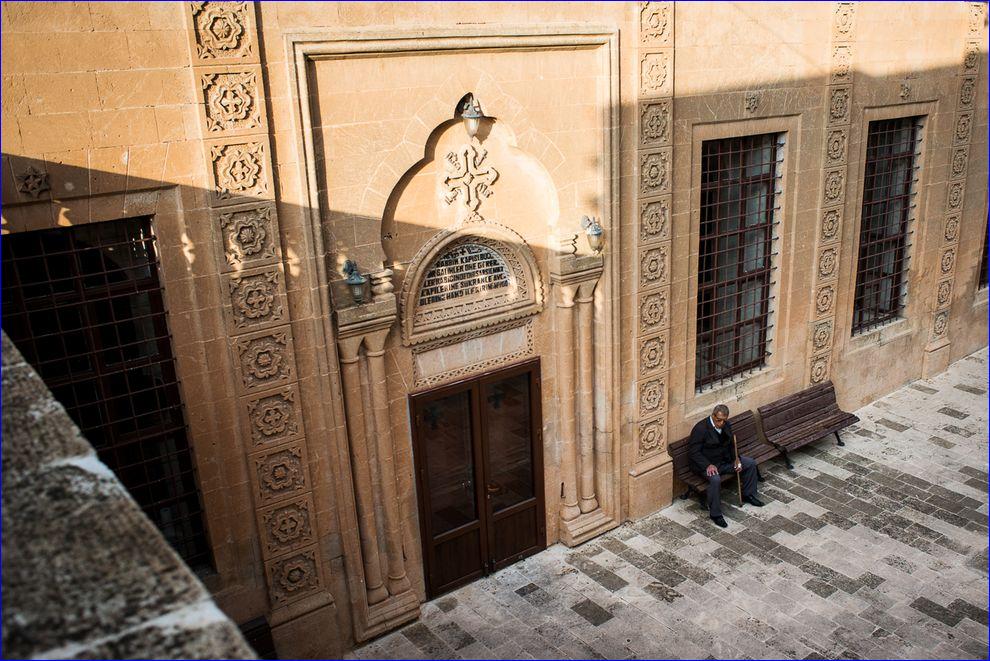
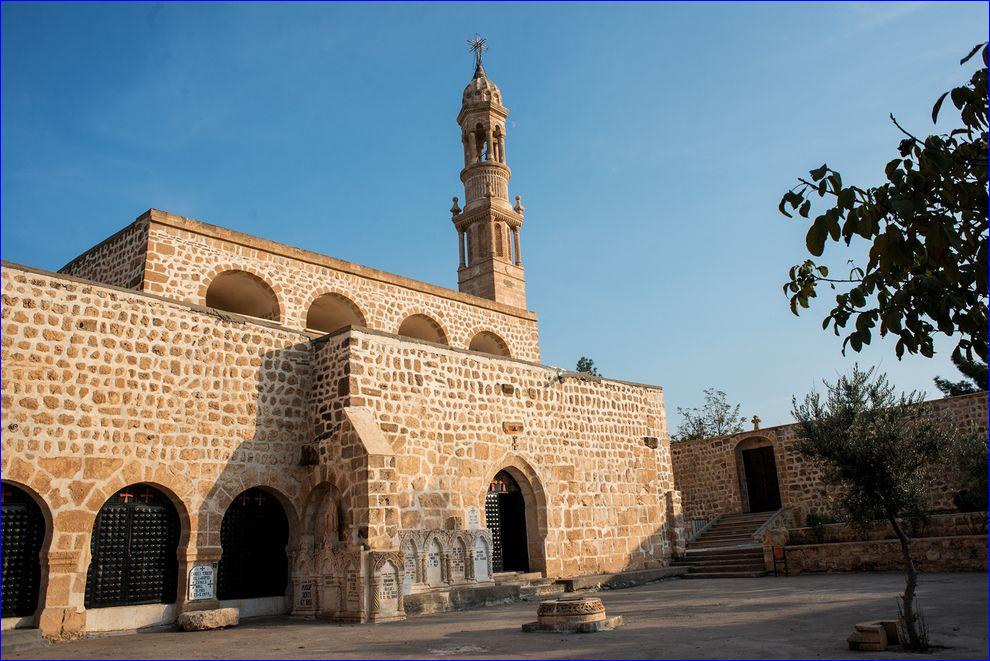
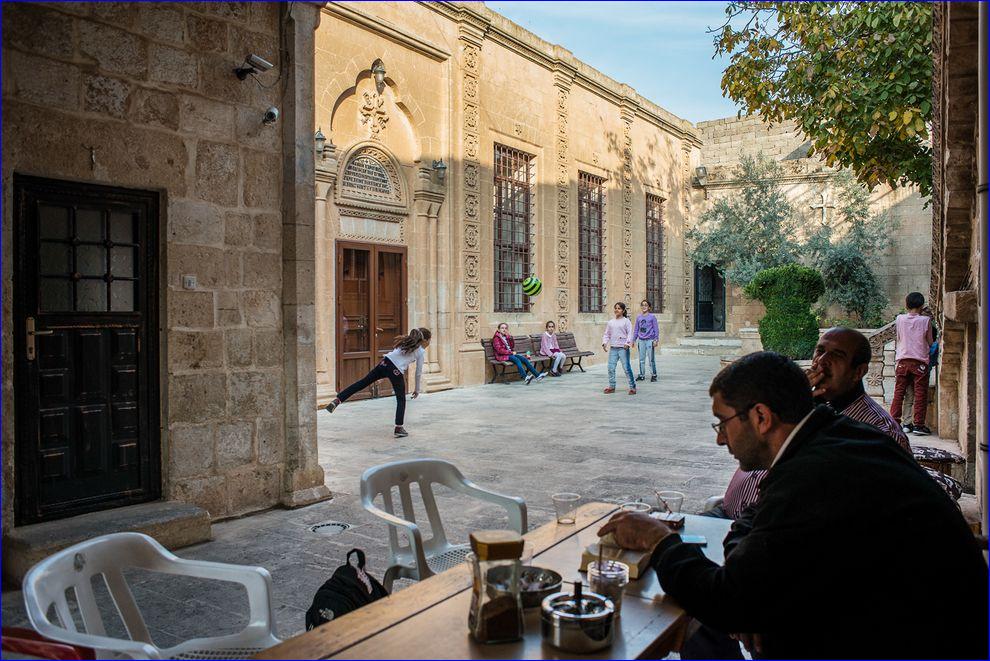
The fifth-century Mor Barsaumo church in Midyat, Turkey, draws Syriac Christians in what was once the faith's heartland, as well as refugees fleeing violence in Syria and Iraq (photo: Monique Jaques/National Geographic).MIDYAT, Turkey -- On most afternoons, Mor Barsaumo, a honey-colored, fifth-century stone church nestled in a warren of slanted streets, draws a crowd. In the narrow courtyard, old men smoke cigarettes and drink coffee, while children kick a soccer ball across the stone floor. In a darkened classroom, empty except for a few desks, a teacher gives private lessons in Syriac, derived from Aramaic, the language of Christ.
And now, the refugees also come.
Advised by relatives or other refugees, newcomers to Midyat often make the steps of the church their first stop. Midyat and its environs--known in Syriac as Tur Abdin, "mountain of the servants of God"--are the historical heartland of the Middle East's widely dispersed Syriac [Assyrian] Orthodox Christian community. Now the region has become a haven as the fighting in Syria and Iraq has forced Christians to flee their homes.
"All Syriac Christians come here. Most of the aid is delivered from here," says Ayhan Gurkan, a deacon at Mor Barsaumo and a member of the Tur Abdin Syriac Christians Committee, set up to look after Midyat's Christian refugees.
Only four of Midyat's eight churches are still used. Mor Barsaumo is the most central, and hence the easiest for newcomers to find. Its courtyard and schoolroom serve as a de facto community center for local Christians and refugees alike. Gurkan, smoking a cigarette by the church gate, is flanked by two Syrian refugees, Yusep Souleman and Nahir Mirza. Souleman's grandchildren play alongside local children in the courtyard.
Gurkan estimates that of the 500 Syriac Christians in Midyat, about a hundred are refugees--most from Syria, with a handful from Iraq. Midyat is in southeastern Turkey, just 32 miles (52 kilometers) north of the border with Syria. Although an official refugee camp for Christians exists in Midyat, built on land donated by nearby Mor Abraham Monastery, few have chosen to live there. This is due partly to the poor provisions, says Gurkan--tents are no defense against the region's cold winters--but also to the success of the Syriac Christian community at looking after its own.
Mor Abraham, a monastery on the outskirts of Midyat, is one of many in the area. The monastery donated land to create a camp for Christian refugees, though few make use of it (photo: Monique Jaques/National Geographic).
"They are our brothers," cuts in Mirza. "They take care of us."
This care is material and spiritual, says Father Ishak Ergun, Mor Barsaumo's priest, who is also on the refugee committee. Refugees find housing in the neighboring Syriac Christian Cultural Center, in monasteries such as Mor Gabriel or Mor Jacob, or in apartments the committee helps them rent in the city center.
The day before, he tells me, another Syrian family came to Mor Barsaumo. He helped them rent a flat from a Christian landlord at a greatly reduced rate; community members furnished the apartment. The committee raises funds--soliciting donations from abroad as well as from wealthier members of the community--to subsidize rent when families are unable to pay. He and Gurkan also help refugees assimilate: accompanying them to hospitals and registration centers and filling out paperwork with them, including applications for asylum in Europe.
For many refugees, pastoral care is no less important. "We pray for them," Ergun says. Not long ago, the community held a three-day fast to "call upon God to stop the pressure and to show a peaceful way forward."
Ayhan G
Type your comment and click or register to post a comment.



or register to post a comment.