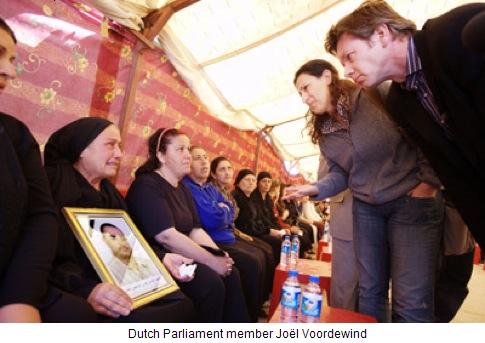
Dutch MP Visits Assyrians in Iraq


The conclusions drawn by Parliament Member Joël Voordewind of the Christian Union party, after his arrival from a dangerous trip to Assyria in Northern Iraq, is that the Assyrian Christians suffer disproportionately more than other Iraqis. He will ask for more attention to their situation. "I have held in my hands the letters of threats from the Muslim fundamentalists which were directed at the Assyrian Christians."

The department of foreign affairs had doubts about his journey to Northern Iraq due to safety concerns, but Joël Voordewind was determined to go. His goal was to research the facts regarding the humanitarian situation of the internally displaced people -- mostly Assyrian Christians, but also Kurds and Arabs -- who have ended up in northern Iraq, fleeing from violence elsewhere in the country. Voordewind, however, concentrated on the Assyrians, the oldest inhabitants and indigenous people in Iraq. "The impression I had was that this minority has been targeted more than the rest. This impression was confirmed through my visits to regional politicians, aid societies and refugees from Mosul and Baghdad," explains the Dutch Parliament Member of the Christian Union, from his hotel in the Kurdish capital of Erbil.

"Other groups have also been targeted by Muslim extremists, but from what I have seen I am convinced that the there is a serious attempt to eradicate these Christian people from the country. I have seen the threatening letters with my own eyes: attacks on Christians started with letters, saying things like "go away Christian -- or you will die", and then signed with: "The Mujaheddin". Other signals are the overwhelming attacks on churches all over Iraq, and the recent killing of the Archbishop of Mosul. There also letters that order Christians to deliver their daughters to the mosque, so they can be married to a Muslim man. I could not find proof of crucifixion of Christians, but they may still be true, as I have met people who have told us that such acts have really taken place."

Numbers

The fact that the Assyrian Christians are victims of violence relatively more than others are also has to do with their work with the Americans there. But as the US Army and the American companies see them as loyal employees, the extremist Muslim groups see them as traitors and employees of the "Western enemy". Besides, in most parts of Iraq one law rules everything: the survival of the fittest. Criminals are not afraid to make money through kidnappings. But does that not contradict the religious cleansing that Voordewind mentions? "No, because the numbers show the contrary. During Saddam Hussein's era about 3 percent of the population of Iraq were Christian Assyrians. But the percentage of the Christian (Assyrian) refugees that ended up in Syria and Jordan now are 36% of the total number of refugees. That is disproportional. From the original 1.4 million Christian Assyrians in Iraq, there are about 400,000 remaining. About 100,000 of these are in the Kurdish part of Northern Iraq as displaced persons. My conclusions are based on the numbers I received from various institutions, such as the Red Cross and the UN organization UNHCR in Erbil. The problem is that many of the regions in Northern Iraq where many displaced persons reside, including the so-called Nineveh Plains where many Assyrian Christians live, are marked as dangerous areas by the aid workers of the Red Cross and the UNHCR. They refuse to visit these places. By the way, I have been to the Nineveh Plains this week."

Assyrian Christians

This immediately brings us to the next problem, says the Dutch Parliamentarian. The Assyrians and the other groups who, for example, left Basra and Baghdad "are completely stripped of their possessions" when they arrive in Northern Iraq. The area within the Kurdish Regional Government (KRG) is relatively safe -- in Erbil for example, a bomb explodes "just" once a year. "For this I compliment the Kurdish government," says Voordewind, who worked as an aid-worker in Northern Iraq in 1991 when the Kurds were attacked by Saddam Hussein. "But the refugees are not reached by the humanitarian organizations, which means that they will not receive any basic help such as enough food, a place to stay, or lavatory facilities. I also heard many stories of Assyrian Christians being deliberately neglected by the Kurds. They are refused any jobs in governmental institutions if they are not a member of one of the ruling Kurdish political parties that form the KRG. Also, lands, houses, and properties of Assyrians have been expropriated by the Kurds without any form of compensation.

The Kurdish authorities deny having heard of such practices. One big problem is that the Assyrians are really scared to declare these issues, perpetrated by the authorities or the Kurdish police. There is a huge gap between what the regional Kurdish government 'sees' and what the Assyrian Christians declare."

Financial Aid

For this reason, Voordewind will ask the Minister of Development (of third world countries), Bert Koenders, to not only send financial aid to the Kurdish authorities, the Red Cross, or the UNHCR, but rather also to organizations such as the Assyrian Aid Society, which reaches the Christian Assyrians in the plains of Nineveh. On request of the SGP (Christian Reform Party) and the Christian Union Party, the Dutch government recently declared to allocate 6 million Euros for the refugees in Northern Iraq. "A substantial amount", according to Voordewind, "but not enough to fulfill the existing needs. According to the UNHCR there are totally 348,000 displaced persons in Northern Iraq, a big part of those people are Assyrians Christians. This group should also, therefore, get more in the greater interest of the rest of the international community. Because when we do nothing, we can be sure that this number of refugees will knock on the door of Western-Europe very soon."

A dream of the Assyrians -- nourished also by patriotic feelings -- is the wish for an autonomous region in the Nineveh plains. Such a territory could form a safe have for the Christians of Iraq. "...an understandable wish of course," says Voordewind. "But such a project should be well planned with both the Kurdish government and the central government in Baghdad. The security of such a territory would be another issue. Today, the Iraqi army -- which in the northern regions outside of the KRG region consists mostly of Kurds -- take care of the security. The Assyrians should be offered the possibility to form their own police force. As of today, these proposals for an Assyrian police force have been blocked by the Iraq government in Baghdad1, which consists of Muslim Kurds and Muslim Shia Arabs. The Netherlands can discuss this issue through diplomatic means with the Iraqi authorities to reconsider their stand in this regard."

By Rinder Sekeris
www.assyrie.nl

Translated from Dutch by Matay Arsan

1 The Baghdad government has approved such a police force -- it is the Mosul provincial council which blocked the policy. The Council is made up of mostly Kurds (AINA, 6-24-2006)


© , Assyrian International News Agency.  All Rights Reserved. Terms of Use.