


Reducing Assyrians to merely a religious category causes an essential part of their identity to be lost. The term "Christian" is a global religious designation shared by millions of people from different nations and ethnic backgrounds, including American Christians, European Christians, Australian Christians, Arab Christians, Kurdish nomads Christians, and others. Therefore, it does not identify a specific indigenous people or represent a distinct national identity.
It is deeply concerning and disappointing to hear some officials, including the Prime Minister of Iraq, refer to the indigenous Assyrian people only as "Christians" rather than recognizing their Assyrian identity. In Iraq today, there are multiple communities that follow Christianity, but they do not all share the same ethnic origin, history, language, or culture. When Assyrians are defined only through a religious label, it contributes to the marginalization of their national identity and weakens recognition of them as an indigenous people.
With the recent statements by the Iraqi Prime Minister regarding the allocation of vacant land and calling "Christians" to return to Iraq, an important question arises: who exactly is being referred to by this term? Is it all Christians around the world, the different Christian communities within Iraq, or the indigenous Assyrian people who have a historical connection to this land? Using a broad term such as "Christians" without acknowledging the Assyrian national identity creates confusion, because this issue is not only about religion; it is about an indigenous people with a homeland, history, and identity.
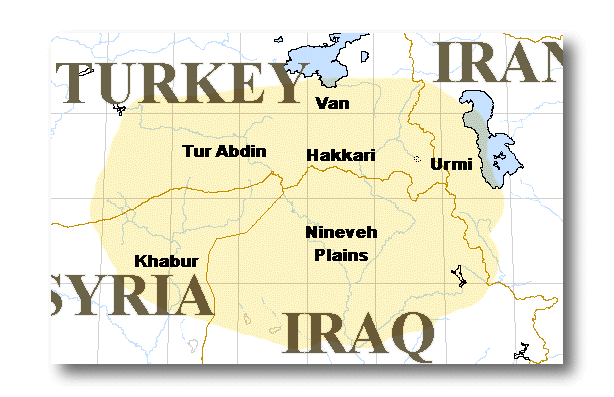
History must also be respected. The modern state of Iraq was established in 1921, while the Assyrian people have maintained a continuous historical, cultural, and civilizational presence in their ancestral homeland of Assyria for thousands of years. Those who govern Iraq today must understand the history of this land and respect the identities of its indigenous peoples rather than replacing them with broad classifications that do not reflect their true identity.
The history of Iraq did not begin with the creation of the modern state; it extends back thousands of years to ancient civilizations and indigenous peoples who existed long before it. The Assyrians are not newcomers to this land; they are one of its indigenous peoples, with a language, culture, heritage, and civilization that have contributed greatly to human history.
Assyrians are not simply a religious community; they are an indigenous people with a distinct identity deeply rooted in Mesopotamia. Recognizing Assyrians means respecting their name, language, culture, and history, not reducing them to a general religious label.
Faith and beliefs must always be respected, but religion should never be used as a tool to erase the identity of an indigenous people.
Guest Editorial Policy
or register to post a comment.